Muscle Classification

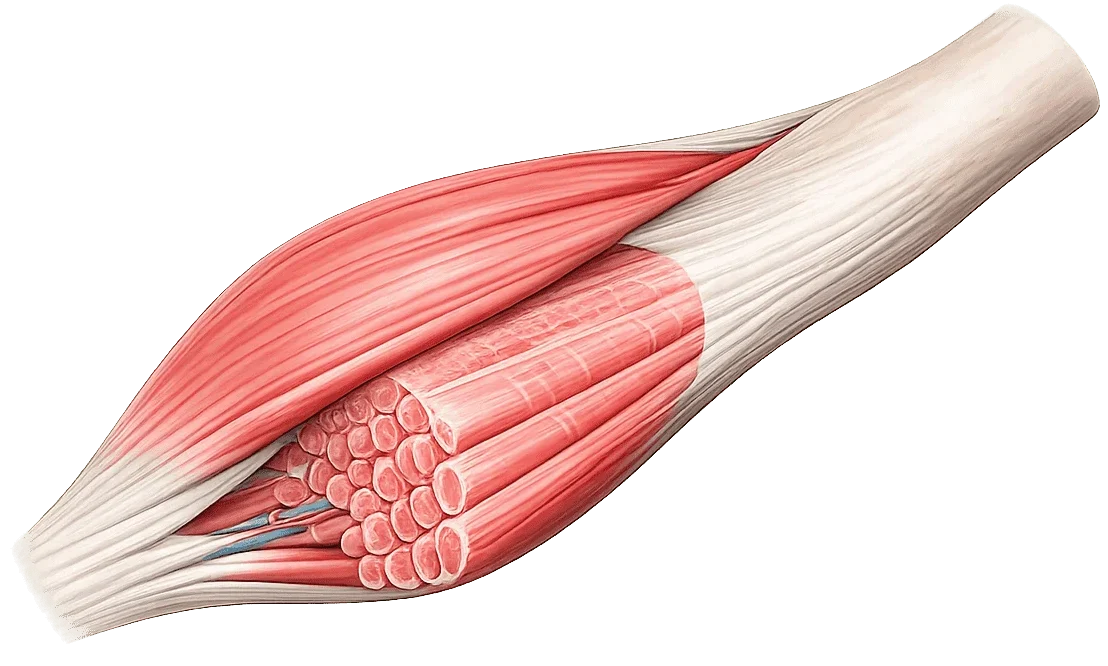
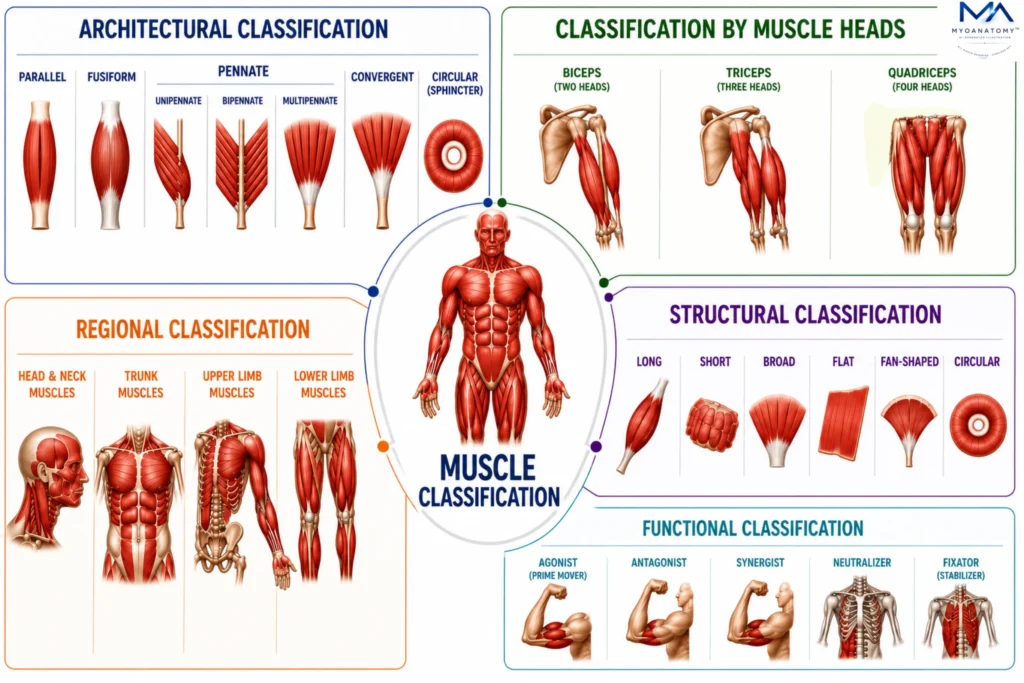
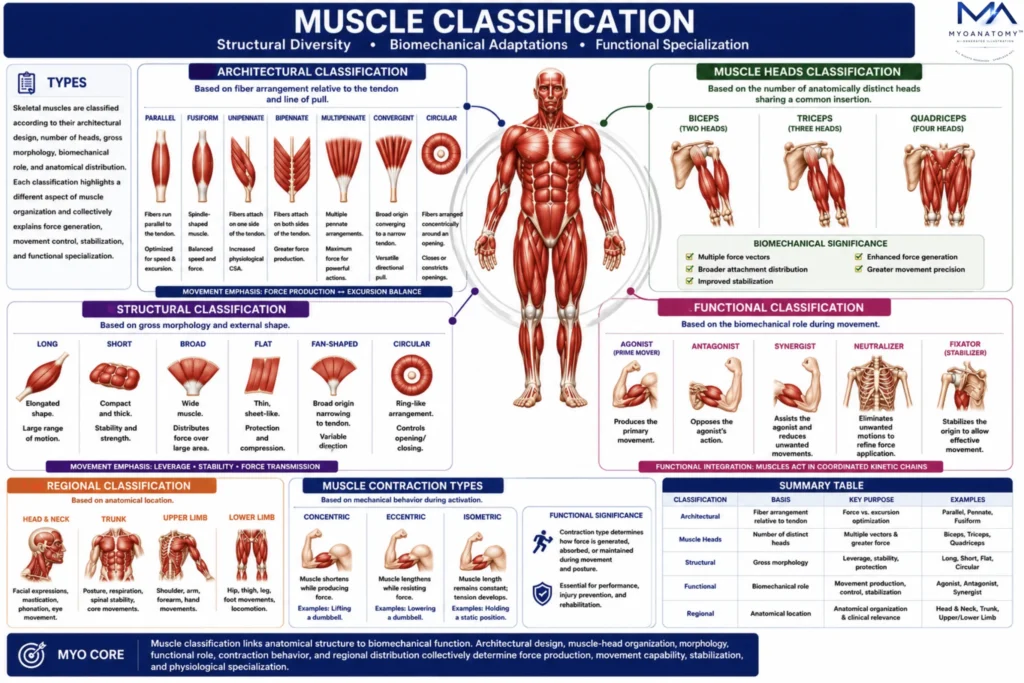
Muscle classification in general myology represents a structure–function paradigm, linking skeletal muscle architecture to biomechanical performance. It is not merely descriptive, but predictive of force generation, excursion, and functional role within kinetic chains.

The primary determinant is fascicular architecture relative to the line of pull:

 Parallel (strap/fusiform): → ↑ excursion and velocity, ↓ force

 Pennate (uni-, bi-, multipennate): ↑ physiological cross-sectional area → ↑ force, ↓ excursion

 Convergent / circular: adaptable force vectors and controlled sphincteric function

These architectural patterns define mechanical output through fiber length, pennation angle, and tendon interaction, which collectively govern the length–tension and force–velocity relationships.

Functionally, muscles operate within integrated neuromuscular systems, where coordinated activation (agonists, antagonists, stabilizers) enables efficient movement and joint stability.

MUSCLE SHAPE CLASSIFCATION

Fascicle Muscle Shapes” – OpenStax College, Anatomy & Physiology, via Wikimedia Commons.

Licensed under  CC BY-SA 3.0

”Muscle Types” – BruceBlaus( Own work), via Wikimedia Commons. 

Licensed under CC BY-SA 4.0

AI-Generated-Illustiaton MyoAnatomy

Definition

In general myology, skeletal muscles are classified according to external morphology and internal architectural organization, reflecting a fundamental structure–function relationship. Muscle shape is a direct manifestation of fascicular arrangement, tendon orientation, and physiological cross-sectional area (PCSA), which together determine mechanical output.

The geometric configuration of a muscle governs:

Force production (primarily via PCSA)

Excursion and shortening velocity (via fiber length)

Direction and control of movement (via fiber orientation and attachment pattern)

Thus, muscle morphology is not merely descriptive but represents a primary determinant of biomechanical performance and functional specialization. Classification into parallel, fusiform, convergent, pennate, and circular types reflects adaptive design to specific mechanical demands within the musculoskeletal system.

Exam Question

Explain how physiological cross-sectional area (PCSA) and fiber length differentially influence force production and excursion in skeletal muscle, and relate this to muscle classification.

Parallel Muscles

Parallel muscles are defined by fibers oriented parallel to the longitudinal axis and line of pull between origin and insertion. This configuration allows fibers to extend along the entire muscle length, maximizing sarcomere number in series.

Consequently, parallel muscles exhibit:

High excursion and contraction velocity (due to long fibers)

Relatively lower force production (due to smaller PCSA)

Efficient transmission of force along a single vector

They are therefore optimized for range of motion and rapid displacement, rather than maximal force generation.

Functional examples:

Sartorius  –  long-range limb movement across hip and knee

Rectus abdominis  – trunk flexion with significant shortening capacity

Biceps brachii  –  rapid elbow flexion and forearm supination

From a biomechanical perspective, parallel architecture favors dynamic movement and precision, but is more susceptible to strain injuries due to greater elongation capacity.

Exam Question

Compare parallel and pennate muscle architectures in terms of sarcomere arrangement, force generation, and functional specialization, and explain why parallel muscles are predisposed to greater excursion but lower maximal force.

Fusiform Muscles

Fusiform muscles represent a specialized subtype of parallel architecture, characterized by a spindle-shaped morphology with a prominent central belly and tapered tendinous ends. This configuration allows fibers to run longitudinally along the muscle’s axis, maintaining a high number of sarcomeres in series.

Functionally, fusiform muscles exhibit:

High shortening velocity and excursion (long fiber length)

Moderate force production (intermediate PCSA compared to pennate muscles)

Smooth, coordinated force transmission along a single vector

This architecture provides an optimal balance between mobility and force, making fusiform muscles particularly suited for controlled, dynamic limb movements.

Examples:

Biceps brachii  –  rapid elbow flexion and forearm supination

Brachioradialis  –  efficient forearm flexion in mid-pronation

Biomechanically, fusiform muscles favor precision and speed, with reduced maximal force relative to pennate muscles but greater versatility in movement amplitude.

Exam Question

Describe how the fusiform architecture optimizes both excursion and coordinated force production, and contrast its mechanical properties with those of purely parallel and pennate muscle types.

Convergent Muscles

Convergent muscles are defined by a broad, often multipoint origin, with fibers arranged in a fan-shaped pattern converging toward a single tendon of insertion. This architecture enables fibers from different regions to be oriented at varying angles relative to the line of pull.

Functionally, convergent muscles demonstrate:

Variable force direction depending on the activated fiber subset

Capacity for selective regional activation, enabling fine control

Potential for substantial force generation when all fibers contract synchronously

This design allows a single muscle to perform complex, multidirectional actions, integrating both precision and power within a unified structure.

Example:

Pectoralis major  –  fibers from clavicular, sternal, and costal parts contribute to diverse movements (flexion, adduction, medial rotation of the humerus).

Biomechanically, convergent muscles function as adaptive force modulators, capable of altering both vector and magnitude of contraction, thereby enhancing versatility within the kinetic chain.

Exam Question

Explain how the architectural design of convergent muscles enables multidirectional force generation and selective activation, and discuss its functional significance using the pectoralis major as an example

Pennate Muscles

Pennate muscles are characterized by fibers arranged obliquely to a central tendon, resembling a feather-like architecture. This configuration permits dense packing of fibers within a given muscle volume, significantly increasing the physiological cross-sectional area (PCSA).

Functionally, pennate muscles exhibit:

High force generation (due to increased PCSA)

Reduced excursion and contraction velocity (shorter fiber length)

Efficient force transmission via angled fibers, with partial loss of force along the line of pull compensated by greater fiber 

Structural subtypes include:

Unipennate  –  fibers on one side of tendon (e.g., extensor digitorum longus)

Bipennate  –  fibers on both sides (e.g., rectus femoris)

Multipennate  –  complex, multiple tendon insertions (e.g., deltoid)

Biomechanically, pennate architecture is optimized for power and load-bearing, making these muscles essential for force-intensive, stabilizing, and postural functions.


Exam Question

Explain how pennation angle influences force production and efficiency in skeletal muscle, and discuss the trade-off between force and excursion in pennate architecture.

Circular Muscles

Circular muscles, or sphincter muscles, consist of concentric rings of muscle fibers arranged around an anatomical opening or passage. Unlike linear muscles, their fibers are oriented perpendicular to the lumen, enabling regulation of aperture diameter.

Functionally, circular muscles:

Control opening and closure of orifices

Regulate passage of substances (e.g., food, air, fluids)

Maintain tonic contraction for continence and physiological control

Upon contraction, these muscles reduce lumen diameter, functioning as dynamic valves within organ systems.

Examples:

Orbicularis oris  –  controls mouth closure and articulation. (Clinically extended: external anal and urethral sphincters)

Biomechanically, circular muscles are specialized for regulatory rather than locomotor function, emphasizing precision and sustained control over force or excursion.


Exam Question

Describe how the unique fiber orientation of circular muscles enables regulation of luminal diameter, and compare their functional role with linear skeletal muscle architectures.e.

Functional Morphology

Defines the structure–function relationship in skeletal muscle, where architectural design determines biomechanical output.

Parallel / Fusiform → ↑ excursion & velocity (long fibers)

Pennate → ↑ force (↑ PCSA, dense fiber packing)

Convergent → variable force direction & selective activation

Circular → regulation of luminal diameter and functional control

These patterns reflect task-specific adaptations, integrating within kinetic chains to produce efficient, coordinated movement.


Exam Question

Explain how variations in fascicular architecture determine force production, excursion, and functional specialization in skeletal muscle.

MUSCLE HEADS CLASSIFCATION

AI -Generated Illustration-MyoAnatomy

Definition

An additional classification of skeletal muscle is based on the number of heads (capita) – distinct points of origin that converge into a common muscle belly and tendon. A “head” represents an independent anatomical origin with a potentially unique line of pull, contributing to the muscle’s overall mechanical profile.

Muscles with multiple heads:

arise from separate anatomical landmarks (often different bones or regions) may span multiple joints or functional compartments

exhibit functional versatility, as each head can generate slightly different force vectors

This arrangement enhances mechanical efficiency and coordination, allowing a single muscle to participate in complex, multi-vector movements and to adapt its contribution depending on joint position and neuromuscular recruitment.

Thus, classification by muscle heads reflects structural complexity linked to functional diversification within the musculoskeletal system.

Exam Question

Explain how multiple heads of a muscle contribute to variations in force direction and functional versatility, and discuss their significance in multi-joint movement.

Biceps Muscles

The term biceps denotes a muscle with two distinct heads of origin, which arise from separate anatomical sites and converge into a single muscle belly with a common insertion. This dual-origin architecture allows integration of different lines of pull into a unified mechanical action.

Example: Biceps brachii

Origin – long head → supraglenoid tubercle of scapula; Short head → from a  coracoid process of scapula

Insertion → radial tuberosity and bicipital aponeurosis

Functionally, the dual heads enable:

elbow flexion

forearm supination

dynamic stabilization of the glenohumeral joint

Biomechanically, the biceps brachii exemplifies how multiple heads enhance functional adaptability, allowing the muscle to contribute across different joints and movement contexts depending on limb position.

Exam Question

Analyze how the dual-head architecture of the biceps brachii contributes to its multi-joint function, including its roles in elbow flexion, forearm supination, and shoulder stabilization.

Triceps Muscles

Triceps muscles are defined by the presence of three distinct heads of origin, which arise from separate anatomical sites and converge into a common tendon, forming a unified functional unit. This multi-headed configuration enables integration of multiple lines of pull into a single, powerful action.

Example: Triceps brachii

Origin – Long head → infraglenoid tubercle of scapula (biarticular component); while a Lateral head → posterior humerus (above radial groove); Medial head → posterior humerus (below radial groove)

Insertion is common  → olecranon process of ulna

Functionally, this architecture allows:

powerful elbow extension (primary role)

force augmentation through summation of multiple heads

shoulder stabilization via the long head

Biomechanically, the triceps exemplifies how multi-headed muscles enhance force production, joint stability, and functional redundancy, particularly in movements requiring sustained or high-load extension.

Exam Question

Analyze how the three heads of the triceps brachii contribute to force generation and joint stabilization, and explain the functional significance of its biarticular long head.

Quadriceps Muscles

Quadriceps muscles are characterized by four heads of origin, forming a large, integrated muscle group optimized for maximal force production in lower limb extension. These heads converge into the quadriceps tendon, which envelops the patella and continues as the patellar ligament to the tibial tuberosity.

Example: Quadriceps femoris

Origin

rectus femoris → anterior inferior iliac spine (biarticular)

vastus lateralis → lateral femur

vastus medialis → medial femur

vastus intermedius → anterior femur

Functionally, the quadriceps:

Produce powerful knee extension (essential for locomotion, rising, and load-bearing)

Provide dynamic stabilization of the knee joint, particularly via vastus medialis

Integrate hip and knee mechanics through rectus femoris

Biomechanically, this multi-headed system maximizes force output, distribution of load, and joint control, making it critical for posture, gait, and high-force lower limb activities.


Exam Question

Explain how the quadriceps femoris architecture optimizes force production and knee stabilization, and discuss the functional role of rectus femoris as a biarticular muscle.

Functional Significance

Classification by muscle heads demonstrates how structural complexity enhances biomechanical performance. Multi-headed muscles integrate multiple origins and force vectors, optimizing both power and functional versatility.

Key features:

Multiple lines of pull → adaptable force direction

Broader attachment distribution → improved load transmission

Increased force capacity through summation of head contributions

Multi-joint involvement (especially in biarticular heads)

Functionally, this architecture supports coordinated movement, joint stabilization, and efficient force transfer within kinetic chains.


Exam Question

Explain how multi-headed muscle architecture enhances force production, movement versatility, and joint stabilization within the musculoskeletal system.

FUNCTIONAL CLASSIFCATION

AI Generated Illustration ( MyoAnatomy)

Definition

Skeletal muscles may also be classified according to the type of movement they produce or their functional role within joint biomechanics. This classification reflects the mechanical actions generated during contraction, as muscles act across synovial joints to produce controlled movement.

Because muscles rarely function in isolation, this system emphasizes integrated neuromuscular coordination, where groups of muscles contribute to:

Agonists (prime movers) → generate the primary action

Antagonists → oppose or modulate movement

Synergists → assist or refine the action

Stabilizers → maintain joint or segmental stability

Functional classification is fundamentally defined by the direction of movement relative to anatomical planes and axes, including flexion–extension, abduction–adduction, and rotation. This framework links muscle activity to kinematic patterns and joint mechanics.

Functional classification provides a dynamic perspective of muscle action, integrating anatomical structure with coordinated movement, force modulation, and stabilization within the musculoskeletal system.

Exam Question

Discuss how functional classification of skeletal muscles (agonists, antagonists, synergists, stabilizers) reflects coordinated movement across joints, and relate this to anatomical planes and axes of motion.

Flexor Muscles

Flexor muscles produce flexion, defined as a movement that decreases the angle between adjacent skeletal segments, typically occurring in the sagittal plane around a mediolateral axis. This action brings body segments closer together and is fundamental for controlled positioning and forward-directed movement.

Functionally, flexors:

Facilitate initiation of movement and positioning against gravity

Contribute to fine motor control and coordinated limb actions

Often act eccentrically to decelerate extension

Examples:

Biceps brachii  –  elbow flexion

Iliopsoas  –  hip flexion

Hamstrings –  knee flexion

Biomechanically, flexors are essential for dynamic movement, energy absorption, and limb control, particularly during locomotion and object manipulation

Exam Question

Explain the biomechanical role of flexor muscles in both concentric and eccentric contraction, and relate their function to movement in the sagittal plane.

Extensor Muscles

Extensor muscles produce extension, defined as a movement that increases the angle between articulating bones, often returning a limb toward the anatomical position. This movement also occurs primarily in the sagittal plane around a mediolateral axis.

Functionally, extensors:

Generate powerful anti-gravity forces

Maintain posture and joint stability

Support weight-bearing and propulsion

Examples:

Triceps brachii  –  elbow extension

Quadriceps femoris  –  knee extension

Gluteus maximus – hip extension

Biomechanically, extensors are adapted for forceful contraction and sustained activity, playing a central role in standing, gait, and vertical support of the body.

Exam Question

Discuss the role of extensor muscles in postural control and locomotion, and explain how their function relates to anti-gravity mechanisms in the human body

Abductor Muscles

Abductor muscles produce abduction, defined as movement of a limb away from the midline, occurring primarily in the frontal plane around an anteroposterior axis. This action is essential for limb positioning, spatial control, and dynamic balance.

Functionally, abductors:

Stabilize joints during single-limb support phases (e.g., gait)

Maintain pelvic and shoulder girdle alignment

Control lateral displacement and postural equilibrium

Examples:

Deltoid (middle fibers)  –  shoulder abduction

Gluteus medius & minimus  –  hip abduction and pelvic stabilization

Biomechanically, abductors play a critical role in preventing collapse toward the midline, particularly during locomotion, ensuring efficient force distribution and balance control.

Exam Question

Explain the role of hip abductors in maintaining pelvic stability during gait, and analyze the consequences of their dysfunction.

Adductor Muscles

Adductor muscles produce adduction, defined as movement of a limb toward the midline, opposing abduction. This movement also occurs in the frontal plane around an anteroposterior axis.

Functionally, adductors:

Provide medial stabilization of the limbs during movement

Contribute to force transmission and limb control during changes in direction

Assist in coordinated, multiplanar movements

Examples:

Adductor longus & adductor magnus – hip adduction

Pectoralis major  –  adduction of the arm at the shoulder

Biomechanically, adductors are essential for maintaining alignment, controlling limb trajectory, and stabilizing the body during dynamic activities such as walking, running, and directional changes.

Exam Question

Discuss how adductor muscles contribute to limb stabilization and control during dynamic movement, and explain their role in coordinating multi-planar motion.

Rotator Muscles

Rotator muscles produce axial rotation of a bone around its longitudinal axis, typically occurring in the transverse plane about a vertical axis. This movement is essential for orienting limb segments and optimizing joint congruency, particularly in ball-and-socket joints.

Two principal forms exist:

Medial (internal) rotation → toward the midline

Lateral (external) rotation → away from the midline

Examples:

Subscapularis  – medial rotation of the humerus

Infraspinatus & Teres minor  –  lateral rotation of the shoulder

Gluteus medius (posterior fibers)  –  lateral rotation of the hip

Biomechanically, rotators are critical for joint stability, fine control of movement direction, and alignment of articulating surfaces, especially during complex, multi-planar motions.

Exam Question

Explain how rotator muscles contribute to joint stability and movement precision, particularly in ball-and-socket joints, and differentiate between medial and lateral rotation.

Pronator Muscles

Pronator muscles produce pronation of the forearm, a rotational movement at the radioulnar joints, whereby the radius crosses over the ulna. This results in the palm facing posteriorly (anatomical position) or inferiorly (when the elbow is flexed).

Functionally, pronation:

Enables precise hand positioning for manipulation

Facilitates grip adaptation and force application

Integrates with elbow and wrist mechanics during coordinated tasks

Examples:

Pronator teres  –  rapid pronation and assists elbow flexion

Pronator quadratus  –  primary stabilizer and pronator of distal forearm

In contrast, supination reorients the palm anteriorly/superiorly, mediated by:

Supinator muscle

Biceps brachii (especially in flexed elbow)

Biomechanically, pronators and supinators form a functional rotational system, essential for dexterity, tool use, and fine motor control.


Exam Question

Describe the biomechanics of pronation and supination at the radioulnar joints, and analyze the functional roles of pronator teres, pronator quadratus, and biceps brachii in forearm rotation

Levator & Depressor Muscles

Levator and depressor muscles produce vertical displacement of anatomical structures, representing movement along the longitudinal axis of the body or a segment. These actions are fundamental for positional control, postural adjustment, and functional coordination of the head, neck, and shoulder girdle.

Levators → elevate a structure (superior displacement)

Depressors → lower a structure (inferior displacement)

Examples:

Levator scapulae  – elevation of the scapula

Masseter & temporalis  –  elevation of the mandible (jaw closure)

Infrahyoid muscles  –  depression of the hyoid bone

Trapezius (lower fibers)  –  depression of the scapula

Functionally, these muscles:

Maintain postural equilibrium (especially in cervical and scapular regions). Enable precise vertical positioning during complex movements. Contribute to functional tasks such as mastication, respiration, and upper limb stabilization

Biomechanically, levator–depressor pairs act as antagonistic systems, ensuring controlled vertical motion, stabilization against gravity, and fine adjustment of skeletal elements within coordinated kinetic chains.

Exam Question

Explain how levator and depressor muscles function as antagonistic pairs to control vertical displacement, and discuss their role in postural stability and coordinated movement of the head and shoulder girdle.

Functional Significance

Skeletal muscle function is organized through coordinated activity within functional groups, where individual muscles assume specialized roles in generating and controlling movement.

Key functional roles include:

Agonists (prime movers) → produce the primary movement

 Antagonists → oppose or regulate the action

 Synergists → assist and refine movement, reducing unwanted motion

Fixators (stabilizers) → stabilize proximal segments to optimize force transmission

This integrated organization enables:

Efficient force generation and transmission across joints

Precision and smoothness of movement

Dynamic joint stabilization during complex tasks

Thus, functional classification provides insight into neuromuscular coordination, biomechanical efficiency, and the regulation of movement patterns, forming the basis for understanding both normal motion and dysfunction.


Exam Question

Discuss the coordinated roles of agonists, antagonists, synergists, and fixators in producing efficient and controlled movement, and explain their importance in joint stability and force transmission.

Scroll to Top