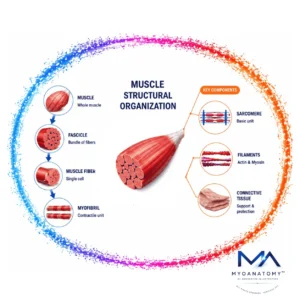
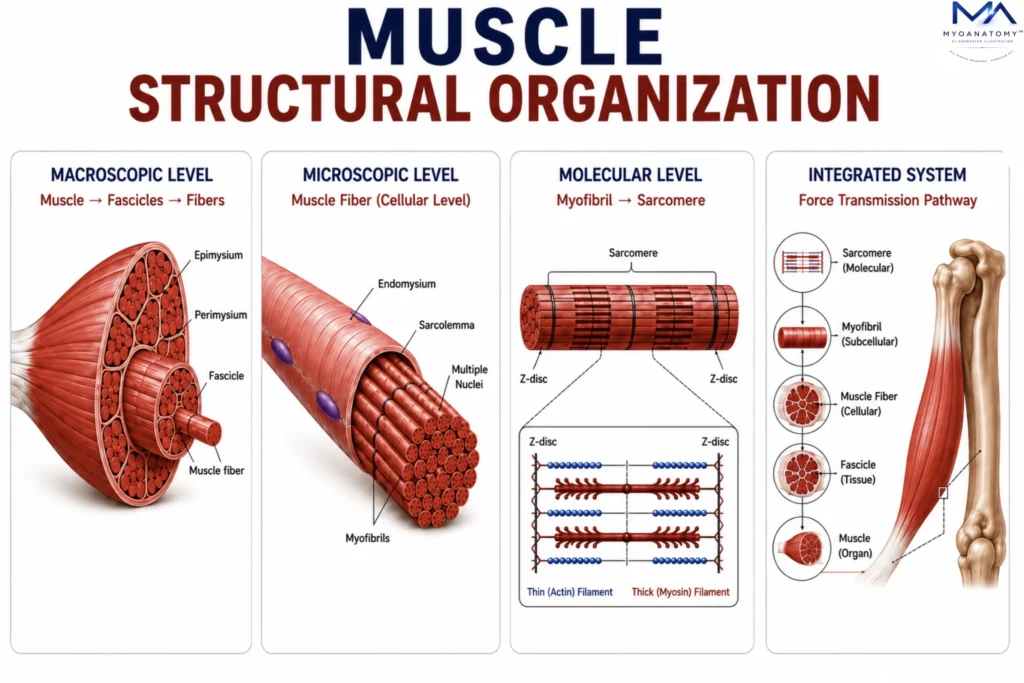
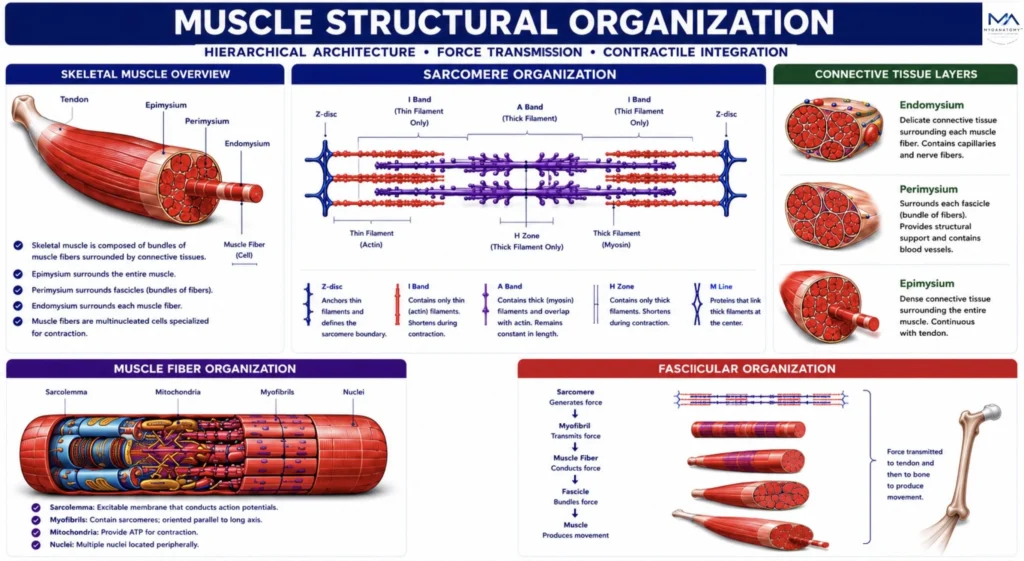
At the macroscopic level, each muscle is enclosed by the epimysium and composed of multiple fascicles, which are bundles of muscle fibers surrounded by perimysium; these fascicles define functional compartments and contribute to the directional properties of force production.
Each muscle fiber is a long, multinucleated cell enveloped by endomysium and densely packed with myofibrils, which are longitudinal arrays of repeating contractile units known as sarcomeres.
The sarcomere represents the fundamental functional unit of contraction, bounded by Z-discs and composed of interdigitating thin (actin) and thick (myosin) filaments whose sliding interaction underlies force generation at the molecular level.
These structural elements are not isolated but are mechanically integrated through a continuous connective tissue network – endomysium, perimysium, and epimysium – which converges into tendons, allowing the transmission of force from individual sarcomeres across fibers and fascicles to skeletal attachments.