Muscle
Structural Organization
MYO CORE
Connective Tissue Layers
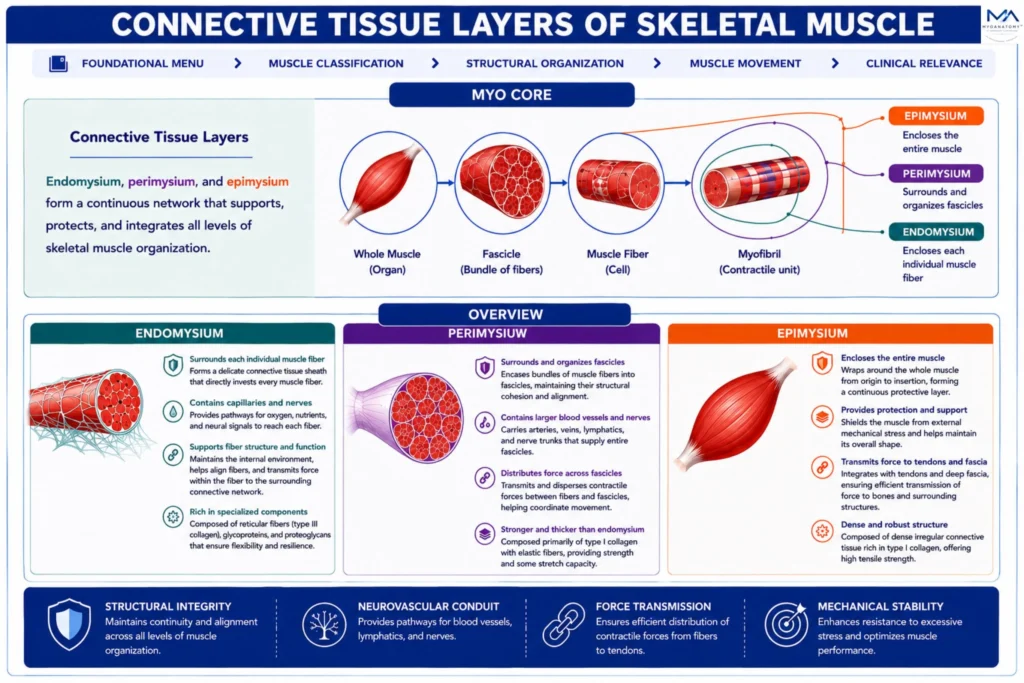
The connective tissue layers of skeletal muscle form a continuous structural framework that surrounds, supports, and integrates all levels of muscle organization. Endomysium encloses individual muscle fibers, perimysium surrounds fascicles, and epimysium invests the entire muscle. Together, these layers maintain structural integrity, provide pathways for neurovascular structures, and ensure efficient transmission of contractile forces.
OVERVIEW
The connective tissue layers of skeletal muscle form a continuous hierarchical framework that mechanically and functionally integrates all levels of muscle organization.
Endomysium surrounds individual muscle fibers, Perimysium organizes fibers into fascicles, and Epimysium encloses the entire muscle, maintaining structural continuity from the cellular level to the whole-muscle unit.
Beyond providing support, these layers are essential for force transmission, conveying forces generated within sarcomeres through the muscle to tendons and skeletal attachments. This interconnected network distributes tension, enhances mechanical efficiency, and protects muscle tissue from excessive stress during contraction.
In addition, the connective tissue framework serves as a conduit for blood vessels, lymphatics, and nerves, supporting tissue viability and neuromuscular coordination. Through their combined structural, mechanical, and physiological roles, the connective tissue layers are fundamental to muscle integrity, coordinated force production, and optimal musculoskeletal function.
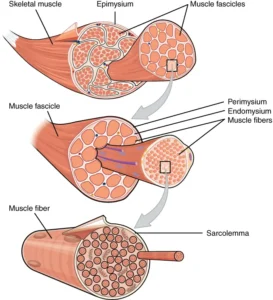
“Muscle Fibers Structure” – OpenStax, Anatomy&Physiology, CNX via Wikimedia Commons. Licensed under CC BY 4.0.
Exam Question
Explain how the coordinated interaction of contractile, regulatory, and structural proteins within the sarcomere enables efficient force generation, mechanical stability, and synchronized skeletal muscle contraction.
ANATOMY
Endomysium
The endomysium is a highly specialized layer of delicate connective tissue that surrounds each individual skeletal muscle fiber, forming the immediate extracellular environment of the cell. Rich in reticular collagen fibers, capillaries, lymphatic channels, and terminal nerve branches, it provides essential structural support while facilitating metabolic exchange and neuromuscular communication.
Functionally, the endomysium serves as the initial interface between the intracellular contractile apparatus and the extracellular connective tissue network, enabling efficient lateral transmission of force generated within sarcomeres.
This intimate association is critical for maintaining fiber integrity, synchronizing contraction, and preserving the physiological microenvironment required for muscle function.
Exam Question
Critically evaluate the anatomical and functional significance of the endomysium, emphasizing its role in maintaining the muscle fiber microenvironment, facilitating neurovascular support, and contributing to force transmission at the cellular level.
Perimysium
The perimysium is a dense connective tissue sheath that organizes muscle fibers into fascicles, establishing the fundamental structural and functional compartments of skeletal muscle.
Beyond its architectural role, the perimysium acts as a major mechanical integrator, distributing forces generated by individual fibers across the fascicle and coordinating their collective contribution to muscle contraction. It contains larger blood vessels, lymphatics, and nerve branches, serving as the principal neurovascular pathway within the muscle.
By linking neighboring fibers into mechanically unified fascicles, the perimysium enhances force transmission, optimizes load distribution, and contributes significantly to the biomechanical efficiency of skeletal muscle.
Exam Question
Discuss the structural organization of the perimysium and analyze how its fascicular architecture contributes to force distribution, neurovascular organization, and the biomechanical efficiency of skeletal muscle.
Epimysium
The epimysium is the outermost dense irregular connective tissue layer that envelops the entire muscle, transforming numerous fascicles into a single functional organ. Composed predominantly of densely arranged collagen fibers, it provides overall structural integrity, maintains muscle architecture, and protects the muscle from external mechanical stresses.
Importantly, the epimysium is continuous with the tendon and deep fascia, forming the final component of the force-transmission pathway from sarcomeres to skeletal attachments.
Through this continuity, contractile forces generated at the molecular level are integrated and transmitted to produce movement. Consequently, the epimysium plays a central role in mechanical stability, force distribution, and the functional coupling of muscle to the musculoskeletal system.
Exam Question
Explain the anatomical composition of the epimysium and critically discuss its role in preserving muscle integrity, integrating fascicular forces, and transmitting contractile force to tendons and skeletal attachments.
SUMMARY TABLE