Muscle Movement
MYO CORE
Neural Innervation
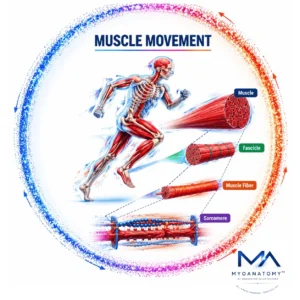
Neural innervation represents the specialized anatomical organization through which α-motor neurons establish functional control over skeletal muscle. Following entry through neurovascular pathways, motor axons branch within the perimysium and form distributed motor units that connect neural structures to dispersed muscle fibers. This highly ordered pattern of innervation determines fiber recruitment, force distribution, and movement precision, providing the anatomical foundation for neuromuscular control and coordinated skeletal muscle function
OVERVIEW
Neural innervation of skeletal muscle is organized as a precise intramuscular anatomical system, not a simple nerve-to-muscle connection. α-motor axons enter the muscle through neurovascular hilum-like regions, travel within the epimysial and perimysial connective tissue planes, and divide into progressively smaller intramuscular branches before terminating on selected muscle fibers.
Within these territories, terminal axons establish neuromuscular junctions on dispersed muscle fibers, forming motor units innervation. Muscles requiring fine control contain smaller motor units with dense neural precision, whereas muscles designed for powerful movement contain larger motor units capable of activating many fibers simultaneously. The anatomical distribution of these motor units prevents localized contraction and allows force to be generated across the muscle in a coordinated pattern.
By integrating intramuscular nerve branching, motor end-plate distribution, and motor unit architecture, skeletal muscle becomes a controlled neuromuscular organ capable of producing graded, stable, and functionally specialized movement.
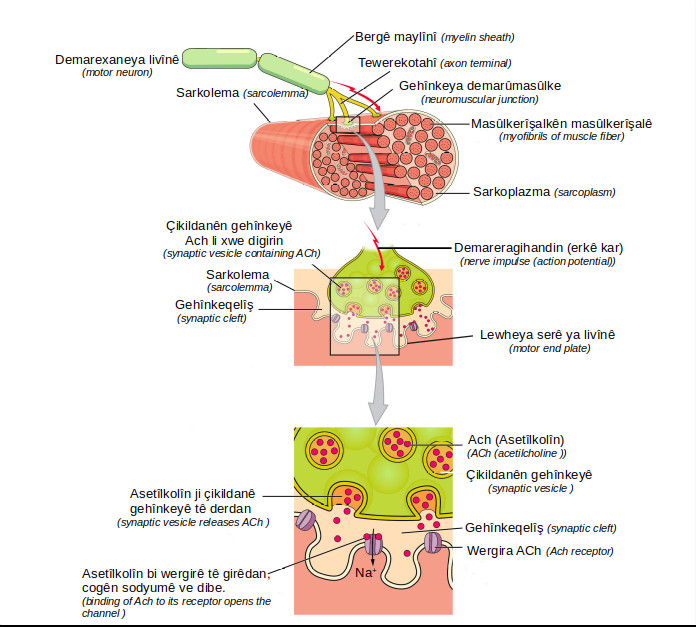
OpenStax. Anatomy & Physiology. Version 8.25. OpenStax, 2016. Motor End Plate and Innervation. Available via Wikimedia Commons. Licensed under CC BY 4.0
Exam Question
Discuss how the anatomical integration of intramuscular neural pathways, motor end-plate distribution, and motor unit organization determines the efficiency, precision, and functional capacity of skeletal muscle contraction.
ANATOMY
Neurovascular Entry
Motor innervation is established at discrete neurovascular entry points where peripheral nerves penetrate the epimysium in close association with segmental arterial branches and accompanying veins.
Following entry, motor fascicles are invested by connective tissue sheaths and course along intermuscular and intramuscular connective tissue planes before entering the perimysial framework.
This organization creates anatomically protected pathways that preserve neural integrity, facilitate vascular support, and establish the primary routes through which motor input is distributed throughout the muscle.
Exam Question
Evaluate the anatomical significance of neurovascular entry zones in establishing protected pathways for intramuscular nerve distribution and neuromuscular organization.
Neural Arborization
Within the perimysium, motor axons undergo extensive arborization to form a highly organized three-dimensional neural network. Branches follow connective tissue septa separating fascicles and progressively divide into smaller terminal branches that penetrate endomysial compartments.
This hierarchical arrangement allows neural input to be distributed across multiple fascicles while maintaining precise anatomical relationships between nerve fibers, connective tissues, and contractile elements.
The resulting architecture ensures coordinated activation of anatomically dispersed muscle fibers throughout the muscle volume.
Exam Question
Analyze how intramuscular neural arborization within the perimysial and endomysial connective tissue framework facilitates coordinated activation of anatomically dispersed muscle fibers.
EndPlate Distribution
Neuromuscular junctions are concentrated within specialized end-plate zones that extend transversely across the muscle rather than being randomly distributed.
Within these regions, terminal axons form highly specialized synaptic contacts upon individual muscle fibers, creating anatomically organized bands of neuromuscular communication.
The spatial distribution of end plates minimizes conduction distance within muscle fibers, optimizes signal propagation, and contributes to synchronized activation of large populations of contractile cells. This arrangement represents a fundamental anatomical adaptation for efficient neuromuscular transmission.
Exam Question
Discuss the anatomical organization of end-plate zones and evaluate their role in optimizing neuromuscular communication, signal propagation, and synchronized muscle fiber activation.
Motor Unit Topography
Motor units exhibit a characteristic mosaic topography in which fibers innervated by a single α-motor neuron are distributed throughout a defined territory rather than clustered together. These territories overlap extensively with neighboring motor units, creating a complex spatial pattern that promotes uniform force distribution across the muscle.
Variations in territorial size, innervation ratio, and fiber-type composition reflect functional specialization and determine the anatomical basis of movement precision, postural control, and powerful force generation. Through this organization, neural control is integrated directly into the structural architecture of skeletal muscle.
Exam Question
Critically assess how motor unit topography, innervation territories, and fiber distribution patterns contribute to force regulation, movement precision, and functional specialization of skeletal muscle.
SUMMARY TABLE