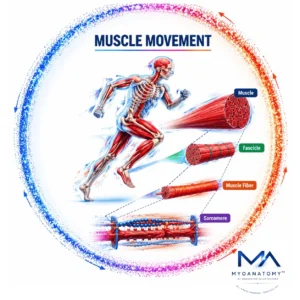
Muscle Movement

MYO CORE

Motor Unit Architecture

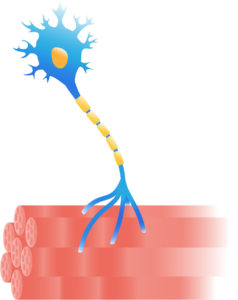
The neuromuscular junction is a highly specialized peripheral cholinergic synapse formed between the terminal branch of an α-motor neuron and a skeletal muscle fiber. 

OVERVIEW

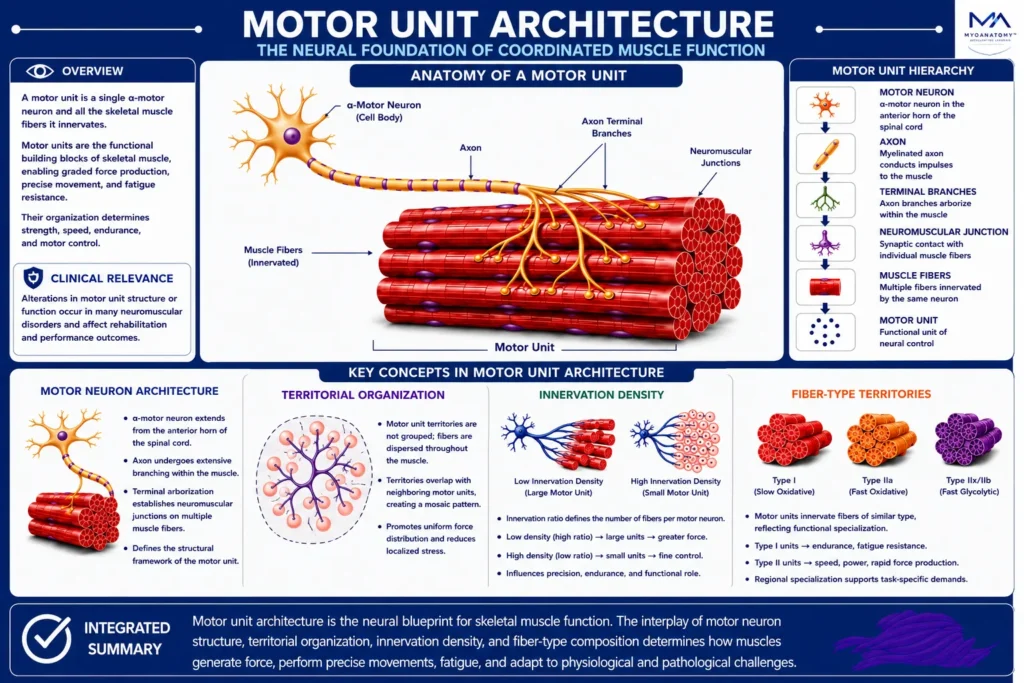
The organization of motor units is determined by patterns of intramuscular axonal branching, neuromuscular junction distribution, and the spatial arrangement of innervated muscle fibers.

Variations in innervation ratio, motor unit territory, and fiber-type composition contribute to the anatomical specialization of individual muscles and influence their functional characteristics.

Motor unit architecture represents the structural framework through which neural innervation is integrated with skeletal muscle organization, establishing the anatomical basis for coordinated activation, force distribution, and functional specialization.

“Motor Unit” – ScholarJay, via  Wikimedia Commons. Licensed under CC BY-SA 4.0

Exam Question

Analyze how the structural organization of motor units integrates neural innervation with skeletal muscle architecture to regulate force distribution, recruitment patterns, and movement precision.

ANATOMY

Motor Neuron Architecture

The anatomical foundation of a motor unit is a single α-motor neuron whose axon extends from the anterior horn of the spinal cord to skeletal muscle. 

Upon entering the muscle, the axon undergoes extensive intramuscular arborization within the connective tissue framework, producing numerous terminal branches that establish neuromuscular junctions on multiple muscle fibers. 

This hierarchical branching pattern defines the structural extent of the motor unit and creates a distributed network through which neural control is integrated with the contractile architecture of the muscle.

Exam Question

Evaluate how the branching architecture of α-motor neurons determines motor unit formation, intramuscular innervation patterns, and the structural integration of neural and muscular tissues.

Territorial Organization

Muscle fibers belonging to a single motor unit are not grouped together but are dispersed throughout anatomically defined territories within the muscle. 

These territories overlap extensively with neighboring motor units, producing a mosaic pattern of innervation that extends throughout the muscle volume. 

Such three-dimensional organization promotes uniform force distribution, minimizes localized mechanical stress, and ensures coordinated activation of contractile elements across the entire muscle.

Exam Question

How the three-dimensional territorial distribution of motor unit fibers contributes to uniform force distribution, coordinated contraction, and the anatomical organization of skeletal muscle.

Innervation Density

Motor unit architecture is strongly influenced by the density of neural innervation and the relationship between motor neurons and their target fibers. The innervation ratio determines the size of motor unit territories and the distribution of neuromuscular junctions within the muscle. 

Variations in innervation density reflect anatomical specialization, with highly precise muscles exhibiting small territories and dense neural representation, whereas force-producing muscles demonstrate broader territories and more extensive patterns of fiber innervation.

Exam Question

How variations in innervation ratio, neuromuscular junction density, and motor unit size influence the anatomical specialization and functional characteristics of skeletal muscles.

Fiber Type Territories

Individual motor units predominantly innervate muscle fibers sharing similar morphological, histochemical, and metabolic characteristics, creating anatomically distinct fiber-type territories within the muscle. 

These territories contribute to the internal organization of skeletal muscle and establish specialized regions adapted for particular mechanical demands. 

The spatial relationship between motor neurons and their associated fiber populations provides the anatomical basis for muscular specialization in posture, endurance, rapid movement, and force production.


Exam Question

Assess how the spatial organization of fiber-type territories within motor units contributes to muscular specialization, mechanical performance, and adaptation to different functional demands.

SUMMARY TABLE

Scroll to Top