Muscle Classification
MYO CORE
Architectural Classification
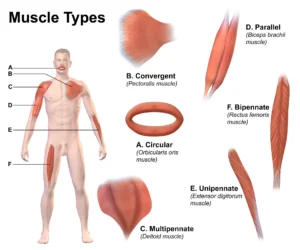
Architectural classification is the most biomechanically significant system of muscle classification because fiber arrangement directly determines force production, contraction velocity, excursion, mechanical efficiency, and functional specialization. Consequently, muscle architecture provides the strongest anatomical basis for predicting muscular performance and movement capability.
OVERVIEW
Different architectural patterns therefore represent specialized structural adaptations that optimize specific biomechanical functions.
Major architectural types include parallel muscles, which favor extensive shortening and mobility; fusiform muscles, which combine large excursion with efficient force generation; and pennate muscles, whose oblique fiber arrangement increases physiological cross-sectional area and maximizes force production.
Pennate muscles are further classified as unipennate, bipennate, or multipennate according to fiber attachment patterns.
Additional forms include convergent muscles, which provide versatile force application through broad origins and common insertions, and circular muscles, which function as sphincters regulating anatomical openings.
Collectively, these architectures demonstrate how fiber organization dictates biomechanical specialization, enabling muscles to optimize mobility, stability, precision, or power according to functional demands.
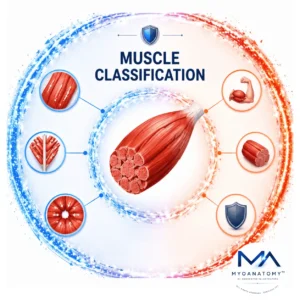
Fascicle Muscle Shapes” – OpenStax College, Anatomy & Physiology, via Wikimedia Commons. Licensed under CC BY-SA 3.0
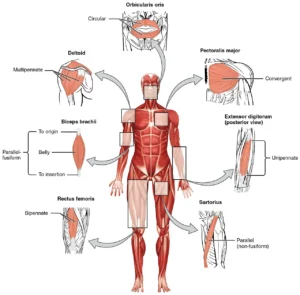
”Muscle Types” – BruceBlaus( Own work), via Wikimedia Commons. Licensed under CC BY-SA 4.0
Exam Question
How does muscle architecture influence biomechanical function, and compare the force-generating capacity and excursion characteristics of parallel, fusiform, pennate, convergent, and circular muscles?
ANATOMY
Parallel Muscles
Parallel muscles are defined by fibers oriented parallel to the longitudinal axis and line of pull between origin and insertion. This configuration allows fibers to extend along the entire muscle length, maximizing sarcomere number in series.
Consequently, parallel muscles exhibit:
High excursion and contraction velocity (due to long fibers)
Relatively lower force production (due to smaller PCSA)
Efficient transmission of force along a single vector
They are therefore optimized for range of motion and rapid displacement, rather than maximal force generation.
Functional examples:
Sartorius – long-range limb movement across hip and knee
Rectus abdominis – trunk flexion with significant shortening capacity
Biceps brachii – rapid elbow flexion and forearm supination
From a biomechanical perspective, parallel architecture favors dynamic movement and precision, but is more susceptible to strain injuries due to greater elongation capacity.
Exam Question
Compare parallel and pennate muscle architectures in terms of sarcomere arrangement, force generation, and functional specialization, and explain why parallel muscles are predisposed to greater excursion but lower maximal force.
Fusiform Muscles
Fusiform muscles represent a specialized subtype of parallel architecture, characterized by a spindle-shaped morphology with a prominent central belly and tapered tendinous ends. This configuration allows fibers to run longitudinally along the muscle’s axis, maintaining a high number of sarcomeres in series.
Functionally, fusiform muscles exhibit:
High shortening velocity and excursion (long fiber length)
Moderate force production (intermediate PCSA compared to pennate muscles)
Smooth, coordinated force transmission along a single vector
This architecture provides an optimal balance between mobility and force, making fusiform muscles particularly suited for controlled, dynamic limb movements.
Examples:
Biceps brachii – rapid elbow flexion and forearm supination
Brachioradialis – efficient forearm flexion in mid-pronation
Biomechanically, fusiform muscles favor precision and speed, with reduced maximal force relative to pennate muscles but greater versatility in movement amplitude.
Exam Question
Describe how the fusiform architecture optimizes both excursion and coordinated force production, and contrast its mechanical properties with those of purely parallel and pennate muscle types.
Pennate Muscles
Pennate muscles are characterized by fibers arranged obliquely to a central tendon, resembling a feather-like architecture. This configuration permits dense packing of fibers within a given muscle volume, significantly increasing the physiological cross-sectional area (PCSA).
Functionally, pennate muscles exhibit:
High force generation (due to increased PCSA)
Reduced excursion and contraction velocity (shorter fiber length)
Efficient force transmission via angled fibers, with partial loss of force along the line of pull compensated by greater fiber
Structural subtypes include:
Unipennate – fibers on one side of tendon (e.g., extensor digitorum longus)
Bipennate – fibers on both sides (e.g., rectus femoris)
Multipennate – complex, multiple tendon insertions (e.g., deltoid)
Biomechanically, pennate architecture is optimized for power and load-bearing, making these muscles essential for force-intensive, stabilizing, and postural functions.
Exam Question
Explain how pennation angle influences force production and efficiency in skeletal muscle, and discuss the trade-off between force and excursion in pennate architecture.
Convergent Muscles
Convergent muscles are defined by a broad, often multipoint origin, with fibers arranged in a fan-shaped pattern converging toward a single tendon of insertion. This architecture enables fibers from different regions to be oriented at varying angles relative to the line of pull.
Functionally, convergent muscles demonstrate:
Variable force direction depending on the activated fiber subset
Capacity for selective regional activation, enabling fine control
Potential for substantial force generation when all fibers contract synchronously
This design allows a single muscle to perform complex, multidirectional actions, integrating both precision and power within a unified structure.
Example:
Pectoralis major – fibers from clavicular, sternal, and costal parts contribute to diverse movements (flexion, adduction, medial rotation of the humerus).
Biomechanically, convergent muscles function as adaptive force modulators, capable of altering both vector and magnitude of contraction, thereby enhancing versatility within the kinetic chain.
Exam Question
Explain how the architectural design of convergent muscles enables multidirectional force generation and selective activation, and discuss its functional significance using the pectoralis major as an example
Circular Muscles
Circular muscles, or sphincter muscles, consist of concentric rings of muscle fibers arranged around an anatomical opening or passage. Unlike linear muscles, their fibers are oriented perpendicular to the lumen, enabling regulation of aperture diameter.
Functionally, circular muscles:
Control opening and closure of orifices
Regulate passage of substances (e.g., food, air, fluids)
Maintain tonic contraction for continence and physiological control
Upon contraction, these muscles reduce lumen diameter, functioning as dynamic valves within organ systems.
Examples:
Orbicularis oris – controls mouth closure and articulation. (Clinically extended: external anal and urethral sphincters)
Biomechanically, circular muscles are specialized for regulatory rather than locomotor function, emphasizing precision and sustained control over force or excursion.
Exam Question
Describe how the unique fiber orientation of circular muscles enables regulation of luminal diameter, and compare their functional role with linear skeletal muscle architectures.e.
SUMMARY TABLE