Muscle Classification
MYO CORE
Regional Classification
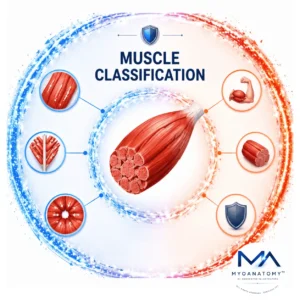
Regional classification organizes skeletal muscles according to their anatomical location and the functional compartments they occupy within the body. This classification reflects the intimate relationship between muscular distribution, regional biomechanics, neurovascular architecture, and specialized physiological functions.
OVERVIEW
Each region exhibits a unique muscular organization shaped by its developmental, biomechanical, and physiological requirements.
The Head & Neck musculature supports complex activities such as facial expression, mastication, ocular movement, phonation, and deglutition; the
Trunk musculature serves as the central stabilizing and respiratory apparatus while protecting vital viscera;
Upper Limb musculature is specialized for mobility, dexterity, and precise motor control.
Lower Limb musculature is adapted for postural support, weight transmission, balance, and locomotion. Together, these regional muscular systems illustrate the sophisticated integration of anatomy and function that underlies human movement, stability, and physiological performance.
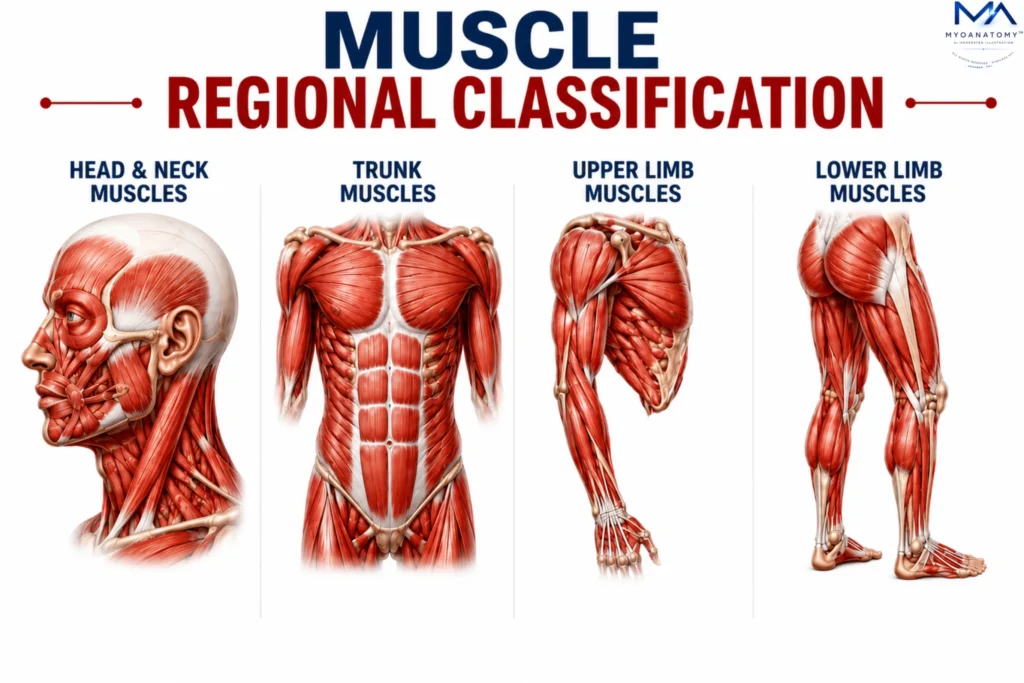
AI Generated Illustration
Exam Question
How does the regional organization of skeletal musculature reflect the structural and functional adaptations required to support communication, posture, respiration, manipulation, balance, and locomotion within the human body?
ANATOMY
Head & Neck Muscles
The muscles of the head and neck constitute a highly specialized muscular system adapted for functions that extend beyond locomotion.
Their precise neuromuscular control and intricate anatomical organization reflect the exceptional functional demands of communication, sensory perception, feeding, respiration, and head posture, making this region one of the most sophisticated functional units of the human musculoskeletal system.
The major muscular groups of this region include the muscles of facial expression, muscles of mastication, extraocular muscles, tongue muscles, pharyngeal muscles, suprahyoid and infrahyoid muscles, as well as the superficial and deep cervical muscles responsible for head and neck movement, postural support, and stabilization.
Exam Question
How does the specialized anatomical organization of the head and neck musculature enable the complex integration of facial expression, mastication, vision, speech, swallowing, respiration, and craniocervical stabilization?
Trunk Muscles
The muscles of the trunk constitute the central biomechanical framework of the human body.
Through their coordinated interaction with the vertebral column, rib cage, pelvis, and associated fascial systems, these muscles facilitate trunk movement, stabilize the axial skeleton, regulate intra-abdominal pressure, and contribute to force transmission between the upper and lower limbs. Their specialized anatomical organization is essential for maintaining balance, spinal integrity, efficient respiration, and core stability during both static posture and dynamic movement.
The major muscular groups of this region include the thoracic wall muscles, abdominal wall muscles, intrinsic and extrinsic back muscles, pelvic floor muscles, and the diaphragm, which collectively form the primary stabilizing and respiratory apparatus of the human body.
Exam Question
How do the muscles of the trunk function collectively to maintain posture, stabilize the vertebral column, support respiration, regulate intra-abdominal pressure, and facilitate efficient force transmission throughout the body?
Upper Limb Muscles
The muscles of the upper limb constitute a highly specialized neuromuscular system.
Their anatomical organization prioritizes freedom of movement over intrinsic stability, enabling a wide range of coordinated actions required for reaching, grasping, manipulation, and fine motor control. Through integrated interactions with the shoulder girdle, upper limb articulations, peripheral nerves, and vascular networks, these muscles regulate force, speed, and accuracy during movement.
The major muscular groups of this region include the shoulder muscles, brachial muscles, antebrachial muscles, and hand muscles, which collectively provide upper-limb mobility, stabilization, prehension, and skilled motor performance.
Exam Question
How does the anatomical organization of the upper limb musculature optimize mobility, dexterity, precision, and skilled motor performance while maintaining dynamic joint stability?
Lower Limb Muscles
The muscles of the lower limb constitute a highly specialized neuromuscular system.
Their anatomical organization prioritizes force generation and postural support, enabling the lower extremity to maintain balance, absorb mechanical loads, and produce efficient movement during standing, walking, running, and other dynamic activities. Through integrated interactions with the pelvis, lower limb articulations, peripheral nerves, and vascular networks, these muscles coordinate propulsion, stabilization, and shock absorption.
The major muscular groups of this region include the gluteal muscles, thigh muscles, leg muscles, and foot muscles, which collectively provide postural control, balance, weight transmission, and efficient locomotor function.
Exam Question
How do the muscles of the lower limb coordinate to provide weight-bearing support, postural stability, balance, shock absorption, and efficient locomotion during human movement?
SUMMARY TABLE