Muscle Classification
MYO CORE
Structural Classification
Structural classification organizes skeletal muscles according to their gross external morphology and geometric form. Focuses on overall muscle shape and how that shape reflects anatomical position, attachment pattern, force transmission, and mechanical role.
OVERVIEW
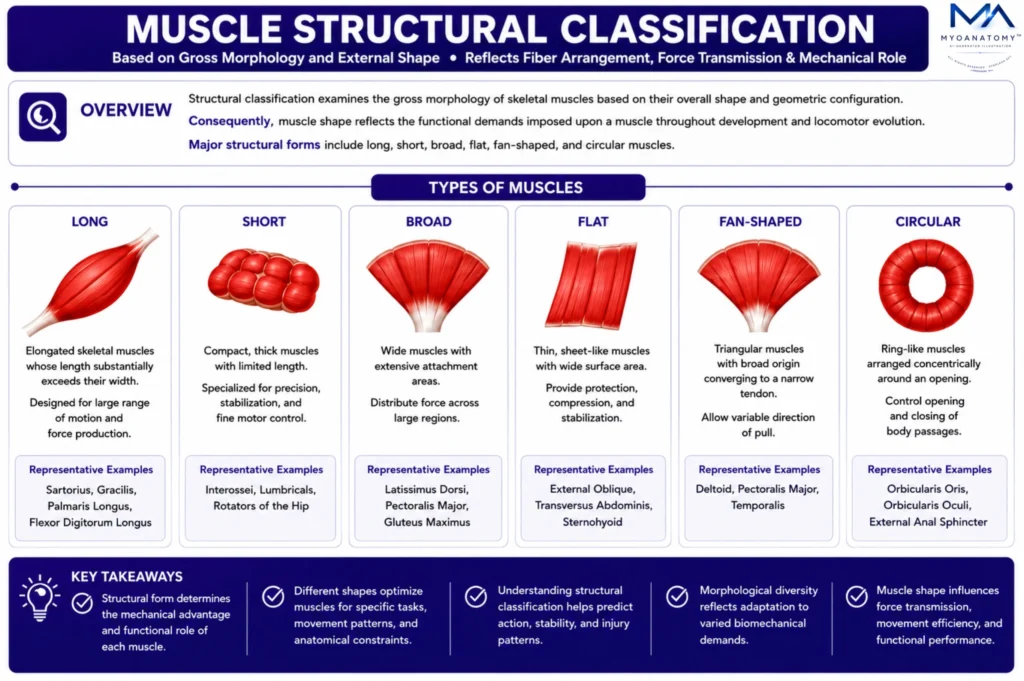
Structural classification examines the gross morphological organization of skeletal muscles based on their overall shape and geometric configuration.
Consequently, muscle shape reflects the functional demands imposed upon a muscle throughout development and locomotor evolution.
Major structural forms include long muscles, adapted for extensive excursion and movement; short muscles, specialized for stabilization and fine motor control; broad and flat muscles, which distribute forces across large attachment areas while contributing to protection and compression; fan-shaped muscles, which permit versatile force application through converging fiber arrangements; and circular muscles, which regulate anatomical openings through sphincteric action.
Collectively, these morphological configurations illustrate how gross anatomy contributes to biomechanical specialization and functional diversity throughout the musculoskeletal system.
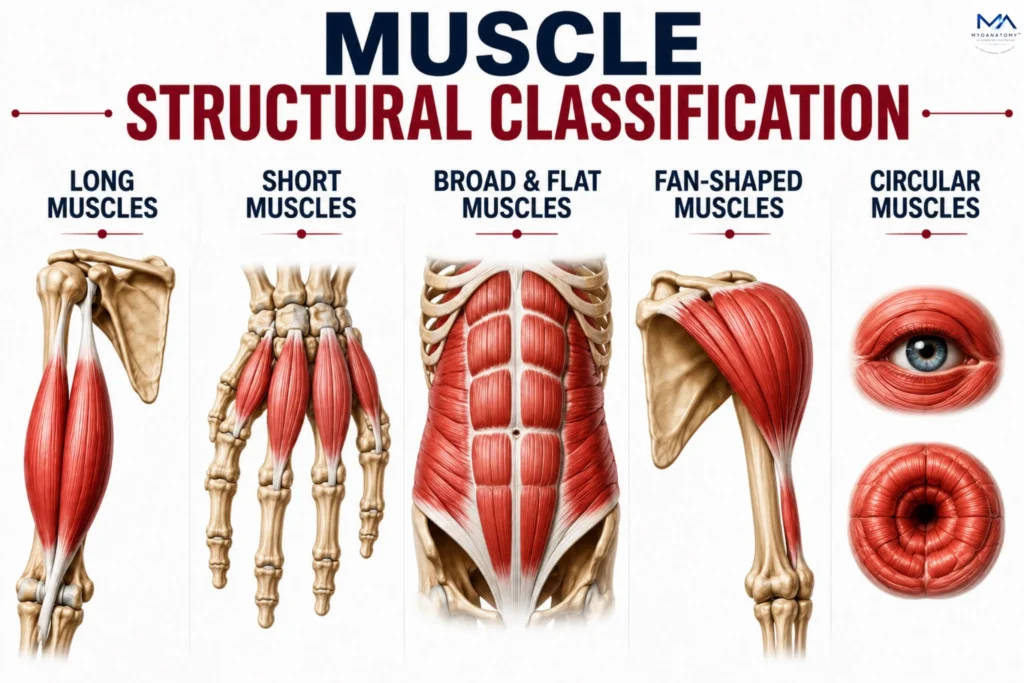
AI Generated Illustration
Exam Question
Explain how muscle shape influences force generation, range of motion, stabilization, protection, and regulation of anatomical openings. Illustrate your answer by comparing the functional roles of long, short, broad, fan-shaped, and circular muscle architectures.
ANATOMY
Long Muscles
Long muscles are elongated skeletal muscles whose length substantially exceeds their width, allowing them to span extensive anatomical distances and frequently cross multiple joints. Muscle fibers arranged predominantly along the longitudinal axis, typically terminating in relatively narrow tendons.
This structural organization provides numerous sarcomeres arranged in series, enabling extensive excursion, rapid shortening, and large ranges of motion. Consequently, long muscles are particularly adapted for producing large-amplitude movements and coordinating motion across multiple articulations.
Representative examples include the sartorius, sternocleidomastoid, gracilis, palmaris longus, flexor digitorum longus, and extensor digitorum longus. Owing to their high excursion capacity, long muscles are especially susceptible to strain injuries associated with excessive stretching or rapid acceleration.
Exam Question
How does the elongated morphology and serial arrangement of fibers in long muscles enhance excursion and contraction velocity, and why are muscles such as the sartorius and sternocleidomastoid particularly suited for large-amplitude movements across multiple joints?
Short Muscles
Short muscles are compact skeletal muscles specialized for precision, stabilization, and fine motor control rather than extensive movement. Typically situated adjacent to joints, vertebrae, or small skeletal elements, they possess short muscle bellies and relatively small fascicles arranged within confined anatomical spaces.
Their structural design prioritizes maintenance of joint congruency and control of segmental motion over maximal force production. Biomechanically, short muscles provide continuous stabilization and subtle positional adjustments that contribute to movement accuracy and postural regulation.
Representative examples include the interossei muscles, interspinales, intertransversarii, rotatores, lumbricals, and the short external rotators of the hip. Dysfunction of these muscles may compromise fine motor performance, segmental stability, and postural control.
Exam Question
How do the structural characteristics of short muscles contribute to joint stabilization, segmental control, and movement precision, and why are muscles such as the interossei and interspinales essential for fine motor function and postural regulation?
Broad Muscles
Broad muscles are wide skeletal muscles characterized by extensive attachment areas and substantial anatomical coverage. They commonly appear as large sheets of muscular tissue with broad origins, expansive fascial connections.
This morphology enables mechanical loads to be distributed across large regions, enhancing force transfer while minimizing focal stress concentrations. Broad muscles play important roles in powerful movement, postural support, stabilization, and the transmission of forces between anatomical regions.
Representative examples include the latissimus dorsi, trapezius, gluteus maximus, rhomboid major, and serratus anterior. Because of their extensive anatomical attachments, injury to broad muscles may significantly affect posture, movement coordination, and overall biomechanical efficiency.
Exam Question
How does the extensive surface area and broad attachment pattern of broad muscles optimize force distribution and regional stabilization, and how is this reflected in the biomechanical functions of the latissimus dorsi, trapezius, and gluteus maximus?
Flat Muscles
Fan-shaped muscles are triangular muscles characterized by broad origins and fibers that progressively converge toward a narrower tendon of insertion. This distinctive morphology combines extensive attachment surfaces with efficient concentration of force into a common insertion.
Fan-shaped muscles provide exceptional versatility in force direction and movement control. Their architecture permits both powerful contraction and multidirectional mechanical actions, making them particularly adaptable to complex movements.
Representative examples include the temporalis, pectoralis major, pectoralis minor, gluteus medius, and portions of the adductor magnus. Damage to specific regions of a fan-shaped muscle may selectively impair individual movement components because different fiber groups contribute distinct force vectors.
Exam Question
How does the sheet-like morphology of flat muscles facilitate force transmission, compression, and structural support, and why are the external oblique and transversus abdominis critical for trunk stability and regulation of intra-abdominal pressure?
Fan-Shaped Muscles
Fan-shaped muscles are triangular muscles characterized by broad origins and fibers that progressively converge toward a narrower tendon of insertion. This distinctive morphology combines extensive attachment surfaces with efficient concentration of force into a common insertion.
Fan-shaped muscles provide exceptional versatility in force direction and movement control. Their architecture permits both powerful contraction and multidirectional mechanical actions, making them particularly adaptable to complex movements.
Representative examples include the temporalis, pectoralis major, pectoralis minor, gluteus medius, and portions of the adductor magnus. Damage to specific regions of a fan-shaped muscle may selectively impair individual movement components because different fiber groups contribute distinct force vectors.
Exam Question
How does the convergent architecture of fan-shaped muscles permit multidirectional force application and selective fiber recruitment, and how do the temporalis and pectoralis major demonstrate this biomechanical versatility?
Circular Muscles
Circular muscles are specialized ring-shaped muscles whose fibers are arranged concentrically around anatomical openings. Unlike most skeletal muscles, which attach between skeletal elements, circular muscles encircle a lumen or aperture and function as sphincters.
Their unique architecture allows the generation of circumferential force that regulates the diameter of openings and controls the movement of substances through anatomical passages. Biomechanically, these muscles are essential for continence, protection, and physiological regulation of body openings.
Representative examples include the orbicularis oris, orbicularis oculi, external anal sphincter, and external urethral sphincter. Dysfunction of circular muscles may impair facial expression, speech, blinking, continence mechanisms, and other protective physiological functions.
Exam Question
How does the concentric arrangement of fibers in circular muscles enable sphincteric function, and why are muscles such as the orbicularis oris, orbicularis oculi, and external anal sphincter essential for physiological regulation and protection of anatomical openings?
SUMMARY TABLE