Muscle Classification
MYO CORE
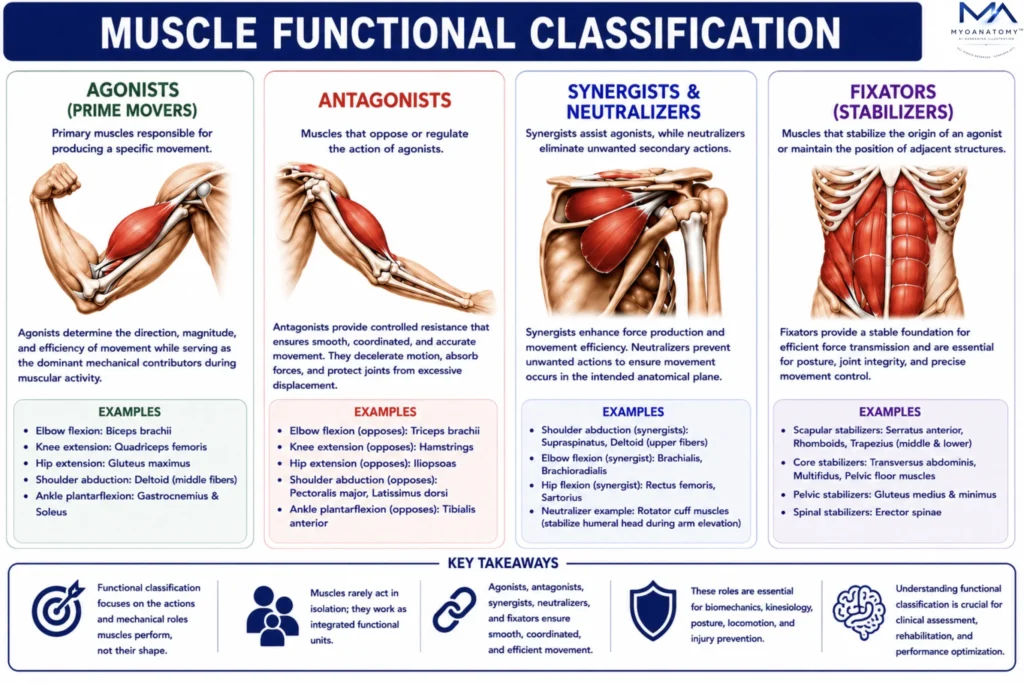
Functional Classification
Functional classification categorizes skeletal muscles according to the primary actions they produce rather than their anatomical shape. Muscles are grouped based on the movements they generate, such as flexion, extension, abduction, adduction, rotation, and stabilization.
OVERVIEW
Human movement results from the coordinated interaction of multiple muscles acting as integrated functional units. Within this system: Agonist (prime mover) serves as the primary muscle responsible for producing a desired action, while: Antagonist opposes or controls that movement through regulated relaxation or contraction.
Synergists assist the agonist by augmenting force production and enhancing movement efficiency, whereas neutralizers prevent unwanted secondary actions that may accompany muscle contraction, thereby ensuring movement precision. Fixators provide a stable foundation by immobilizing the origin or proximal segment of a muscle, allowing effective force transmission to the intended skeletal structure.
Together, these functional relationships enable smooth, controlled, and coordinated movement while maintaining joint stability, postural control, and biomechanical efficiency throughout the musculoskeletal system.
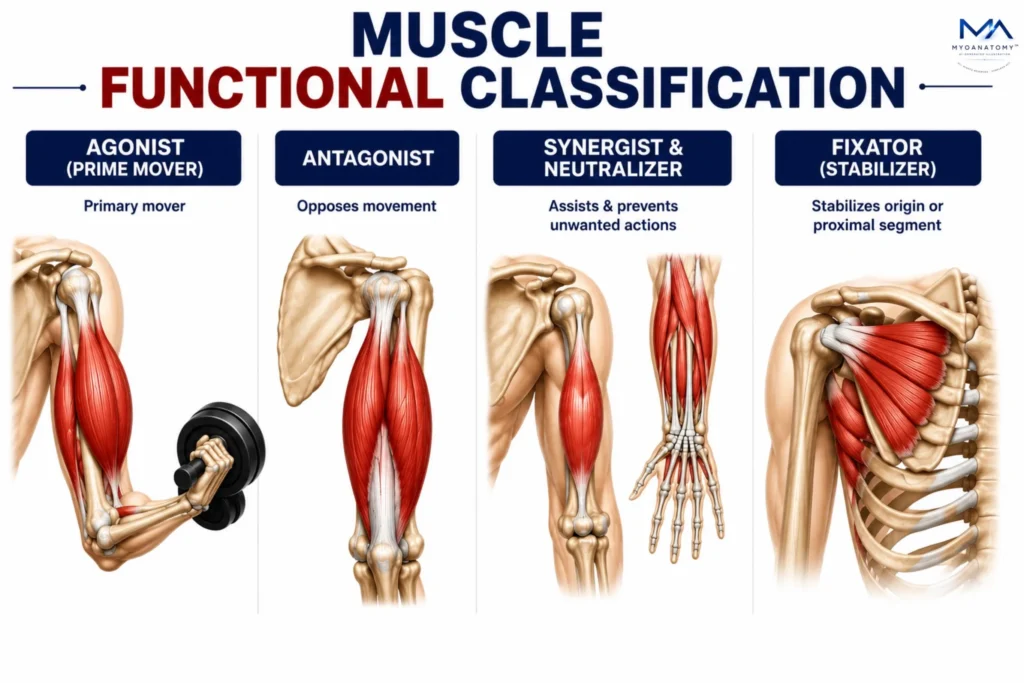
AI Generated Illustration
Exam Question
Muscles operate as integrated functional units rather than isolated structures. Discuss the biomechanical significance of agonists, antagonists, synergists, neutralizers, and fixators, highlighting their collective contribution to coordinated movement, postural control, stabilization, and locomotion.
ANATOMY
Agonists Muscles
Agonists are the primary muscles responsible for producing a specific movement and generating the principal force required for motion.
They determine the direction, magnitude, and efficiency of movement while serving as the dominant mechanical contributors during muscular activity.
Examples include the biceps brachii during elbow flexion, quadriceps femoris during knee extension, gluteus maximus during hip extension, and deltoid during shoulder abduction.
Clinically, agonist weakness resulting from nerve injury, tendon rupture, or neuromuscular disease may cause reduced strength, limited range of motion, and impaired functional performance.
Exam Question
How do agonist muscles function as the primary generators of movement, and how might dysfunction of the biceps brachii, quadriceps femoris, gluteus maximus, or deltoid alter joint mechanics, force production, and overall motor performance?
Antagonists Muscles
Antagonists oppose or regulate the action of agonists, providing controlled resistance that ensures smooth, coordinated, and accurate movement. Through eccentric contraction, they decelerate motion, absorb forces, and protect joints from excessive displacement.
Examples include the triceps brachii opposing elbow flexion by the biceps brachii, hamstringsopposing knee extension by the quadriceps, and latissimus dorsi opposing shoulder abduction by the deltoid.
Dysfunction of antagonist muscles may contribute to spasticity, contractures, abnormal movement patterns, and impaired neuromuscular control.
Exam Question
Explain the biomechanical importance of antagonist muscles in regulating movement. How do the triceps brachii, hamstrings, and latissimus dorsi contribute to movement control, and what functional consequences may arise when antagonist activity is impaired?
Synergists & Neutralizers
Synergists assist agonists by enhancing force production and improving movement efficiency, whereas neutralizers eliminate unwanted secondary actions to ensure movement occurs within the intended anatomical plane.
Examples include the brachialis assisting the biceps brachii during elbow flexion, supraspinatus assisting the deltoid during shoulder abduction, and wrist extensors neutralizing unwanted wrist flexion during powerful finger flexion.
Impairment of synergistic or neutralizing function may result in compensatory movements, decreased precision, biomechanical inefficiency, and increased risk of overuse injury.
Exam Question
Discuss the roles of synergists and neutralizers in optimizing movement efficiency and precision. Using the brachialis, supraspinatus, and wrist extensors as examples, explain how these muscles assist agonists and prevent unwanted secondary actions during complex movements.
Fixators Muscles
Fixators stabilize the origin of an agonist or maintain the position of adjacent skeletal structures, providing a stable foundation for efficient force transmission. They primarily function through isometric contraction and are essential for posture, joint integrity, and movement control.
Examples include the rotator cuff muscles stabilizing the glenohumeral joint, trapezius and serratus anterior stabilizing the scapula, and transversus abdominis stabilizing the trunk during limb movements.
Weakness of stabilizing muscles may lead to joint instability, postural dysfunction, impaired movement efficiency, and a greater susceptibility to musculoskeletal injury.
Exam Question
Why are fixator muscles essential for efficient force transmission and joint stability? Describe how the rotator cuff muscles, trapezius, serratus anterior, and transversus abdominis contribute to stabilization, and discuss the biomechanical effects of stabilizer weakness on posture and movement.
SUMMARY TABLE