Muscle Classification

MYO CORE

Muscle Heads Classification

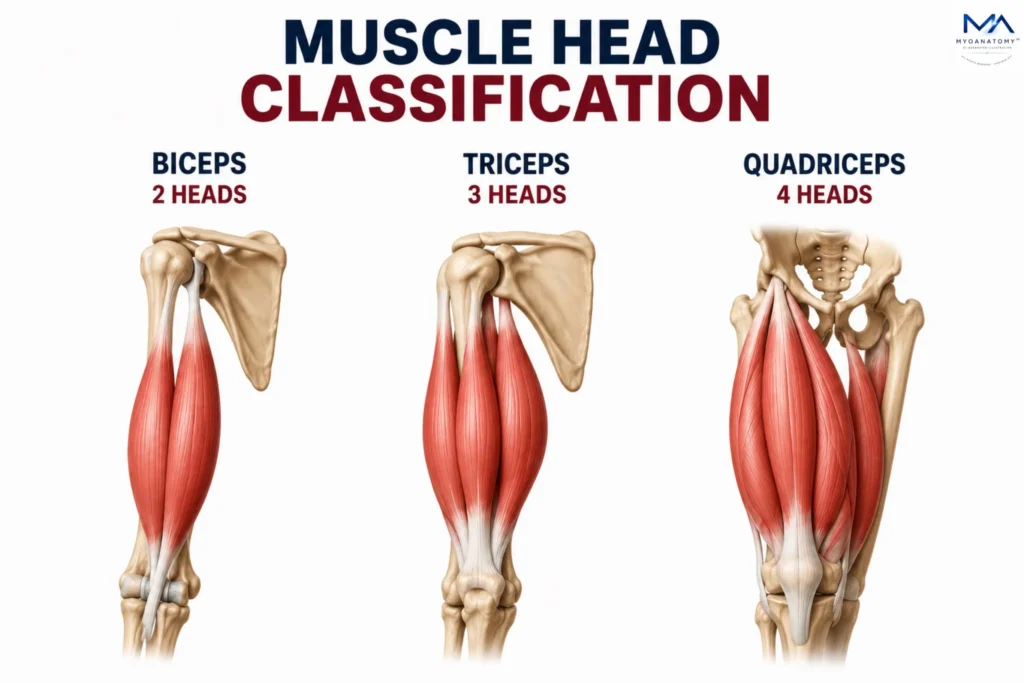
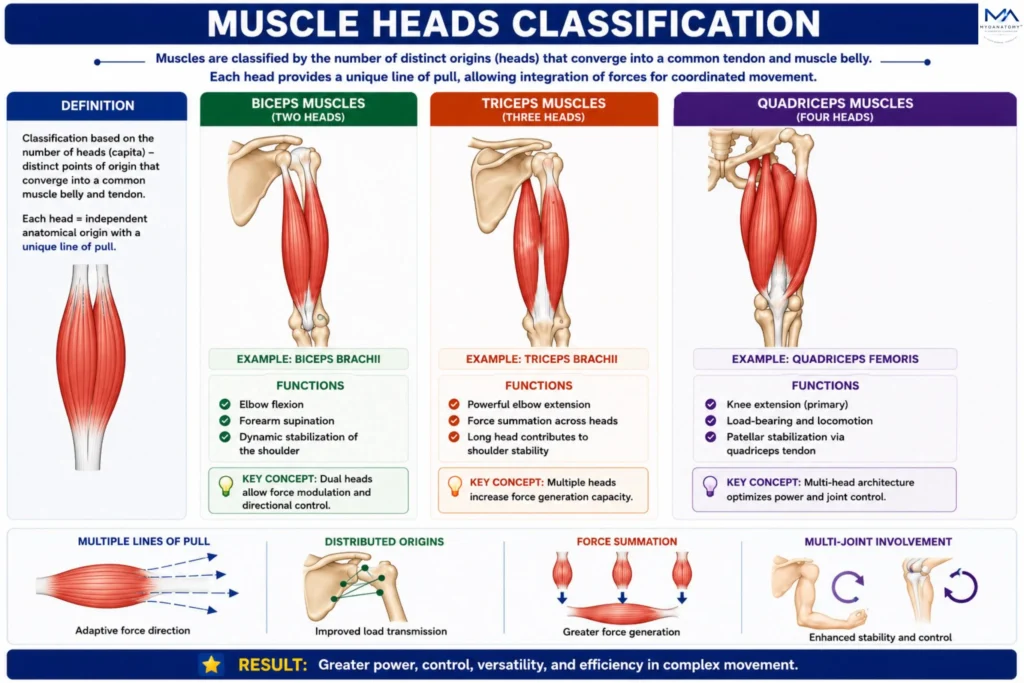
Muscle-head classification organizes skeletal muscles according to the number of distinct heads that originate separately and converge into a common tendon or insertion. Multiple heads provide different lines of pull, improving force distribution, movement precision, and joint stability. 

OVERVIEW

An additional classification of skeletal muscle is based on the number of heads (capita) – distinct points of origin that converge into a common muscle belly and tendon. A “head” represents an independent anatomical origin with a potentially unique line of pull, contributing to the muscle’s overall mechanical profile.

Muscles with multiple heads:

arise from separate anatomical landmarks (often different bones or regions) may span multiple joints or functional compartments

exhibit functional versatility, as each head can generate slightly different force vectors

This arrangement enhances mechanical efficiency and coordination, allowing a single muscle to participate in complex, multi-vector movements and to adapt its contribution depending on joint position and neuromuscular recruitment.

Thus, classification by muscle heads reflects structural complexity linked to functional diversification within the musculoskeletal system.

AI Generated Illustration

Exam Question

Explain how multiple heads of a muscle contribute to variations in force direction and functional versatility, and discuss their significance in multi-joint movement.

ANATOMY

Biceps Muscles

The term biceps denotes a muscle with two distinct heads of origin, which arise from separate anatomical sites and converge into a single muscle belly with a common insertion. This dual-origin architecture allows integration of different lines of pull into a unified mechanical action.

Example: Biceps brachii

Origin – long head → supraglenoid tubercle of scapula; Short head → from a  coracoid process of scapula

Insertion → radial tuberosity and bicipital aponeurosis

Functionally, the dual heads enable:

elbow flexion

forearm supination

dynamic stabilization of the glenohumeral joint

Biomechanically, the biceps brachii exemplifies how multiple heads enhance functional adaptability, allowing the muscle to contribute across different joints and movement contexts depending on limb position.

Exam Question

Analyze how the dual-head architecture of the biceps brachii contributes to its multi-joint function, including its roles in elbow flexion, forearm supination, and shoulder stabilization.

Triceps Muscles

Triceps muscles are defined by the presence of three distinct heads of origin, which arise from separate anatomical sites and converge into a common tendon, forming a unified functional unit. This multi-headed configuration enables integration of multiple lines of pull into a single, powerful action.

Example: Triceps brachii

Origin – Long head → infraglenoid tubercle of scapula (biarticular component); while a Lateral head → posterior humerus (above radial groove); Medial head → posterior humerus (below radial groove)

Insertion is common  → olecranon process of ulna

Functionally, this architecture allows:

powerful elbow extension (primary role)

force augmentation through summation of multiple heads

shoulder stabilization via the long head

Biomechanically, the triceps exemplifies how multi-headed muscles enhance force production, joint stability, and functional redundancy, particularly in movements requiring sustained or high-load extension.

Exam Question

Analyze how the three heads of the triceps brachii contribute to force generation and joint stabilization, and explain the functional significance of its biarticular long head.

Quadriceps Muscles

Quadriceps muscles are characterized by four heads of origin, forming a large, integrated muscle group optimized for maximal force production in lower limb extension. These heads converge into the quadriceps tendon, which envelops the patella and continues as the patellar ligament to the tibial tuberosity.

Example: Quadriceps femoris

Origin

rectus femoris → anterior inferior iliac spine (biarticular)

vastus lateralis → lateral femur

vastus medialis → medial femur

vastus intermedius → anterior femur

Functionally, the quadriceps:

Produce powerful knee extension (essential for locomotion, rising, and load-bearing)

Provide dynamic stabilization of the knee joint, particularly via vastus medialis

Integrate hip and knee mechanics through rectus femoris

Biomechanically, this multi-headed system maximizes force output, distribution of load, and joint control, making it critical for posture, gait, and high-force lower limb activities.
Exam Question

Explain how the quadriceps femoris architecture optimizes force production and knee stabilization, and discuss the functional role of rectus femoris as a biarticular muscle.

SUMMARY TABLE

Scroll to Top