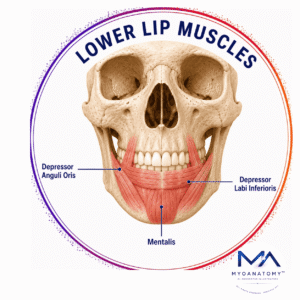
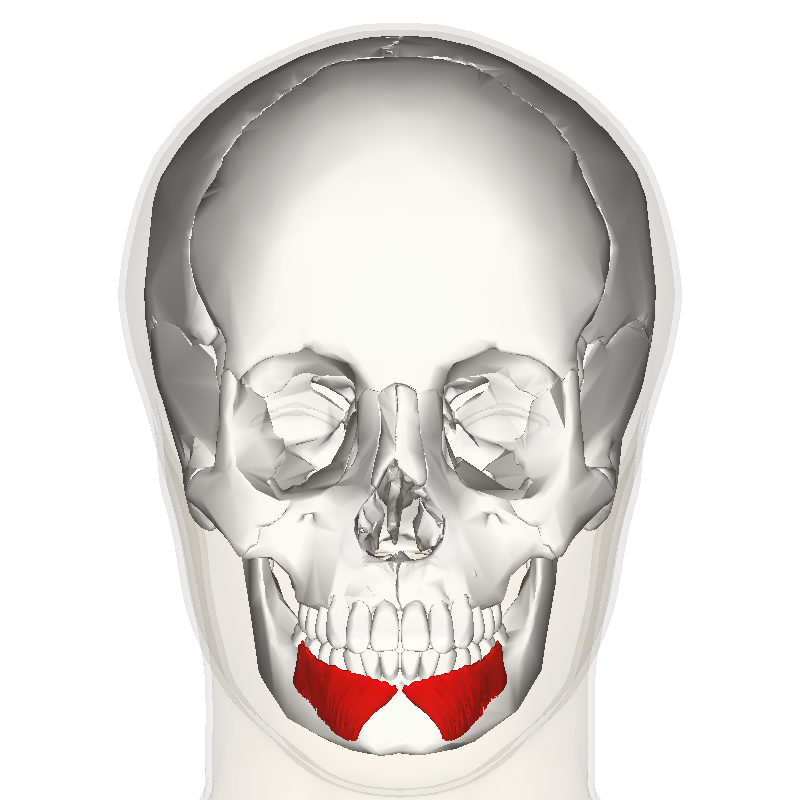
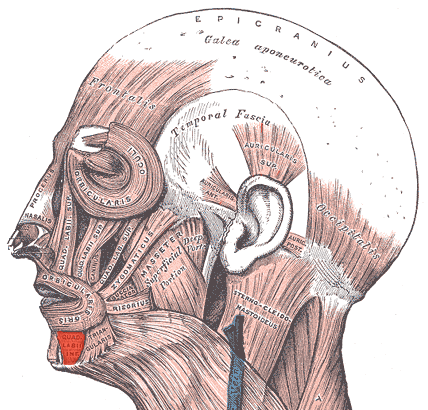
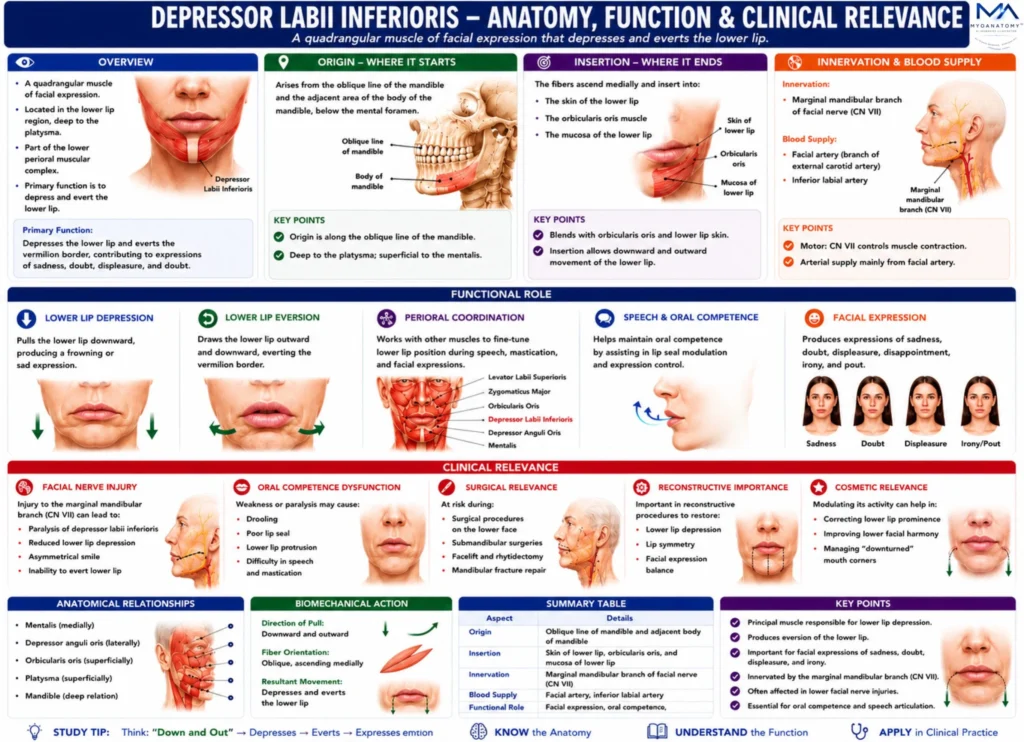
The depressor labii inferioris is a quadrangular muscle of facial expression located in the lower lip region, extending from the anterior mandible to the skin of the lower lip. It forms part of the lower perioral muscular complex, which regulates movements of the lower lip during facial expression, speech, and oral competence.
Depressor Labii Inferioris Muscle
CORE
Overview
Anatomically, the depressor labii inferioris lies medial to the depressor anguli oris and lateral to the mentalis muscle, occupying a position between these two muscles on the anterior surface of the mandible. It is situated deep to the platysma and partly superficial to the mandible. The muscle’s fibers ascend from the mandible to the lower lip, where they blend with the orbicularis oris muscle and dermis of the lip.
The depressor labii inferioris is a quadrangular muscle of facial expression arising from the oblique line of the mandible and inserting into the skin and mucosa of the lower lip. Its principal action is depression and eversion of the lower lip, exposing the mandibular teeth and contributing to facial expressions such as sadness or doubt.
Functionally, the depressor labii inferioris is responsible for depression and eversion of the lower lip, exposing the mandibular incisors and canine teeth. Through this action it contributes to facial expressions associated with sadness, doubt, irony, displeasure, or grimacing. It also plays an important role in the fine control of lip movements required for speech and articulation.
Clinically, it is important in facial nerve injury, mandibular surgery, and reconstructive procedures, where dysfunction may lead to asymmetry of the lower face and impaired lip control


ANATOMY
Origin
The depressor labii inferioris originates from the:
oblique line of the mandible
anterior surface of the body of the mandible
The origin lies superior to the mandibular border and medial to the origin of the depressor anguli oris.
This mandibular attachment provides a firm anchor from which the muscle can exert downward traction on the lower lip.
Exam Question
Describe the origin of the depressor labii inferioris and explain how its mandibular attachment contributes to its biomechanical action.
Insertion
The fibers ascend superiorly and insert into:
skin of the lower lip
mucosa of the lower lip
fibers of the orbicularis oris muscle
The insertion into the dermis allows the muscle to directly modify the position and contour of the lower lip during facial expression.
Exam Question
Discuss the insertion of the depressor labii inferioris and explain how its insertion enables lower lip movement.
Anatomical Relation
The depressor labii inferioris has several important anatomical relationships.
Superficial relations –platysma muscle subcutaneous tissue and skin of the lower lip region
Deep relations –mandible
Medial relations –mentalis muscle
Lateral relations – depressor anguli oris
Superior relations –orbicularis oris
Inferior relation – inferior border of the mandible
These anatomical relationships are important for surgical approaches to the lower lip and chin.
Fiber Direction and Architecture
The depressor labii inferioris has a quadrangular shape with fibers running:
superomedially from the mandible toward the lower lip.
This orientation allows the muscle to exert:
downward traction on the lower lip slight eversion of the lip margin
the eversion of the lip is particularly important for expressions that expose the mandibular teeth.

Exam Question
Analyze the anatomical relationships of the depressor labii inferioris and discuss their clinical significance during lower facial surgery.
Innervation
Motor innervation is provided by:
marginal mandibular branch of the facial nerve (CN VII)
This branch travels along the inferior border of the mandible and supplies the muscles of the lower lip and chin region
Exam Question
Describe the innervation of the depressor labii inferioris and explain the functional consequences of injury to its motor nerve supply.
FUNCTIONAL ROLE
Lower Lip Depression
The depressor labii inferioris is the primary muscle responsible for downward displacement of the lower lip. By pulling the lower lip inferiorly, it contributes to facial expressions associated with sadness, disappointment, irony, and emotional tension.
This action increases exposure of the mandibular incisors and modifies the vertical dimension of the oral fissure, making it an important determinant of lower facial expression.
Exam Question
Explain the mechanism by which the depressor labii inferioris produces depression of the lower lip and identify facial expressions associated with this action.
Lower Lip Eversion
In addition to depression, the muscle produces eversion of the lower lip by rotating the vermilion border outward. This movement enhances visibility of the mucosal surface of the lower lip and is frequently observed during crying, pouting, grimacing, and expressive emotional reactions.
Eversion contributes to the dynamic shaping of the lower lip and increases the expressive capacity of the lower third of the face
Exam Question
Discuss how the depressor labii inferioris contributes to eversion of the lower lip and explain the functional importance of this movement.
Perioral Coordination
The depressor labii inferioris functions as an integral component of the lower perioral muscular complex. Through coordinated interaction with the depressor anguli oris, mentalis, platysma, and orbicularis oris, it regulates lower lip position, contour, and movement.
This muscular synergy enables precise modulation of oral movements required for facial expression, speech articulation, mastication, and swallowing while maintaining balanced lower facial mechanics.
Exam Question
Analyze the coordinated interaction between the depressor labii inferioris and adjacent perioral muscles during speech and mastication.
Functional Significance
The depressor labii inferioris plays a critical role in lower facial function beyond emotional expression. It contributes to articulation of bilabial and labiodental speech sounds, stabilization of the lower lip during mastication, maintenance of lip competence during swallowing, and fine regulation of oral aperture morphology.
Normal muscle function is therefore essential for effective communication, coordinated oral activity, and preservation of lower facial symmetry.
Exam Question
Evaluate the importance of the depressor labii inferioris in facial expression, oral competence, and articulation.
CLINICAL RELEVANCE
Facial Nerve Injury
The depressor labii inferioris is innervated by the marginal mandibular branch of the facial nerve (CN VII). Injury to this nerve may result in paralysis or significant weakness of the muscle, producing impaired depression of the lower lip and noticeable lower facial asymmetry.
Affected individuals commonly demonstrate an uneven smile, reduced lower lip mobility, and diminished ability to perform expressive movements involving the lower lip
Exam Question
Discuss the clinical manifestations of marginal mandibular branch injury and explain its effects on depressor labii inferioris function.
Oral Competency
Normal function of the depressor labii inferioris contributes to effective lower lip positioning and maintenance of oral competence.
Paralysis or dysfunction may compromise lip seal integrity, resulting in drooling, saliva leakage, impaired control of oral contents, and difficulties with articulation. These functional deficits can negatively affect speech clarity, swallowing efficiency, and overall oral motor performance
Exam Question
Explain the role of the depressor labii inferioris in maintaining oral competence and discuss the consequences of muscle dysfunction
Surgical Relevance
The marginal mandibular nerve is particularly vulnerable during surgical procedures involving the lower face and upper neck, including submandibular gland excision, mandibular fracture repair, cervical lymph node surgery, and cosmetic neck procedures. Iatrogenic injury may impair the depressor labii inferioris and adjacent mimetic muscles, leading to persistent lower facial weakness and postoperative asymmetry.
Careful identification and preservation of the nerve are therefore essential surgical considerations
Exam Question
Why is preservation of the marginal mandibular nerve important during lower facial and cervical surgical procedures?
Reconstructive Importance
The depressor labii inferioris represents a key anatomical structure in facial reanimation, lower lip reconstruction, and aesthetic facial surgery. Restoration of its function is important for achieving symmetrical lower facial movement and natural emotional expression.
Conversely, excessive muscular activity may contribute to disproportionate downward displacement of the lower lip, adversely affecting facial balance and aesthetics. Consequently, the muscle is frequently considered in both reconstructive and cosmetic treatment planning
Exam Question
Evaluate the importance of the depressor labii inferioris in facial reanimation and reconstructive surgery of the lower face.
SUMMARY TABLE