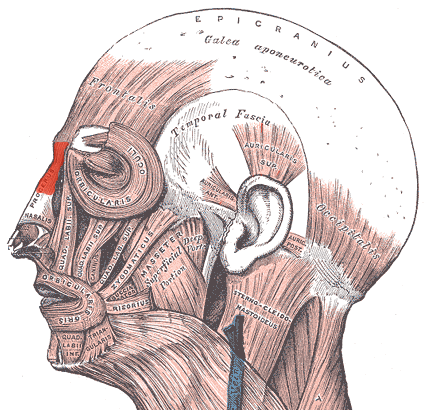
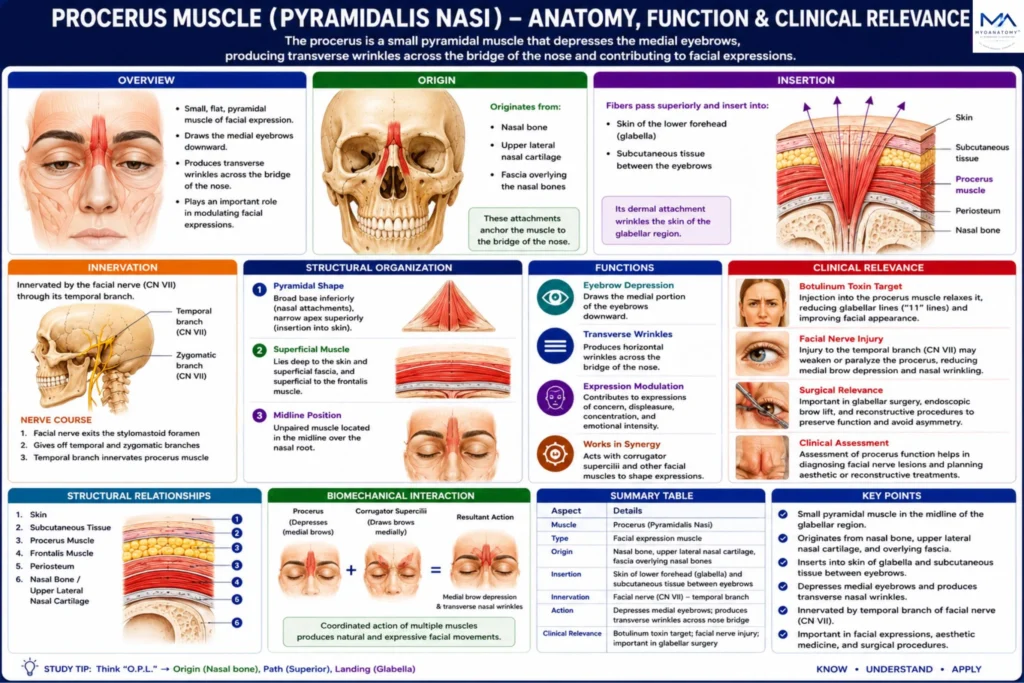
The procerus is a small pyramidal muscle of facial expression located in the midline of the upper nasal region, extending from the nasal bones and upper nasal cartilage to the skin of the glabella, the smooth area between the eyebrows. Although relatively small, the procerus plays an important role in modulating the position of the medial eyebrows and producing transverse wrinkles across the bridge of the nose.
Procerus Muscle
CORE
Overview
Anatomically, the procerus lies superficial to the nasal bones and upper lateral nasal cartilages, deep to the skin, and intermingles superiorly with fibers of the frontal belly of the occipitofrontalis and the corrugator supercilii muscles. Through these connections it participates in the coordinated muscular network that regulates eyebrow movement and facial expression in the glabellar region.
By pulling the medial eyebrows downward and producing transverse wrinkles in the glabellar region, it contributes to facial expressions associated with concentration and emotional intensity.
Functionally, it works together with the corrugator supercilii, orbicularis oculi, and frontalis muscles to regulate eyebrow position and forehead skin tension.
Clinically, the muscle is significant in cosmetic procedures, facial nerve pathology, and surgical approaches to the forehead and nasal root.

ANATOMY
Origin
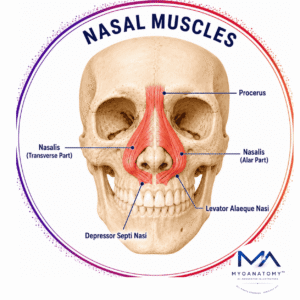
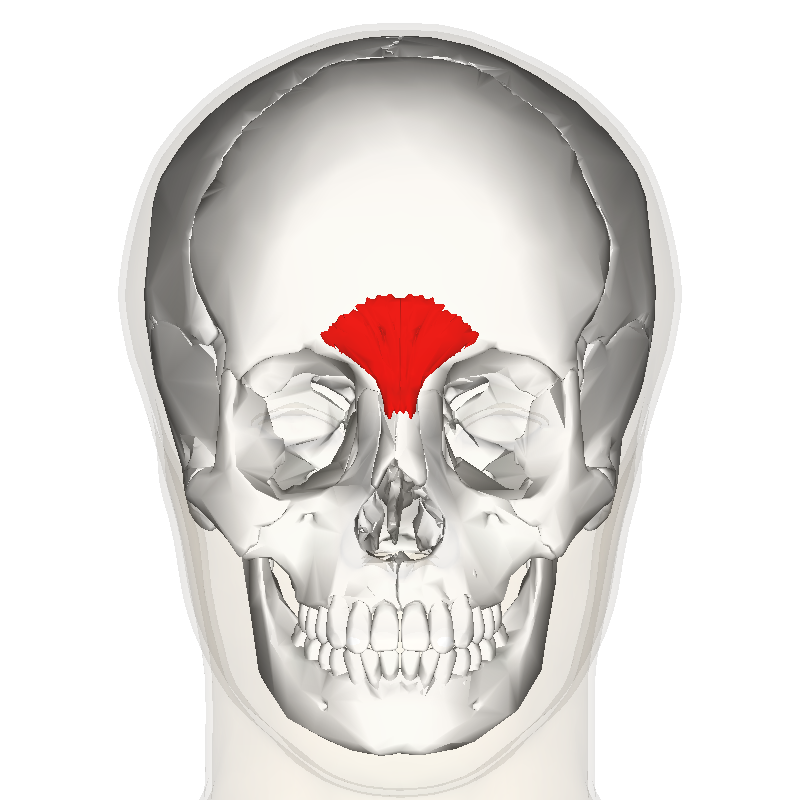
The procerus originates from the inferior nasal region, specifically from:
nasal bone
upper lateral nasal cartilage
fascia overlying the nasal bones
These attachments anchor the muscle to the bridge of the nose.
Exam Question
Describe the origin of the procerus muscle and explain how its osseocartilaginous attachments anchor the muscle to the bridge of the nose and influence its functional biomechanics.
Insertion
The muscle fibers pass superiorly and insert into:
skin of the lower forehead (glabella)
subcutaneous tissue between the eyebrows
Through its insertion into the dermis, contraction directly alters the position of the skin of the glabellar region.
Exam Question
Describe the insertion of the procerus muscle and discuss how its dermal attachment contributes to glabellar skin movement and facial expression
Innervation
Motor innervation is supplied by the:
temporal branch of the facial nerve (CN VII)
occasionally contributions from the lower temporal or upper zygomatic branches
These branches form part of the facial nerve plexus that controls the muscles of the upper face.
Exam Question
Discuss the motor innervation of the procerus muscle, including the facial nerve branches involved, and explain the functional consequences of injury to these branches.
FUNCTIONAL ROLE
Eyebrow Depression
The procerus depresses the medial portion of the eyebrows, producing downward movement of the glabellar region. This action counteracts the elevating effect of the frontalis muscle and contributes to regulation of eyebrow position during facial expression.
Exam Question
Explain how contraction of the procerus muscle contributes to medial eyebrow depression and analyze its interaction with other muscles regulating eyebrow position.
Nasal Wrinkling
Contraction of the procerus generates transverse wrinkles across the bridge of the nose. These characteristic skin folds are commonly associated with expressions of concentration, displeasure, and emotional tension.
Exam Question
Describe the mechanism by which the procerus muscle produces transverse wrinkles across the bridge of the nose and discuss the facial expressions associated with this action
Glabellar Control
The procerus functions as a key component of the glabellar muscle complex. Acting synergistically with the corrugator supercilii, orbicularis oculi, and frontalis, it coordinates eyebrow movement and regulates tension within the forehead and nasal skin.
Exam Question
Analyze the role of the procerus muscle within the glabellar muscle complex and explain how it coordinates with the frontalis, corrugator supercilii, and orbicularis oculi muscles.
Visual Protection
By lowering the medial eyebrows during squinting, the procerus contributes to protection of the visual apparatus. This action helps reduce excessive light exposure and assists visual focus under challenging environmental conditions.
Exam Question
Discuss the functional significance of the procerus muscle in visual protection and explain how its actions assist adaptation to bright light and environmental stressors.
CLINICAL RELEVANCE
Glabellar Lines
Repeated contraction of the procerus contributes to the formation of transverse wrinkles across the bridge of the nose, known as glabellar lines.
These dynamic facial lines become increasingly prominent with aging and repetitive facial expression.
Exam Question
Explain the anatomical basis of glabellar line formation and discuss the contribution of repetitive procerus muscle contraction to age-related facial wrinkles.
Aesthetic Medicine
The procerus is a primary target in botulinum toxin therapy for treatment of glabellar rhytids.
Selective muscle relaxation reduces wrinkle formation and softens frown-related facial expressions while preserving overall facial harmony.
Exam Question
Discuss the anatomical and functional rationale for targeting the procerus muscle during botulinum toxin therapy and explain its role in the management of glabellar rhytids.
Surgical Anatomy
The procerus is closely related to the supraorbital and supratrochlear neurovascular structures.
Precise anatomical knowledge is essential during brow-lift, forehead, and glabellar procedures to prevent sensory deficits and preserve normal upper facial function.
Exam Question
Describe the anatomical relationship of the procerus muscle to the supratrochlear and supraorbital neurovascular structures and explain its surgical relevance during forehead and glabellar procedures.
Facial Paralysis
Injury to the temporal branch of the facial nerve may impair procerus function, resulting in reduced ability to wrinkle the nasal bridge and altered symmetry of glabellar facial expressions.
Assessment of this muscle can assist in localization of facial nerve lesions.
Exam Question
Explain how injury to the temporal branch of the facial nerve affects procerus muscle function and discuss the clinical findings that may assist localization of facial nerve lesions.
SUMMARY TABLE