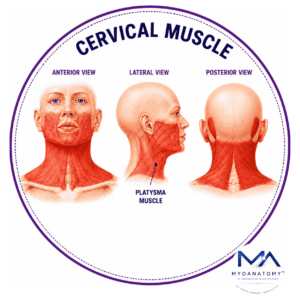
Cervical Muscle

MYO CORE

Platysma Muscle

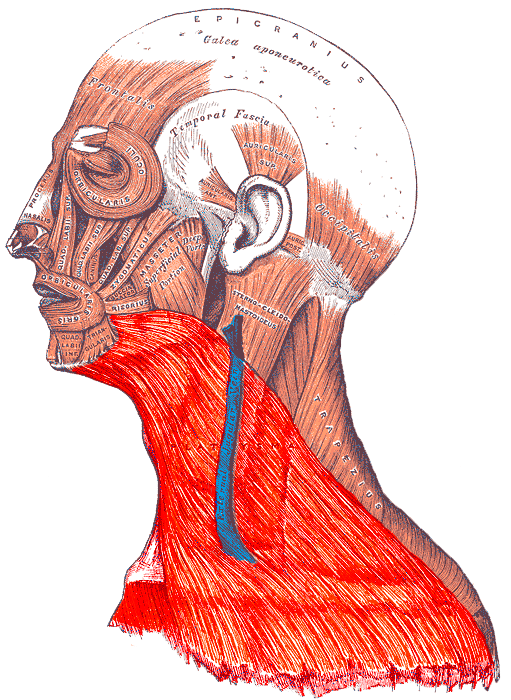
The platysma is a broad, thin, superficial muscle of facial expression that occupies the anterolateral region of the neck and extends superiorly into the lower face. It represents the most superficial muscle of the cervical region, lying immediately deep to the skin and superficial fascia and forming an important component of the superficial musculoaponeurotic system (SMAS).

OVERVIEW

Unlike most skeletal muscles, the platysma possesses extensive cutaneous attachments and inserts largely into the skin and soft tissues of the lower face rather than onto bone. Through these dermal insertions, the muscle directly influences facial expression, mandibular movement, and cervical skin tension.

Embryologically, the platysma develops from the mesenchyme of the second pharyngeal (hyoid) arch, placing it within the group of mimetic muscles innervated by the facial nerve (CN VII). Although anatomically situated within the neck, functionally it belongs to the musculature of facial expression.

The platysma forms a dynamic muscular sheet extending from the upper thoracic and shoulder regions to the mandible and lower face, linking cervical movement with facial expression. Through its broad attachments, it contributes to emotional expression, mandibular depression, and maintenance of cervical soft-tissue contour.

Functionally, the platysma acts primarily as a depressor of the lower face and mandible, while simultaneously tightening the skin of the neck. It becomes particularly active during expressions of tension, fear, sadness, discomfort, or emotional distress.

ANATOMY

Origin

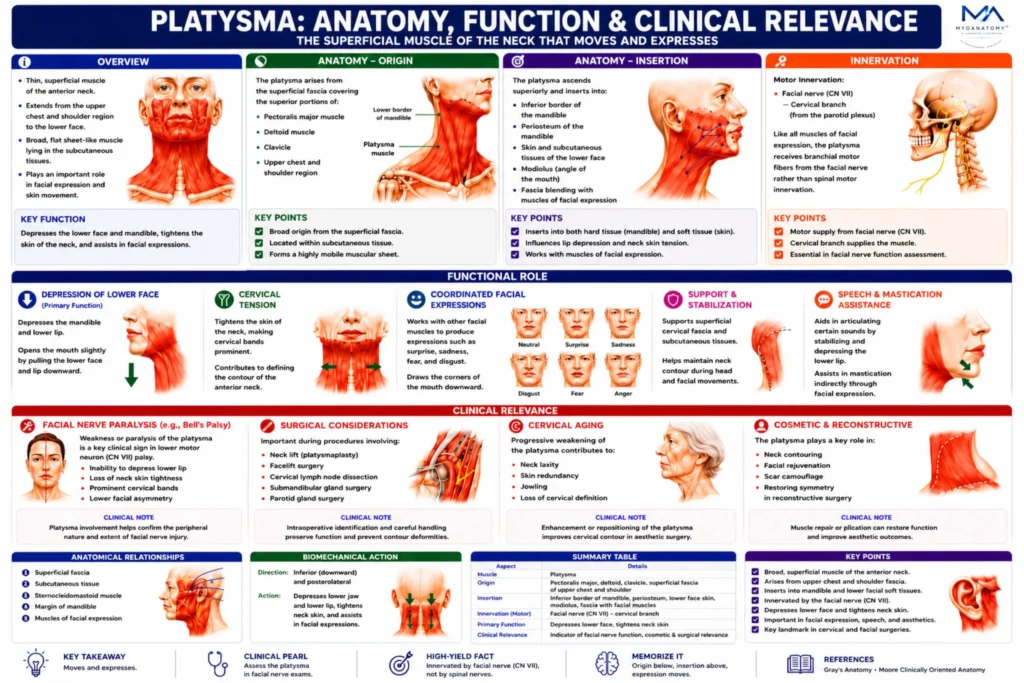
The platysma arises from the superficial fascia covering the superior portions of the:

pectoralis major muscle

deltoid muscle

These origins are located within the subcutaneous tissues of the upper thorax and shoulder region rather than on specific bony structures.

Because the muscle originates from fascia, it forms a highly mobile muscular sheet capable of transmitting tension across the neck and lower face

Exam Question

Describe the anatomical origin of the platysma and discuss how its fascial attachment contributes to its unique mobility and functional characteristics.

Insertion

Superiorly – the platysma ascends across the anterolateral neck and inserts into:

inferior border of the mandible

periosteum of the mandible

skin and subcutaneous tissues of the lower face

modiolus (angle of the mouth)

fascia blending with muscles of facial expression

Fibers commonly interdigitate with:

depressor anguli oris; depressor labii inferioris

mentalis; orbicularis oris

These attchments allow the platysma to influence both cervical and facial movements.


Exam Question

Describe the insertion of the platysma and explain how its cutaneous attachments enable both cervical and facial movements.

Innervation

The platysma receives motor innervation from the cervical branch of the facial nerve (CN VII)

The cervical branch emerges from the parotid plexus and courses inferiorly across the neck to supply the muscle.

Like all muscles of facial expression, the platysma receives branchial motor fibers derived from the facial nerve rather than spinal motor innervation.

Exam Question

Identify the motor innervation of the platysma and explain the clinical significance of its embryological relationship with the facial nerve (CN VII).

FUNCTIONAL ROLE

Mandibular Depression

The platysma functions as an accessory depressor of the mandible, assisting in opening the mouth by exerting an inferior pull on the lower jaw. Although its contribution is less powerful than that of the suprahyoid muscles and lateral pterygoid, it enhances mandibular mobility during speech, mastication, and facial expression. 

Through its broad superficial attachments, the muscle helps coordinate movements of the lower face with mandibular displacement, contributing to smooth oro-facial function.

Exam Question

Why is the platysma considered an accessory depressor of the mandible, and during which activities is this function most important?

Lip Depression

Through its superior insertion into the lower facial soft tissues, the platysma depresses the lower lip and draws the corners of the mouth downward. This action contributes to facial expressions associated with sadness, fear, tension, apprehension, and emotional distress. 

By influencing the position of the lower lip and oral commissures, the muscle plays an important role in non-verbal communication and the dynamic expression of human emotion.

Exam Question

Discuss the role of the platysma in lower lip depression and emotional facial expression.

Cervical Tension

The platysma tightens the skin of the anterior neck, producing visible cervical tension and maintaining smooth contour of the superficial cervical region. Contraction stretches the overlying skin and subcutaneous tissues, reducing skin redundancy and accentuating neck definition. 

This function becomes particularly evident during forceful facial expressions, mandibular depression, and states of emotional stress, when prominent cervical bands may become visible.

Exam Question

Why does contraction of the platysma produce visible cervical bands, and how does this contribute to neck contour?

Tissue Support

The platysma contributes to stabilization of the superficial cervical soft tissues by maintaining fascial tension and supporting normal soft-tissue positioning. 

Although not primarily a protective muscle, its broad muscular sheet helps preserve cervical contour during movement of the head and neck. Through continuous low-level tension, the muscle assists in maintaining structural organization of the superficial neck and lower facial tissues.

Exam Question

Discuss the contribution of the platysma to superficial cervical soft-tissue support and maintenance of cervical contour.

CLINICAL RELEVANCE

Nerve Paralysis

Injury to the cervical branch of the facial nerve may result in weakness or paralysis of the platysma. Clinical manifestations include loss of platysmal contraction, diminished cervical skin tension, lower facial asymmetry, and impaired depression of the lower lip. 

Assessment of platysma function is therefore an important component of neurological examination when evaluating facial nerve integrity and lower facial motor deficits.

Exam Question

Describe the clinical manifestations of injury to the cervical branch of the facial nerve and explain how platysma dysfunction may be identified during physical examination.

Cervical Aging

Degeneration of platysmal support mechanisms contributes significantly to age-related changes of the neck and jawline. Progressive weakening of the muscle, combined with loss of skin elasticity and fascial integrity, promotes neck laxity, blunting of the cervicomental angle, formation of platysmal bands, and loss of mandibular definition. 

Consequently, the platysma is regarded as one of the principal anatomical determinants of cervical aging and lower facial aesthetic appearance.

Exam Question

Why is the platysma regarded as a major anatomical determinant of cervical aging and jawline definition?

Cosmetic Surgery

The platysma is a key structure in aesthetic and reconstructive procedures involving the neck and lower face. 

Surgical modification of platysmal tension is frequently performed during facelift surgery, neck lift procedures, cervicofacial reconstruction, and facial rejuvenation operations. Precise management of the platysma is essential for restoring youthful cervical contours, improving mandibular definition, and achieving optimal aesthetic outcomes.

Exam Question

Describe the importance of the platysma in facial rejuvenation and neck-contouring procedures.

Surgical Landmark

The platysma serves as an important anatomical landmark during procedures involving the submandibular region, parotid gland, cervical lymphatics, and neck dissection surgery. I

dentification of the muscle assists surgeons in orienting within the superficial cervical layers and locating adjacent neurovascular structures. Preservation of the cervical branch of the facial nerve during surgical intervention is crucial to maintain platysma function and lower facial symmetry

Exam Question

Why is identification and preservation of the platysma important during surgery of the neck and lower face?

SUMMARY TABLE

Scroll to Top