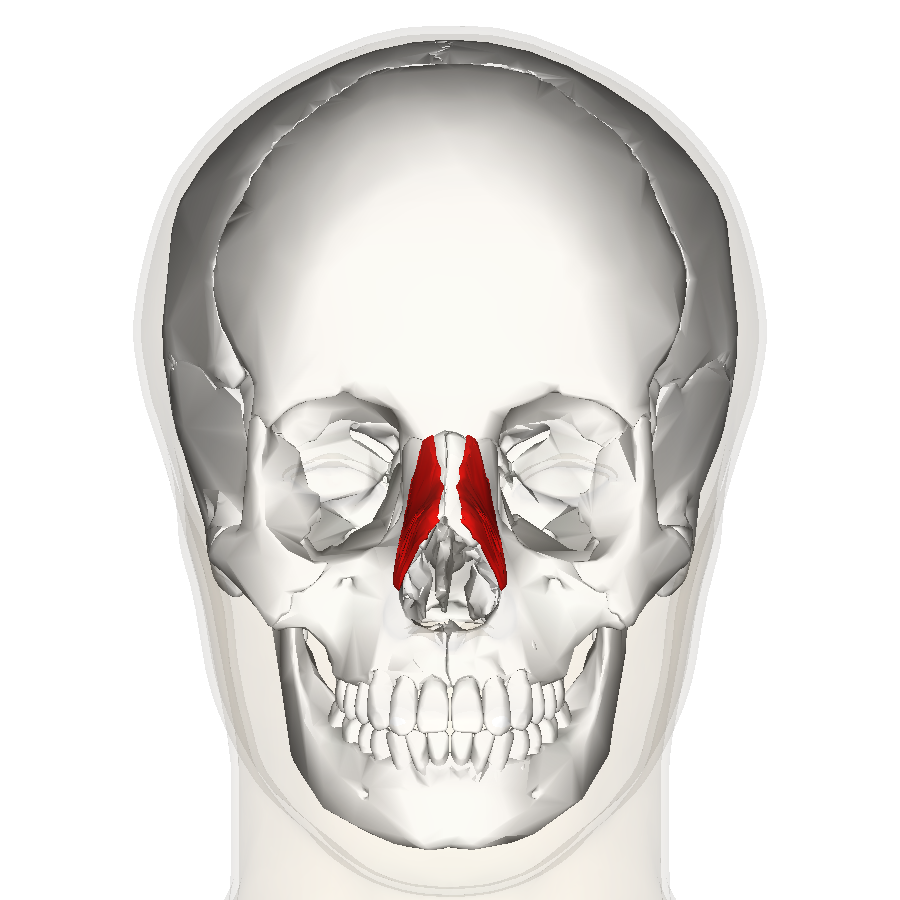
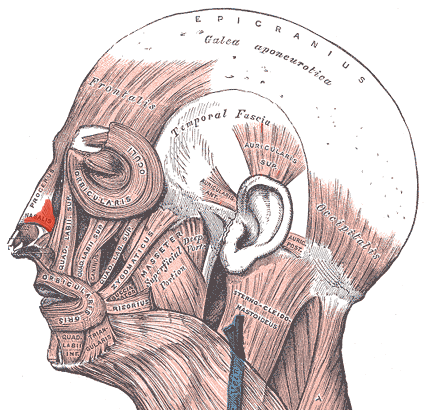
The nasalis is the principal muscle of the external nose, responsible for regulating the diameter of the nasal apertures. It is a thin but functionally important muscle of facial expression located over the dorsum and lateral surfaces of the nose, extending between the maxilla and the nasal cartilages.

Nasalis Muscle

CORE

Overview

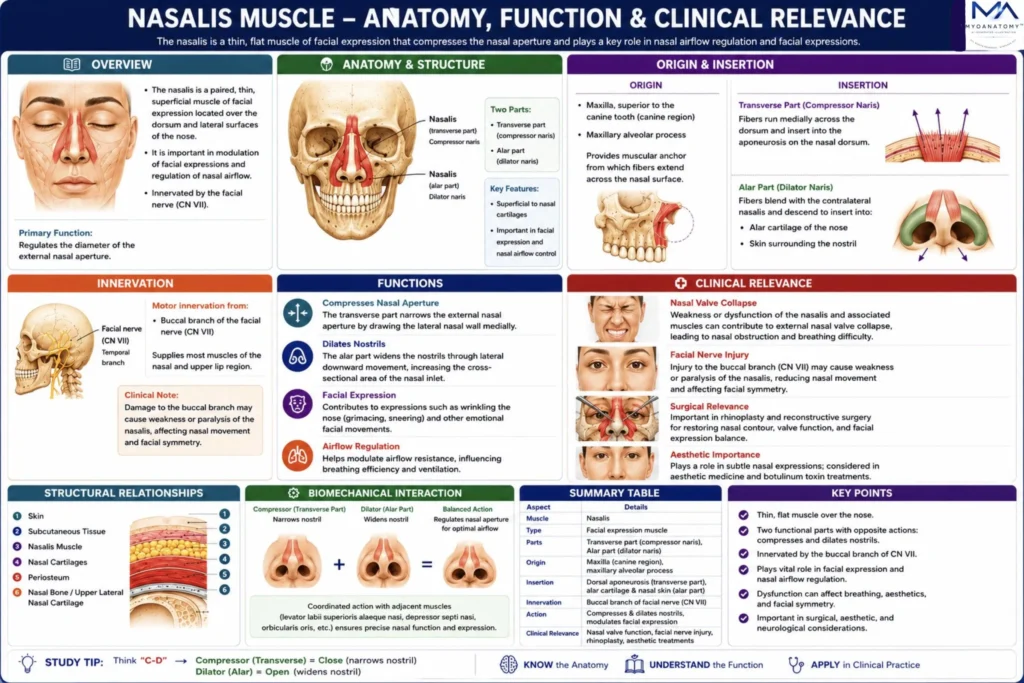
Anatomically, the nasalis consists of two distinct functional parts:

transverse part (compressor naris) – compresses the nasal aperture

alar part (dilator naris) – dilates the nostrils

These two components act antagonistically to regulate the size of the nostrils, thereby controlling the airflow entering the nasal cavity.

The nasalis lies superficial to the nasal cartilaginous framework, particularly the upper lateral and alar cartilages, and blends medially with fibers of the procerus and laterally with muscles of the upper lip.

Functionally, the nasalis contributes to nasal breathing, facial expression, and modulation of airflow through the nostrils, particularly during deep inspiration, emotional expression, and speech articulation.

ANATOMY

Origin

The nasalis originates primarily from

maxilla superior to the canine tooth (canine region)

maxillary alveolar process

These origins provide the muscular anchor from which fibers extend across the nasal surface.

Exam Question

Discuss the origin of the nasalis muscle, including its maxillary attachments and their importance in establishing the muscular framework of the external nose

Insertion

Insertion varies according to the 2 components of the muscle.

Transverse part (compressor naris)

fibers run medially across the dorsum of the nose and insert into:

aponeurosis on the nasal dorsum

fibers blending with the contralateral nasalis

Alar part (dilator naris)

fibers descend toward the nostril and insert into:

alar cartilage of the nose

skin surrounding the nostril

Exam Question

Describe the insertion of both the transverse (compressor naris) and alar (dilator naris) parts of the nasalis muscle, emphasizing their functional implications for nasal movement.

Innervation

The nasalis receives motor innervation from the:

Buccal branch of the facial nerve (CN VII)

This branch supplies most muscles of the nasal and upper lip region.


Exam Question

Discuss the motor innervation of the nasalis muscle, including its facial nerve supply and the functional consequences of denervation.

FUNCTIONAL ROLE

Nasal Compression

The transverse part of the nasalis compresses the external nasal aperture by drawing the lateral nasal wall medially, thereby narrowing the nostrils. 

This action contributes to selected facial expressions and assists modulation of airflow during forceful expiration

Exam Question

Explain the mechanism by which the transverse part of the nasalis muscle compresses the external nasal aperture and discuss its role in facial expression and expiratory airflow modulation

Nostril Dilation

The alar part of the nasalis widens the nostrils through lateral expansion of the nasal ala, increasing the cross-sectional area of the nasal inlet. 

This facilitates airflow and becomes particularly important during deep inspiration, physical exertion, and respiratory distress.


Exam Question

Describe the action of the alar part of the nasalis muscle in nostril dilation and explain its importance during increased respiratory demand

Airflow Control

By regulating nostril diameter, the nasalis influences nasal airflow resistance and ventilation efficiency. 

Dynamic adjustment of the external nasal aperture helps maintain optimal airflow through the nasal cavity under varying physiological demands.

Exam Question

Discuss the contribution of the nasalis muscle to regulation of nasal airflow resistance, ventilation efficiency, and maintenance of physiological nasal breathing.

Functional Integration

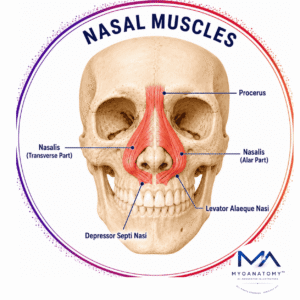
The nasalis functions within a coordinated perinasal muscular complex that includes the levator labii superioris alaeque nasi, depressor septi nasi, and orbicularis oris. 

Together these muscles regulate the morphology of the nasal vestibule and upper lip, enabling precise modulation of facial expression and respiratory airflow. 

Because the nasal valve is the narrowest segment of the upper airway, even minor muscular adjustments can produce significant effects on nasal airflow dynamics.


Exam Question

Evaluate the coordinated interactions between the nasalis, levator labii superioris alaeque nasi, depressor septi nasi, and orbicularis oris in regulating nasal morphology, facial expression, and respiratory airflow dynamics

CLINICAL RELEVANCE

Nasal Valve Collapse

Dysfunction or weakness of the nasalis and associated perinasal muscles may contribute to collapse of the external nasal valve, reducing airway patency. 

This can result in increased airflow resistance, impaired nasal breathing, and clinically significant nasal obstruction, particularly during inspiration.

Exam Question

Discuss the role of nasalis dysfunction in the development of nasal valve collapse and explain its effects on upper airway patency and nasal respiration.

Facial Nerve Paralysis

Paralysis of the nasalis secondary to facial nerve dysfunction may impair active control of the nasal aperture.

Clinical manifestations include reduced nostril movement, diminished nasal flare, and asymmetry of the nose during facial expression.

Exam Question

Describe the clinical manifestations of nasalis paralysis in facial nerve lesions and explain its effects on nostril mobility, nasal symmetry, and facial expression

Surgical Relevance

The nasalis is an important anatomical consideration during rhinoplasty and nasal reconstructive procedures. 

Preservation of its structural integrity helps maintain normal nostril contour, nasal symmetry, and physiological airflow dynamics, whereas inadvertent disruption may adversely affect both aesthetics and nasal function

Exam Question

Evaluate the anatomical and functional importance of the nasalis muscle during rhinoplasty and nasal reconstructive procedures, emphasizing preservation of both nasal form and respiratory function.

Functional Assessment

Evaluation of nasalis function forms part of the clinical examination of facial nerve integrity and nasal valve competence. 

Abnormal muscle activity may provide important diagnostic information regarding facial nerve lesions, neuromuscular dysfunction, or disorders affecting nasal airflow mechanics.

Exam Question

Discuss the significance of the nasalis muscle in facial nerve assessment, nasal valve competence, reconstructive surgery, and disorders affecting nasal airflow mechanics.

SUMMARY TABLE

Scroll to Top