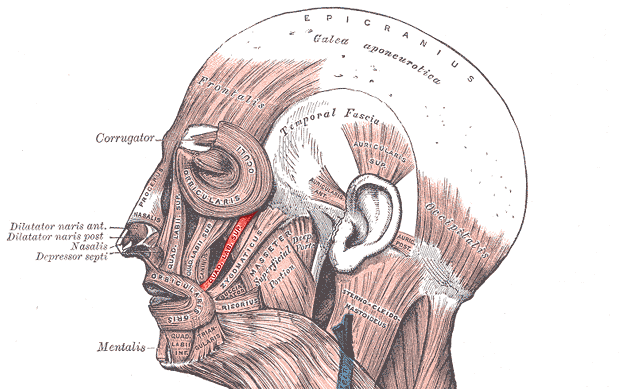
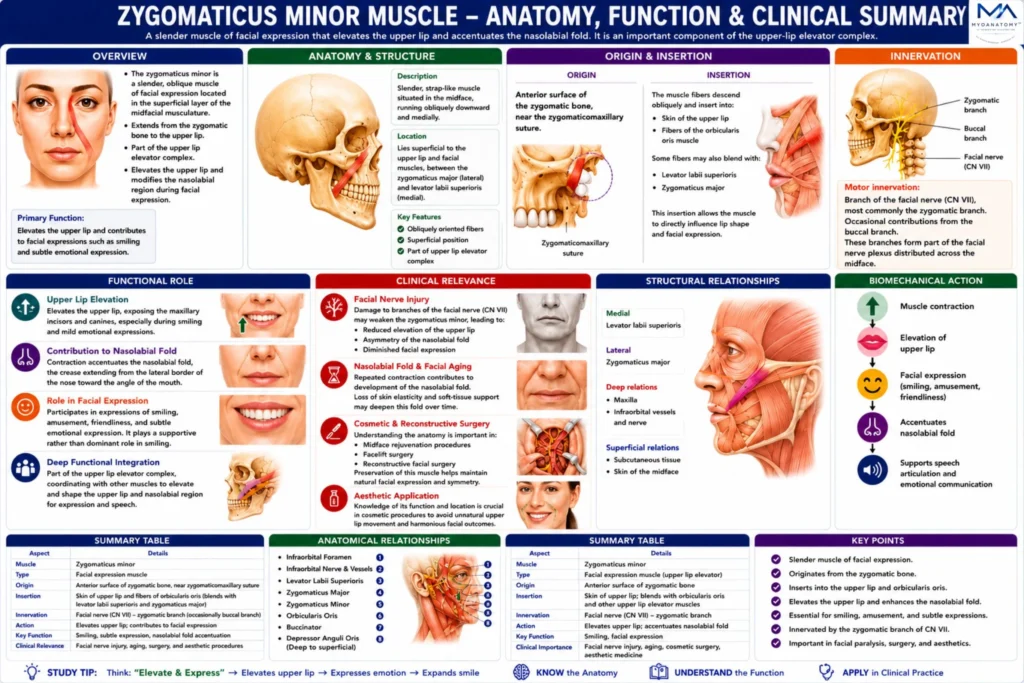
The zygomaticus minor is a slender, elongated muscle of facial expression located in the superficial layer of the midfacial musculature, extending from the zygomatic bone to the upper lip. It forms part of the upper lip elevator complex, a coordinated group of muscles responsible for raising the upper lip and modifying the shape of the nasolabial region during facial expression
Zygomaticus Minor Muscle
CORE
Overview
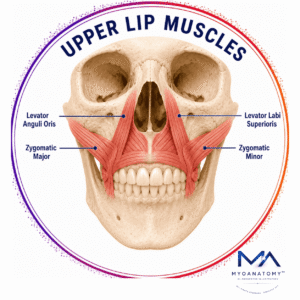
Anatomically, the zygomaticus minor lies medial to the zygomaticus major and lateral to the levator labii superioris, forming an intermediate component of the zygomatic–labial muscular system. Its fibers run obliquely downward and medially across the anterior surface of the maxilla toward the upper lip, where they blend with the orbicularis oris muscle and the dermis of the lip.
The zygomaticus minor is a slender muscle of facial expression that elevates the upper lip and contributes to the formation of the nasolabial fold. Positioned between the levator labii superioris and the zygomaticus major, it forms part of the upper lip elevator complex, coordinating facial movements involved in smiling and emotional expression.
Although smaller and less powerful than the zygomaticus major, the muscle plays an important supportive role in midfacial dynamics, and its function is essential for maintaining symmetry of facial expression and normal lip movement.
Clinically, it is relevant in facial nerve disorders, cosmetic surgery, and reconstructive procedures affecting the midface.
ANATOMY
Origin
The zygomaticus minor originates from the:
anterior surface of the zygomatic bone, near the zygomaticomaxillary suture
This origin lies superior and medial to the origin of the zygomaticus major, and just lateral to the origin of the levator labii superioris.
The bony attachment provides a stable anchor allowing the muscle to exert downward traction toward the lip.
Exam Question
Describe the origin of the zygomaticus minor from the anterior surface of the zygomatic bone. Explain how the orientation of its fibers and skeletal attachment determine the vector and biomechanical efficiency of upper-lip elevation
Insertion
The muscle fibers descend obliquely and insert into:
skin of the upper lip
fibers of the orbicularis oris muscle
Some fibers may also blend with:
levator labii superioris
zygomaticus major
The insertion into the dermis allows the muscle to directly influence lip shape and facial expression.
Exam Question
Discuss the insertion of the zygomaticus minor into the upper lip, dermis, and orbicularis oris complex. Explain how this pattern of insertion enables direct modification of lip contour, facial expression, and soft-tissue dynamics.
Innervation
Motor innervation is supplied by
branches of the facial nerve (CN VII), most commonly:
zygomatic branch of the facial nerve
Occasionally buccal branch contributions
These branches form part of the facial nerve plexus distributed across the midface.
Exam Question
Evaluate the motor innervation of the zygomaticus minor by branches of the facial nerve (CN VII). Discuss the anatomical basis of its neural control and the clinical consequences of interruption of these motor pathways.
FUNCTIONAL ROLE
Upper Lip Elevation
The primary function of the zygomaticus minor is elevation of the upper lip. Contraction raises the upper lip superiorly, exposing the maxillary incisors and contributing to facial expressions associated with smiling and positive emotional display.
Although less powerful than several adjacent upper-lip elevators, it plays an important role in refining upper-lip movement and enhancing midfacial expression.
Exam Question
Explain the biomechanical role of the zygomaticus minor in elevating the upper lip. Discuss how contraction alters upper-lip position, exposes the maxillary dentition, and contributes to dynamic movements of the oral aperture
Facial Expression
The zygomaticus minor contributes significantly to formation and accentuation of the nasolabial fold, the prominent crease extending from the lateral aspect of the nose toward the angle of the mouth.
During smiling, speech, and other expressions involving upper-lip elevation, contraction of the muscle increases the prominence of this anatomical landmark and participates in dynamic contouring of the midface
Exam Question
Discuss the role of the zygomaticus minor in the production of facial expressions associated with smiling, amusement, friendliness, and subtle emotional signaling. Explain why its contribution is considered supportive rather than dominant.
Expression Integration
Functionally, the zygomaticus minor participates in facial expressions associated with smiling, amusement, friendliness, and subtle emotional communication. Its action is generally supportive rather than dominant, assisting larger mimetic muscles in producing natural and coordinated facial movements.
Through its contribution to upper-lip elevation, the muscle helps generate nuanced emotional expressions and non-verbal social signaling.
Exam Question
Discuss the role of the zygomaticus minor in the production of facial expressions associated with smiling, amusement, friendliness, and subtle emotional signaling. Explain why its contribution is considered supportive rather than dominant.
Muscular Coordination
The zygomaticus minor forms part of the upper-lip elevator complex, acting in coordination with the levator labii superioris alaeque nasi, levator labii superioris, and zygomaticus major. Together, these muscles regulate elevation and shaping of the upper lip, nasolabial region, and oral aperture.
This integrated muscular network is essential for smiling, facial expression, speech articulation, and dynamic midfacial movement while maintaining harmonious facial symmetry and function.
Exam Question
Evaluate the functional integration of the zygomaticus minor with the levator labii superioris, levator labii superioris alaeque nasi, zygomaticus major, and orbicularis oris. Discuss how coordinated activation of these muscles produces harmonious facial expression and upper-lip movement.
CLINICAL RELEVANCE
Facial Paralysis
The zygomaticus minor receives motor innervation from branches of the facial nerve (CN VII). Injury to these branches may impair muscle function, resulting in reduced upper-lip elevation, flattening of the nasolabial fold, facial asymmetry, and diminished emotional expression.
Such findings are commonly observed in facial nerve palsy and contribute to functional and aesthetic deficits of the midface.
Exam Question
Critically discuss the effects of facial nerve paralysis on zygomaticus minor function. Explain how muscle weakness may alter upper-lip elevation, nasolabial fold prominence, facial symmetry, and emotional expressiveness.
Facial Aging
Repeated activity of the zygomaticus minor contributes to dynamic formation of the nasolabial fold throughout life.
With advancing age, progressive loss of skin elasticity, subcutaneous volume, and connective tissue support transforms this dynamic fold into a permanent anatomical feature, making it one of the most recognizable manifestations of midfacial aging.
Exam Question
Explain the role of the zygomaticus minor in age-related changes of the midface. Discuss how repetitive muscular activity, loss of dermal elasticity, and soft-tissue descent contribute to progressive deepening of the nasolabial fold.
Surgical Relevance
Detailed knowledge of zygomaticus minor anatomy is essential during facial, maxillofacial, and reconstructive procedures.
Because the muscle contributes to upper-lip elevation and facial expression, preservation of its integrity helps maintain facial symmetry, functional movement, and natural postoperative appearance
Exam Question
Evaluate the surgical importance of the zygomaticus minor during facial, maxillofacial, and reconstructive procedures. Discuss how preservation of the muscle contributes to postoperative facial symmetry, function, and aesthetic outcome
Aesthetic Applicaton
The zygomaticus minor is an important consideration in midface rejuvenation, facelift surgery, and cosmetic facial procedures.
Understanding its anatomical relationships and functional role allows clinicians to preserve natural facial dynamics, optimize aesthetic outcomes, and maintain harmonious movement of the upper lip and nasolabial region following intervention.
Exam Question
Critically discuss the relevance of the zygomaticus minor in aesthetic medicine. Explain how knowledge of its anatomy assists in facial rejuvenation procedures, facelift surgery, filler placement, and preservation of natural facial dynamics.
SUMMARY TABLE