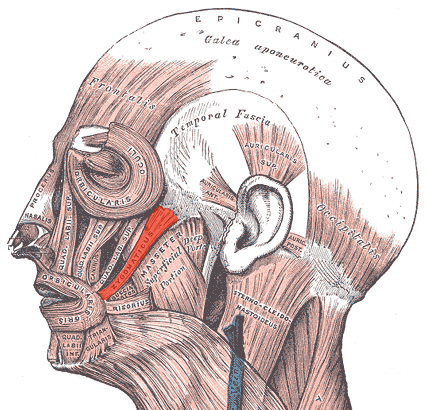
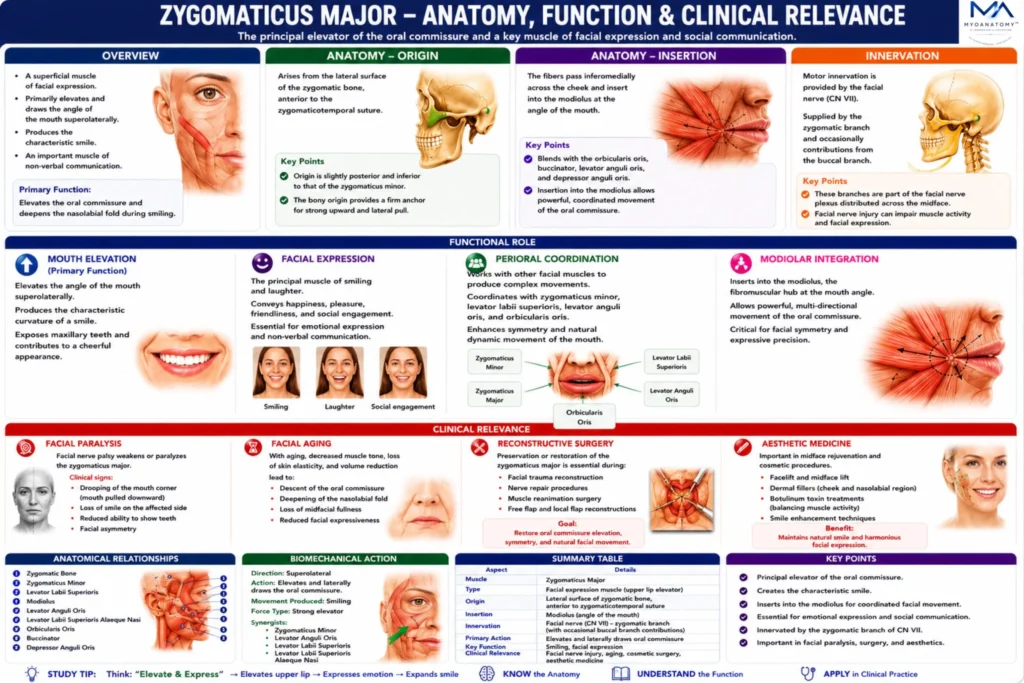
The zygomaticus major is a prominent muscle of facial expression located in the lateral midface, extending from the zygomatic bone to the angle of the mouth. It is one of the principal muscles responsible for elevation of the corner of the mouth, making it a key muscle involved in smiling and emotional facial expression

Zygomaticus Major Muscle

CORE

Overview

Anatomically, the muscle runs obliquely downward and medially across the cheek. It lies superficial to the masseter muscle and lateral to the zygomaticus minor. Its fibers converge at the modiolus, a fibromuscular node located at the angle of the mouth where several facial muscles interlace.

Receives motor innervation from the facial nerve (cranial nerve VII).

Functionally, it acts as the primary elevator of the angle of the mouth, playing a central role in expressions of happiness and laughter.
ANATOMY

Origin

The zygomaticus major arises from:

lateral surface of the zygomatic bone, near the zygomaticotemporal suture

The muscle originates slightly posterior and inferior to the origin of the zygomaticus minor.

Exam Question

Describe the origin of the zygomaticus major from the zygomatic bone. How does its osseous attachment determine the direction and force of commissural movement during smiling?

Insertion

The fibers pass inferomedially and insert into:

skin and muscle at the angle of the mouth

modiolus

At this location, the fibers blend with several muscles including:

orbicularis oris

buccinator

levator anguli oris

depressor anguli oris.

Exam Question

The zygomaticus major inserts into the modiolus rather than directly into bone. Explain the anatomical and biomechanical importance of this insertion and its influence on complex facial expressions

Innervation

Motor innervation is supplied by the:

zygomatic branch of the facial nerve (CN VII)

buccal branch of the facial nerve

These branches form part of the facial nerve plexus supplying the midface muscles.

Exam Question

Discuss the motor innervation of the zygomaticus major. Which branches of the facial nerve supply the muscle, and what clinical manifestations occur following injury to these branches?

FUNCTIONAL ROLE

Mouth Elevation

The primary function of the zygomaticus major is superolateral elevation of the oral commissure. 

By drawing the angle of the mouth upward and laterally, it produces the characteristic curvature of the smile, exposes the maxillary teeth, and serves as the dominant muscular force underlying positive facial expression.

Exam Question

Explain how contraction of the zygomaticus major elevates the oral commissure. Why is this action fundamental to the formation of a normal smile?

Facial Expression

The zygomaticus major is the principal muscle of smiling and laughter. 

Its activity conveys happiness, pleasure, friendliness, and social engagement, making it one of the most important muscles involved in emotional communication and non-verbal facial signaling.


Exam Question

Analyze the role of the zygomaticus major in emotional communication. Why is the muscle considered one of the most important anatomical substrates of positive affective expression?

Perioral Coordination

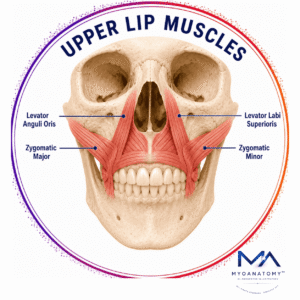
Functionally, the zygomaticus major operates in concert with the levator labii superioris, levator anguli oris, zygomaticus minor, and orbicularis oris.

This coordinated muscular activity precisely regulates upper-lip position, oral aperture shape, and commissural movement, allowing smooth and natural facial expressions.

Exam Question

Describe how the zygomaticus major coordinates with the levator labii superioris, levator anguli oris, zygomaticus minor, and orbicularis oris to produce balanced facial movement.

Modular Integration

The zygomaticus major is a major component of the modiolus, the fibromuscular convergence point at the corner of the mouth. Through its integration with surrounding perioral muscles, it helps balance the forces controlling mouth position, facial symmetry, oral competence, and the fine modulation of complex facial expressions.


Exam Question

The zygomaticus major is a major component of the modiolus. Discuss how this relationship contributes to facial symmetry, oral competence, speech articulation, and complex facial expressions.

CLINICAL RELEVANCE

Facial Paralysis

Injury to the facial nerve (CN VII), particularly its zygomatic or buccal branches, may impair zygomaticus major function. Loss of muscle activity reduces elevation of the oral commissure, producing an asymmetric smile, diminished emotional expression, and impaired facial symmetry. 

Because the zygomaticus major is a primary muscle of smiling, its dysfunction is often a prominent feature of facial nerve palsy.

Exam Question

How does facial nerve paralysis affect the function of the zygomaticus major? Discuss the resulting changes in smile symmetry, commissural elevation, and emotional facial expression.

Facial Aging

Age-related loss of skin elasticity, soft-tissue support, and facial fat volume alters the mechanical efficiency of the zygomaticus major. 

These changes contribute to descent of the oral commissure, flattening of the midface, and deepening of perioral folds, producing characteristic features of facial aging and reduced facial expressiveness

Exam Question

Explain how aging-related changes in skin elasticity, facial fat distribution, and soft-tissue support alter the functional effectiveness of the zygomaticus major and contribute to facial aging.

Reconstructive Surgery

Preservation of the zygomaticus major is essential during facial, maxillofacial, and reconstructive procedures. Damage to the muscle or its neurovascular supply may compromise smile dynamics and oral commissure control.

Restoration of normal zygomaticus major function is therefore a key objective in facial reanimation and reconstructive surgery.

Exam Question

Why is preservation of the zygomaticus major critical during maxillofacial and facial reconstructive procedures? Discuss its importance in facial reanimation and restoration of normal smile mechanics.

Aesthetic Medicine

The zygomaticus major represents an important anatomical landmark in facial rejuvenation procedures, including facelift surgery, filler placement, and neuromodulator treatments.

Detailed understanding of its anatomy helps maintain natural smile mechanics, preserve facial harmony, and avoid distortion of normal facial expression following cosmetic intervention.

Exam Question

Evaluate the significance of the zygomaticus major in aesthetic medicine. How can detailed anatomical understanding of the muscle improve outcomes during facial rejuvenation and cosmetic procedures?

SUMMARY TABLE

Scroll to Top