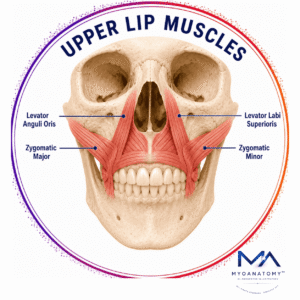
Upper Lip Muscle
MYO CORE
Levator Anguli Oris Muscle
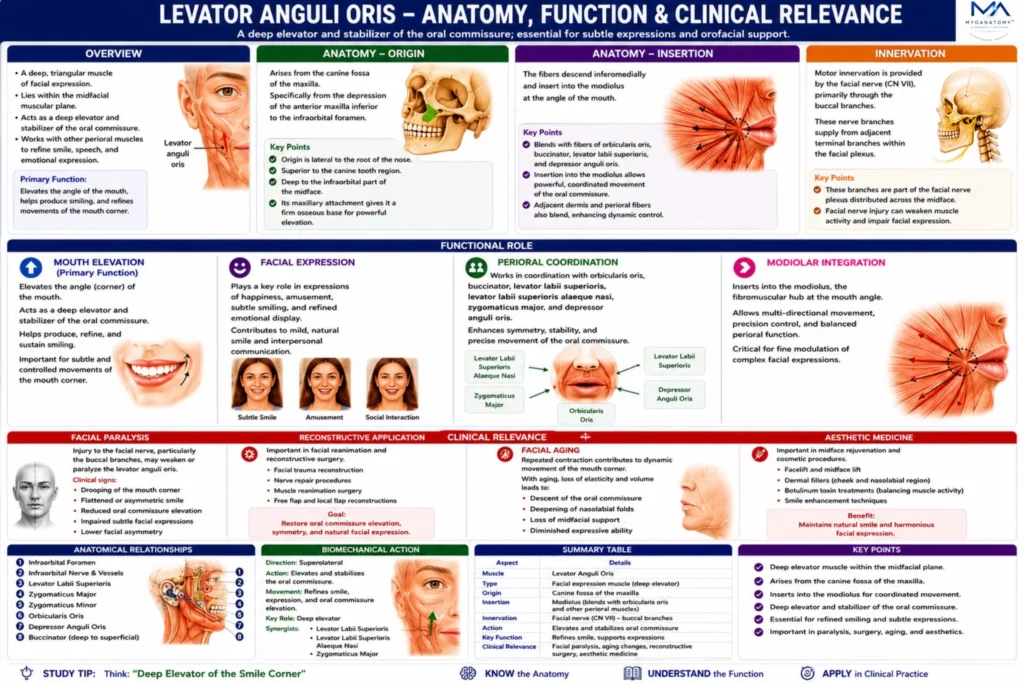
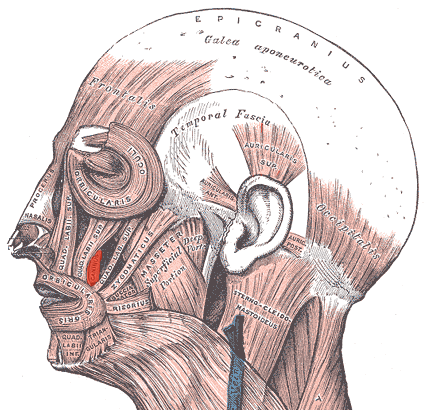
The levator anguli oris is a deep, triangular muscle of facial expression situated in the canine fossa of the maxilla, extending from the anterior maxilla to the modiolus at the angle of the mouth. Although smaller and less visually obvious than the zygomaticus major, it is anatomically very important because it acts as a deep elevator and stabilizer of the oral commissure.
OVERVIEW
It lies within the midfacial muscular plane, deep to the levator labii superioris and partly deep to the zygomatic muscles, and superficial to the maxillary bone. Because of this position, it forms part of the deep elevator system of the upper lip and mouth angle, supporting the more superficial smiling muscles.
The levator anguli oris is a deep triangular muscle of facial expression arising from the canine fossa of the maxilla and inserting into the modiolus at the angle of the mouth.
It acts as a deep elevator and stabilizer of the oral commissure, helping produce smiling and refined movements of the mouth corner.
Its true importance lies not only in elevating the mouth angle, but in its role as a deep structural component of the modiolus and upper perioral elevator system. Through this position, it coordinates with the zygomatic and levator labii muscles to maintain oral symmetry, expressive control, and functional integrity of the mouth angle.
Clinically, it is important in facial nerve palsy, maxillofacial surgery, smile reconstruction, and aesthetic facial anatomy, where even subtle dysfunction may significantly alter facial expression
ANATOMY
Origin
The levator anguli oris arises from the:
canine fossa of the maxilla
specifically from the depression of the anterior maxilla inferior to the infraorbital foramen
This origin places it:
lateral to the root of the nose
superior to the canine tooth region
deep to the infraorbital part of the midface
Its maxillary attachment gives it a fixed osseous base from which it can elevate the soft tissues of the mouth angle.
Exam Question
Describe the origin of the levator anguli oris. How does its attachment within the canine fossa of the maxilla influence its biomechanical action on the mouth angle?
Insertion
The fibers descend inferolaterally and insert into:
modiolus at the angle of the mouth
blending fibers of orbicularis oris
adjacent dermis and perioral muscular fibers at the oral commissure
Because the insertion is partly into the modiolus rather than into bone, the muscle acts as a dynamic modulator of mouth-corner position rather than a simple linear mover.
Exam Question
The levator anguli oris inserts primarily into the modiolus rather than directly into bone. Explain the functional significance of this insertion and its effect on dynamic facial movements.
Anatomical Relation
The levator anguli oris is especially important anatomically because of its deep location.
Superficial Relation
levator labii superioris
superficial fascia of the midface
overlying skin of the nasolabial region
Deep Relation
canine fossa of the maxilla
anterior surface of the maxilla
Medial Relation
levator labii superioris alaeque nasil
levator labii superioris
Lateral Relation
zygomaticus minor
zygomaticus major
Superior Relation
infraorbital foramen
Infraorbital nerve and vessels
Inferior Relation
modiolus
orbicularis oris
buccinator
These relations are highly relevant in maxillofacial surgery, local anesthesia, midface trauma, and reconstructive procedures.
Exam Question
Discuss the anatomical relationships of the levator anguli oris with surrounding muscles, neurovascular structures, and facial soft tissues. Why are these relationships clinically important during maxillofacial surgery?
Innervation
Motor innervation is provided by the
facial nerve (CN VII), primarily through:
buccal branches of the facial nerve
In some individuals, there may be overlapping supply from adjacent terminal facial branches within the facial plexus of the midface, which is common in mimetic musculature
Exam Question
Describe the motor innervation of the levator anguli oris. Which branches of the facial nerve supply the muscle, and what functional deficits may occur following injury to these branches?
FUNCTIONAL ROLE
Commissural Elevation
The primary function of the levator anguli oris is elevation of the oral commissure. Contraction draws the angle of the mouth superiorly, contributing to the upward displacement characteristic of smiling and positive facial expression.
Unlike the zygomaticus major, which produces a pronounced superolateral pull, the levator anguli oris generates a more direct vertical elevation, making it particularly important in subtle and controlled movements of the mouth corner.
Exam Question
How does contraction of the levator anguli oris contribute to elevation of the oral commissure, and how does its action differ from that of the zygomaticus major?
Commissural Support
Beyond active elevation, the levator anguli oris provides structural support to the junction between the upper lip and oral commissure.
Through its deep anatomical position, it helps maintain the contour, tension, and stability of the mouth angle while contributing to the dynamic shaping of the nasolabial region during facial expression.
Exam Question
Beyond active movement, how does the levator anguli oris contribute to structural support, stability, and contour maintenance of the oral commissure and nasolabial region?
Expression Control
The levator anguli oris plays an important role in facial expressions associated with smiling, pleasure, mild amusement, and restrained social interaction.
By producing a controlled superior displacement of the commissure, it contributes to refined emotional expression and allows subtle modulation of facial appearance during interpersonal communication.
Exam Question
Explain the role of the levator anguli oris in fine modulation of facial expression. Why is it particularly important for subtle emotional communication rather than exaggerated facial movements?
Modular Integration
The levator anguli oris is a key component of the modiolus, the fibromuscular convergence point at the corner of the mouth where multiple facial muscles interlace.
Through this integration, it coordinates with the orbicularis oris, buccinator, zygomaticus major, depressor anguli oris, and risorius to regulate commissural position, maintain oral symmetry, support speech articulation, preserve lip competence, and ensure balanced perioral movement during complex facial expressions
Exam Question
Analyze the role of the levator anguli oris within the modiolus. How does interaction with neighboring perioral muscles facilitate coordinated facial expression, speech, and oral competence?
CLINICAL RELEVANCE
Facial Paralysis
Injury to the facial nerve, particularly its buccal branches, may impair the function of the levator anguli oris and reduce its ability to elevate the oral commissure. Clinically, this may present as drooping of the mouth corner, flattening of the nasolabial fold, diminished smile symmetry, and impaired facial expression.
Because the muscle contributes significantly to commissural elevation, its dysfunction is an important component of the lower facial asymmetry observed in facial nerve palsy.
Exam Question
How does facial nerve paralysis affect the function of the levator anguli oris, and what characteristic clinical signs would be expected in the lower midface?
Surgical Relevance
The levator anguli oris originates within the canine fossa of the maxilla, placing it in close proximity to the infraorbital region.
Consequently, it is an important anatomical structure during midfacial trauma management, maxillary surgery, infraorbital approaches, and reconstructive procedures. Detailed knowledge of its anatomy helps preserve normal facial movement while avoiding injury to adjacent neurovascular structures.
Exam Question
Why is detailed anatomical knowledge of the levator anguli oris essential during infraorbital, maxillary, and reconstructive facial procedures? Discuss potential surgical risks.
Reconstructive Application
The levator anguli oris is of particular importance in facial reanimation, smile reconstruction, and aesthetic facial surgery. Restoration of a natural smile requires preservation or reconstruction of the muscle’s commissural elevating function and its contribution to modiolar stability.
In cosmetic procedures, maintaining the integrity of the muscle helps preserve balanced facial expression and prevents an unnatural or overcorrected appearance.
Exam Question
Evaluate the importance of the levator anguli oris in facial reanimation and smile reconstruction procedures. How does preservation of the muscle influence postoperative outcomes?
Facial Aging
Although not the sole determinant of the nasolabial fold, repeated contraction of the levator anguli oris contributes to dynamic movement of the midface and oral commissure.
With advancing age, progressive soft-tissue descent, loss of elasticity, and long-term muscular activity accentuate the nasolabial crease, making it a prominent feature of facial aging and altered facial contour.
Exam Question
Discuss the contribution of the levator anguli oris to age-related changes of the midface and oral commissure. How do soft-tissue descent and long-term muscle activity alter facial appearance?
SUMMARY TABLE