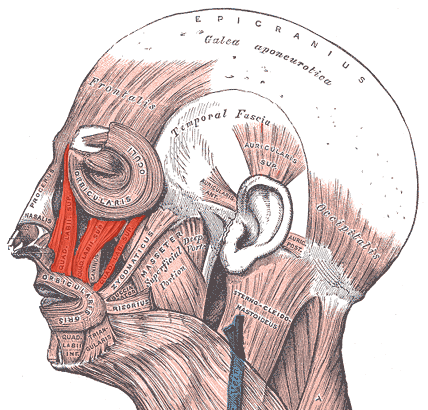
The levator labii superioris is a thin quadrangular muscle of facial expression located in the midface, extending from the infraorbital margin of the maxilla to the upper lip. It lies lateral to the levator labii superioris alaeque nasi and medial to the zygomaticus minor, forming part of the muscular complex responsible for elevation of the upper lip.

Levator Labii Superioris Muscle

CORE

Overview

Anatomically, this muscle occupies the region between the orbital margin and the upper lip, running vertically downward over the anterior surface of the maxilla. It contributes significantly to the formation and modulation of the nasolabial fold, the prominent crease extending from the lateral side of the nose to the corner of the mouth.

The levator labii superioris is a key muscle of the midfacial expression complex, responsible for elevating the upper lip and shaping the nasolabial fold. Working in concert with adjacent muscles of the upper lip elevator system, it contributes to facial expressions involving smiling, sneering, and emotional signaling, while also playing a role in speech articulation and midface dynamics.

Clinically, the muscle is significant in facial nerve pathology, cosmetic facial procedures, and midface reconstructive surgery, reflecting its important role in both functional and aesthetic facial anatomy

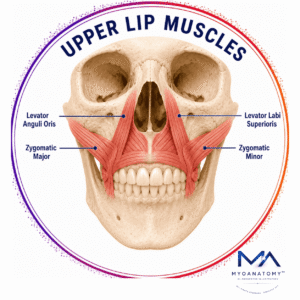
This muscle acts in coordination with other muscles of the upper lip elevator system, including:

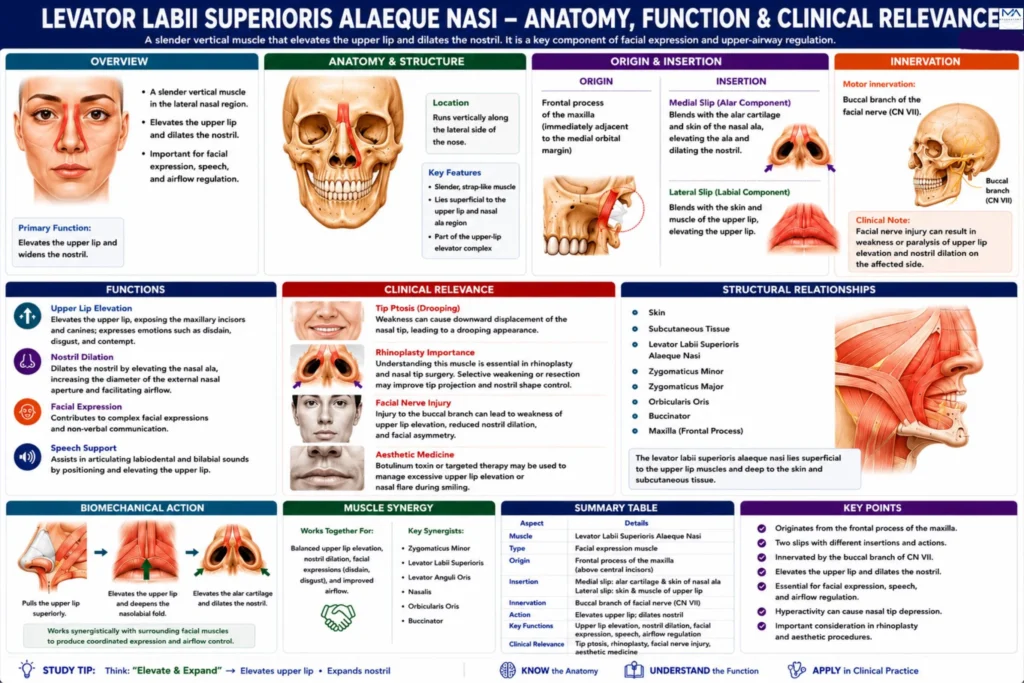
levator labii superioris alaeque nasi

zygomaticus minor

zygomaticus major

Together these muscles form a dynamic muscular network controlling movements of the upper lip and nasolabial region.

ANATOMY

Origin

The levator labii superioris originates from:

infraorbital margin of the maxilla

maxilla superior to the infraorbital foramen

This origin lies just inferior to the orbit, making the muscle an important component of the infraorbital muscular layer of the face.

Exam Question

How does the origin of the levator labii superioris influence its function, biomechanics, and clinical importance in midfacial anatomy?

Insertion

Muscle fibers descend inferiorly and insert into:

skin and muscle of the upper lip

fibers blending with orbicularis oris

Through these insertions, the muscle can elevate and shape the upper lip during facial expression.

Exam Question

How does the insertion of the levator labii superioris into the upper lip facilitate facial expression, speech, and oral function?

Innervation

Motor innervation is supplied by the:

buccal branch of the facial nerve (CN VII)

occasionally contributions from the zygomatic branch

These nerve branches form part of the facial nerve plexus supplying the muscles of the midface.

Exam Question

How does facial nerve innervation support the function of the levator labii superioris, and what changes occur following nerve damage?

FUNCTIONAL ROLE

Upper Lip Elevation

The principal action of the levator labii superioris is elevation and slight retraction of the upper lip. Contraction draws the upper lip superiorly, exposing the maxillary incisors and canine teeth while increasing the vertical dimension of the oral aperture. 

This movement is fundamental to numerous voluntary and involuntary facial actions and represents the muscle’s primary functional role within the perioral region

Exam Question

Explain how the levator labii superioris elevates the upper lip and why this action is important for facial expression and oral function.

Facial Expression

The levator labii superioris is an important muscle of facial expression, contributing to a variety of emotional displays including smiling, sneering, contempt, disgust, and grimacing.

By elevating the upper lip, it modifies the appearance of the mouth and midface, facilitating non-verbal communication of emotional states. Its activity is coordinated with other mimetic muscles to generate complex and highly nuanced facial expressions.


Exam Question

How does the levator labii superioris contribute to facial expression and interact with other muscles to produce emotional displays?

Nasolabial Modulation

Contraction of the levator labii superioris accentuates the nasolabial fold, the prominent cutaneous groove extending from the lateral aspect of the nose toward the angle of the mouth. 

Through elevation of the upper lip and adjacent soft tissues, the muscle enhances definition of this anatomical landmark and contributes significantly to dynamic facial contouring. Consequently, it plays an important role in shaping midfacial aesthetics during facial expression.

Exam Question

Discuss the role of the levator labii superioris in shaping and modulating the nasolabial fold during facial movement.

Speech Articulation

The levator labii superioris contributes to speech production by regulating upper-lip position and controlling the shape of the oral aperture. 

Through coordinated interaction with adjacent perioral musculature, it assists in the articulation of labial and labiodental phonemes while maintaining precise lip movements required for fluent speech. This functional role supports effective verbal communication and accurate pronunciation.


Exam Question

How does the levator labii superioris contribute to speech production and precise upper-lip movements during articulation?

CLINICAL RELEVANCE

Nasolabial Aging

Repeated activity of the levator labii superioris contributes to dynamic formation of the nasolabial fold during facial expression. With advancing age, progressive loss of skin elasticity, subcutaneous volume, and connective tissue support transforms this dynamic fold into a permanent anatomical feature. 

As a result, deepening of the nasolabial fold becomes a characteristic manifestation of facial aging and midfacial soft-tissue descent.

Exam Question

Explain how levator labii superioris activity contributes to age-related deepening of the nasolabial fold and midfacial aging.

Facial Paralysis

The levator labii superioris receives motor innervation from branches of the facial nerve (CN VII). Injury to the buccal division may impair muscular function, resulting in reduced upper-lip elevation and diminished exposure of the maxillary dentition. 

Clinically, affected individuals may demonstrate upper-lip drooping, facial asymmetry, and weakened expressive movements during smiling or emotional communication

Exam Question

What functional and aesthetic changes occur when the levator labii superioris is affected by facial nerve injury?

Surgical Relevance

Because the muscle originates adjacent to the infraorbital region, surgical procedures involving the midface require careful preservation of nearby neurovascular structures, particularly the infraorbital nerve. Injury to this nerve may produce sensory disturbances of the lower eyelid, lateral nose, upper lip, and cheek. 

Detailed knowledge of levator labii superioris anatomy is therefore essential during facial trauma reconstruction, maxillofacial surgery, and midfacial operative approaches.

Exam Question

Why is preservation of the levator labii superioris important during maxillofacial and reconstructive surgical procedures?

Aesthetic Application

The levator labii superioris is an important consideration in facial rejuvenation and cosmetic medicine. Its anatomical relationship to the upper lip and nasolabial region makes it relevant during nasolabial fold correction, facial lifting procedures, and selected neuromodulator treatments. 

Accurate understanding of its structure and function helps preserve natural upper-lip mobility, facial symmetry, and expressive dynamics while optimizing aesthetic outcomes following reconstructive or cosmetic interventions.

Exam Question

How does the anatomy and function of the levator labii superioris influence facial aesthetic procedures and rejuvenation strategies?

SUMMARY TABLE

Scroll to Top