Inferior Nasal Conchae

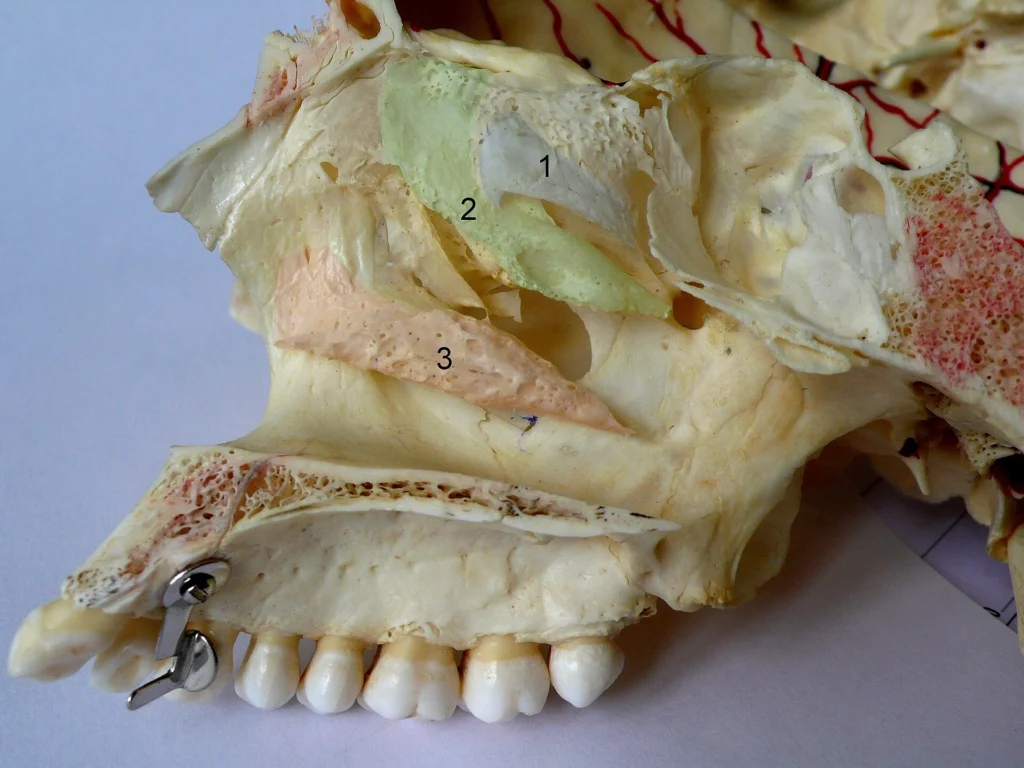
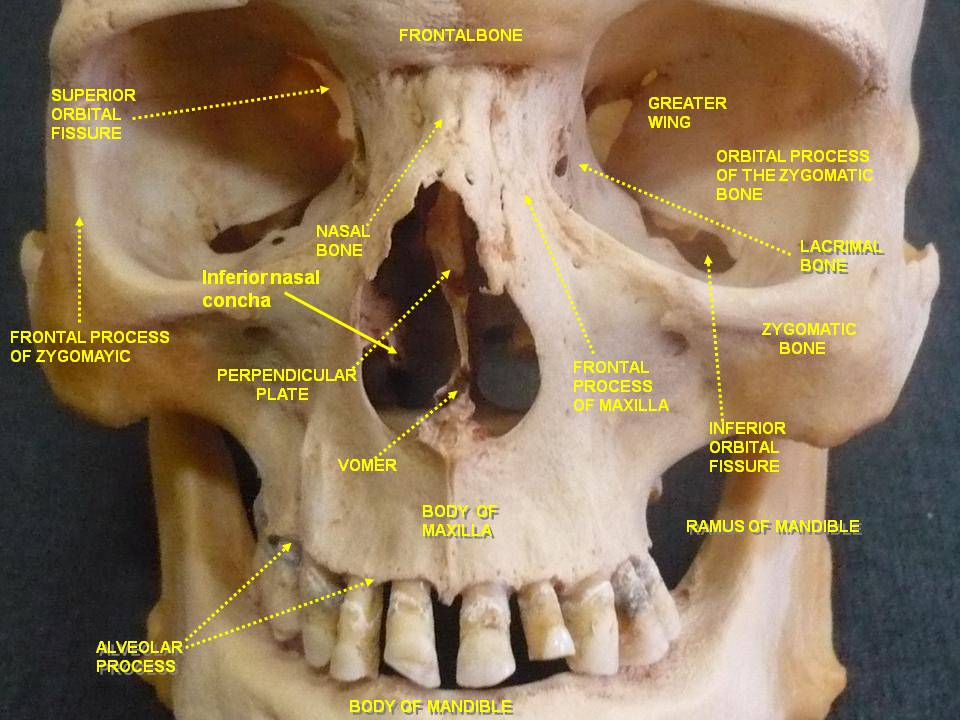
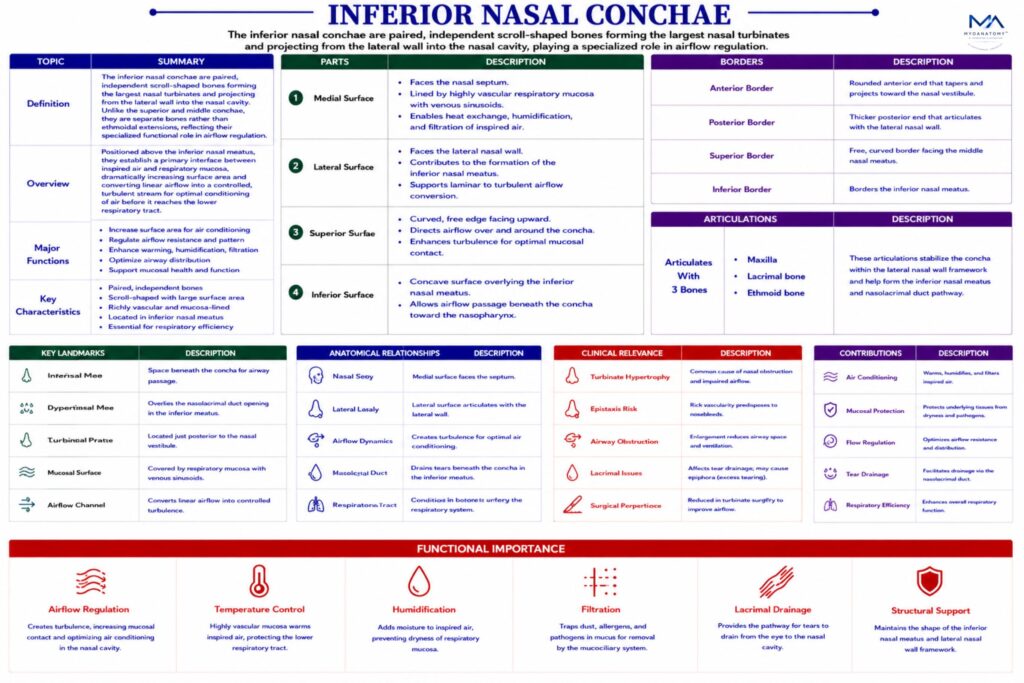
The inferior nasal conchae are paired, independent scroll-shaped bones forming the largest nasal turbinates and projecting from the lateral wall into the nasal cavity. Unlike the superior and middle conchae, they are separate bones rather than ethmoidal extensions, reflecting their specialized functional role in airflow regulation.

CORE

Overview

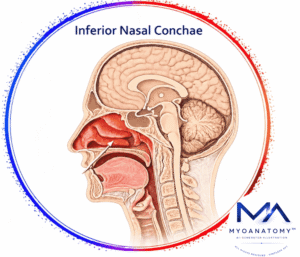
Positioned above the inferior nasal meatus, they establish a primary interface between inspired air and respiratory mucosa, dramatically increasing surface area. 

This geometry converts linear airflow into a controlled, turbulent stream, enhancing heat exchange, humidification, and particulate filtration, thereby optimizing the conditioning of inspired air before it reaches the lower respiratory tract.

ANATOMY

Surfaces

The inferior nasal concha presents 2 functionally distinct surfaces, each adapted to its role in airflow and anatomical integration.

Medial Surface – convex and projecting into the nasal cavity, covered by highly vascular respiratory epithelium. It induces controlled turbulence, increasing air–mucosa contact time, which enhances warming, humidification, and filtration. Vascular sinusoids within this mucosa enable rapid volume changes, directly regulating airflow resistance.

Lateral Surface – concave and facing the lateral nasal wall, contributing to the formation of the inferior nasal meatus. This surface establishes the anatomical pathway for nasolacrimal duct drainage, linking the orbit to the nasal cavity, and participates in the structural framework of the osteomeatal region.

Exam Question

Explain how the structural differences between the medial and lateral surfaces of the inferior nasal concha optimize nasal airflow dynamics, and analyze their role in regulating resistance, turbulence, and mucosal conditioning.

Borders

The inferior nasal concha has 2  principal borders, defining its articulations and free functional edge.

Superior Border – irregular and attached, articulating with the maxilla, palatine, lacrimal, and ethmoid bones. It gives rise to the lacrimal, maxillary, and ethmoidal processes, forming part of the nasolacrimal canal and osteomeatal complex, thereby stabilizing the concha within the lateral nasal wall.

Inferior Border – thick and free, forming the lower limit of the concha within the nasal cavity. It directs airflow along the inferior meatus and maximizes mucosal exposure, contributing to efficient air conditioning and flow distribution.

Exam Question

Critically evaluate how the superior and inferior borders of the inferior nasal concha contribute to both structural stabilization within the lateral nasal wall and functional modulation of airflow through the inferior meatus.

Process

Three processes arise from the superior border, each with distinct anatomical and functional roles.

Lacrimal Process extends anteriorly to articulate with the lacrimal bone, completing the nasolacrimal canal, allowing tear flow from the lacrimal sac into the nasal cavity.

Maxillary Processprojects laterally to articulate with the maxilla, contributing to the medial wall of the maxillary sinus and reinforcing the lateral nasal wall.

Ethmoidal Process extends superiorly to articulate with the uncinate process of the ethmoid, forming part of the osteomeatal complex, critical for sinus drainage pathways.


Exam Question

Analyze the anatomical and functional significance of the lacrimal, maxillary, and ethmoidal processes of the inferior nasal concha, with particular emphasis on their role in integrating lacrimal drainage and osteomeatal complex physiology.

Articulations

The inferior nasal concha articulates with 4  bones- maxilla, palatine, lacrimal, and ethmoid- forming a stable yet adaptive framework within the lateral nasal wall.

These articulations integrate the concha into the respiratory, lacrimal, and sinus drainage systems, anchoring it structurally while allowing functional modulation of airflow and mucosal dynamics

Exam Question

Discuss how the articulations of the inferior nasal concha with surrounding bones create a stable yet dynamic framework that integrates respiratory, lacrimal, and sinus drainage systems.

Landmarks

The inferior nasal concha presents several key anatomical landmarks, primarily defined by its processes and its relationship to adjacent drainage pathways.

Inferior Nasal Meatus – space located inferior to the concha, representing the terminal drainage site of the nasolacrimal duct; serves as a critical functional landmark linking the lacrimal apparatus to the nasal cavity.

Lacrimal Process anterior projection contributing to the nasolacrimal canal, forming the bony conduit for tear drainage from the orbit into the nasal cavity.

Maxillary Process lateral projection articulating with the maxilla, helping define the medial wall of the maxillary sinus and reinforcing the lateral nasal wall.

Ethmoidal Process–  superior projection articulating with the uncinate process of the ethmoid, forming part of the osteomeatal complex, a key region for paranasal sinus drainage.

Exam Question

Evaluate the clinical and functional importance of the inferior nasal meatus and associated conchal processes as key anatomical landmarks in nasal airflow regulation and nasolacrimal drainage.

FUNCTIONAL IMPORTANCE

Airflow Regulation


The inferior nasal concha acts as a primary regulator of nasal airflow resistance by projecting into the airway and altering its cross-sectional geometry. 

Its curved structure converts linear airflow into controlled turbulence, increasing contact between inspired air and the mucosal surface, thereby optimizing airflow distribution and preventing direct high-velocity passage to the lower respiratory tract.

Mucosal Conditioning

The concha is lined by highly vascular respiratory mucosa containing venous sinusoids capable of rapid engorgement. This enables efficient heat exchange, humidification, and particulate filtration, ensuring that inspired air reaches near body temperature and optimal humidity while trapping inhaled particles and pathogens.

Nasal Cycle

Through autonomic regulation of its vascular plexus, the inferior nasal concha participates in the nasal cycle, a physiological process of alternating congestion and decongestion between nasal cavities. 

This dynamic modulation redistributes airflow, prevents mucosal desiccation, and maintains long-term epithelial function and defense

Lacrimal Drainage

By forming the superior boundary of the inferior nasal meatus, the concha establishes the terminal drainage pathway of the nasolacrimal duct. 

This allows tears to enter the nasal cavity, integrating ocular surface physiology with nasal function and explaining the coupling between lacrimation and nasal secretion.

CLINICAL RELEVANCE

Turbinate Hypertrophy

Chronic inflammation or allergic stimulation leads to hypertrophy of the inferior nasal concha, primarily due to expansion of its vascular sinusoids and mucosal thickening. 

This reduces airway caliber, increases resistance, and results in nasal obstruction, reflecting dysregulation of normal airflow control mechanisms.

Airway Obstruction

Structural enlargement or positional deviation of the inferior concha disrupts nasal airflow dynamics, causing turbulent flow and impaired ventilation efficiency. 

This may contribute to mouth breathing, sleep-disordered breathing, and reduced air conditioning capacity within the upper respiratory tract

Epiphora Mechanism

Obstruction or narrowing of the inferior nasal meatus at the level of the nasolacrimal duct opening impairs tear drainage, leading to epiphora (excess tearing). 

This demonstrates the dependence of lacrimal function on the anatomical relationship between the concha and drainage pathway.

Surgical Target

The inferior nasal concha is a common target in procedures such as turbinectomy or turbinate reduction, performed to relieve nasal obstruction. 

Surgical modification must preserve mucosal function to avoid complications such as atrophic rhinitis or empty nose syndrome, highlighting the balance between structural reduction and physiological preservation

SUMMARY TABLE

Scroll to Top