Osteology
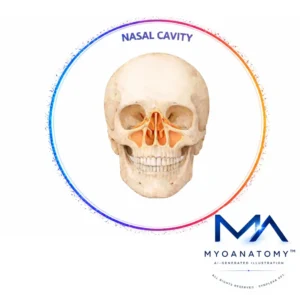
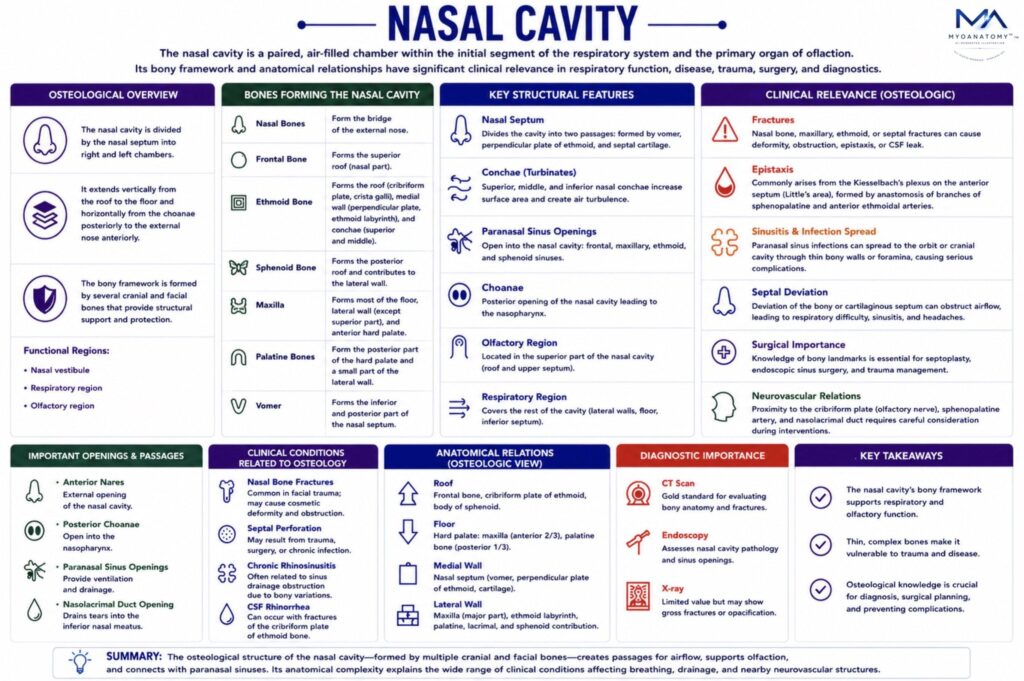
The nasal cavity is a paired air-filled chamber within the viscerocranium forming the initial segment of the respiratory tract and the primary organ of olfaction. It extends from the external nasal aperture (piriform aperture) anteriorly to the choanae posteriorly, where it communicates with the nasopharynx.
CORE


Overview
Anatomically, the nasal cavity occupies a central position within the facial skeleton, lying:
inferior to the anterior cranial fossa
medial to the orbital cavities
superior to the oral cavity
anterior to the nasopharynx
Because of these relationships, the nasal cavity represents a critical anatomical intersection between the respiratory system, olfactory system, cranial cavity, paranasal sinuses, and facial skeleton.
Its skeletal framework is formed by several bones of the viscerocranium and neurocranium, which collectively support the nasal septum and lateral nasal walls, while accommodating specialized respiratory and olfactory mucosa.

ANATOMY
General Structure
General Structure and Orientation
The nasal cavity is divided into right and left chambers by the nasal septum, which extends vertically from the roof to the floor of the cavity.
Each nasal chamber extends from:
external nares anteriorly
to the choanae posteriorly
Structurally, the cavity can be divided into 3 functional regions:
nasal vestibule
respiratory region
olfactory region
The nasal vestibule represents the transition from the external nose, while the respiratory and olfactory regions form the functional internal nasal cavity.
Exam Question
Explain how the division of the nasal cavity into right and left chambers by the septum, and into vestibular, respiratory, and olfactory regions, determines airflow pathway from external nares to choanae.
Nasal Bones
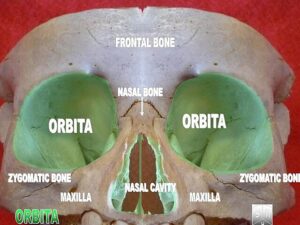
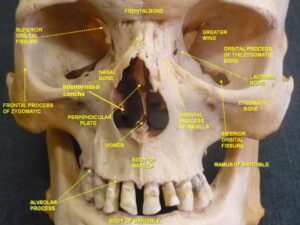
The bony framework of the nasal cavity is formed by several cranial and facial bones.
These include:
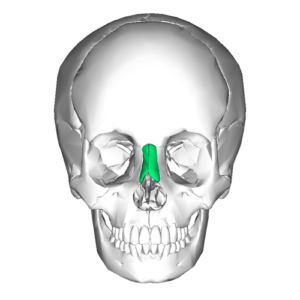
nasal bones
frontal bone
ethmoid bone
sphenoid bone
maxilla
palatine bones
lacrimal bones
inferior nasal conchae
vomer
Together these bones create the roof, floor, septum, and lateral walls of the nasal cavity.
Exam Question
List the bones forming the nasal cavity and explain how their arrangement contributes to the formation of the roof, floor, septum, and lateral walls.
Superior Wall
The roof ( superior wall) of the nasal cavity is narrow and composed of several bones arranged from anterior to posterior nasal bones; frontal bone’ cribriform plate of the ethmoid bone; body of the sphenoid bone.
The cribriform plate is particularly important because it contains numerous small foramina transmitting olfactory nerve fibers (cranial nerve I) from the nasal mucosa to the olfactory bulbs in the anterior cranial fossa.
Thus the roof forms the anatomical boundary between the nasal cavity and the cranial cavity.
Exam Question
Describe the anatomical components of the superior wall of the nasal cavity and explain the role of the cribriform plate in transmitting olfactory nerve fibers.
Inferior Wall
The floor ( inferior wall) of the nasal cavity is formed by the hard palate, which separates the nasal cavity from the oral cavity.
It consists of:
palatine processes of the maxillae (anterior portion)
horizontal plates of the palatine bones (posterior portion)
This rigid partition allows simultaneous respiration and feeding.
Exam Question
Identify the structures forming the inferior wall of the nasal cavity and explain how this wall separates the nasal cavity from the oral cavity.
Medial Wall
Medial Wall (Nasal Septum)
The medial wall of each nasal chamber is formed by the nasal septum, which divides the cavity into right and left passages.
The septum consists of:
perpendicular plate of the ethmoid bone
vomer
septal cartilage
The nasal septum maintains symmetrical airflow and structural support of the external nose
Exam Question
Describe the components of the nasal septum and explain its role in dividing the nasal cavity and maintaining airflow symmetry.
Lateral Wall
The lateral wall of the nasal cavity is complex and irregular.
It is formed by contributions from: maxilla ethmoid bone inferior nasal concha lacrimal bone palatine bone.
Projecting from this wall are three curved bony structures called nasal conchae (turbinates).
Exam Question
List the bones contributing to the lateral wall of the nasal cavity and explain how the presence of nasal conchae relates to its structural complexity.
SUMMARY TABLE