Vomer Bone
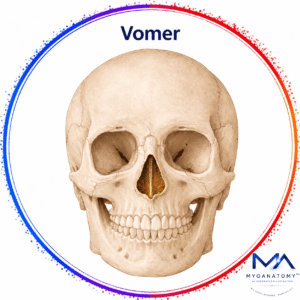
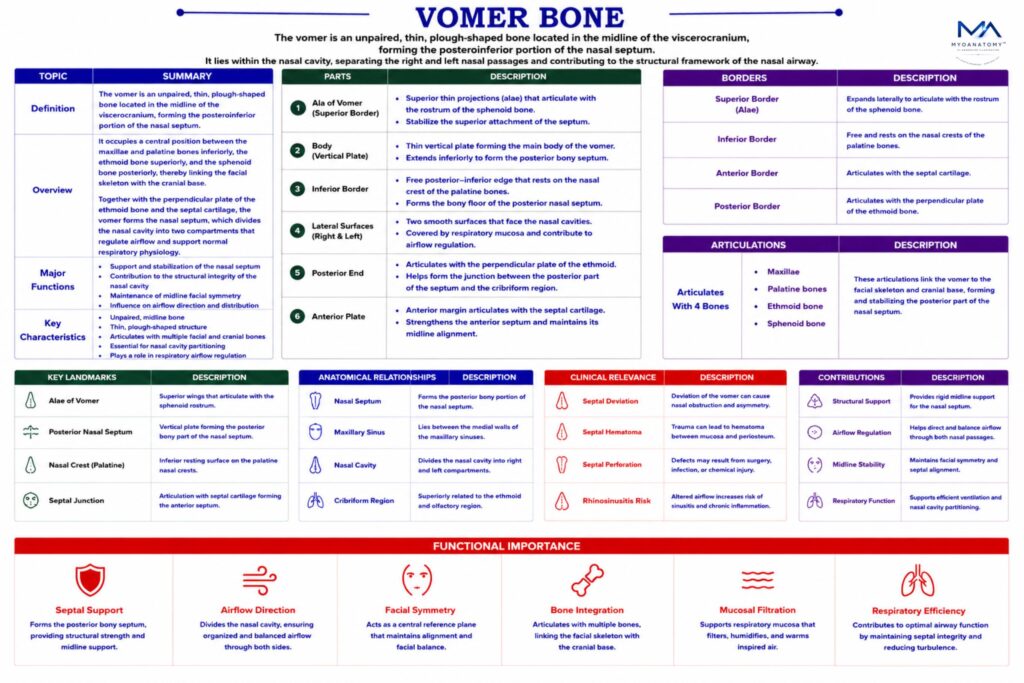
The vomer is an unpaired, thin, plough-shaped bone located in the midline of the viscerocranium, forming the posteroinferior portion of the nasal septum. It lies within the nasal cavity, separating the right and left nasal passages and contributing to the structural framework of the nasal airway.
Although relatively small and delicate, the vomer plays an essential role in maintaining the structural integrity and symmetry of the nasal cavity.
CORE


Overview
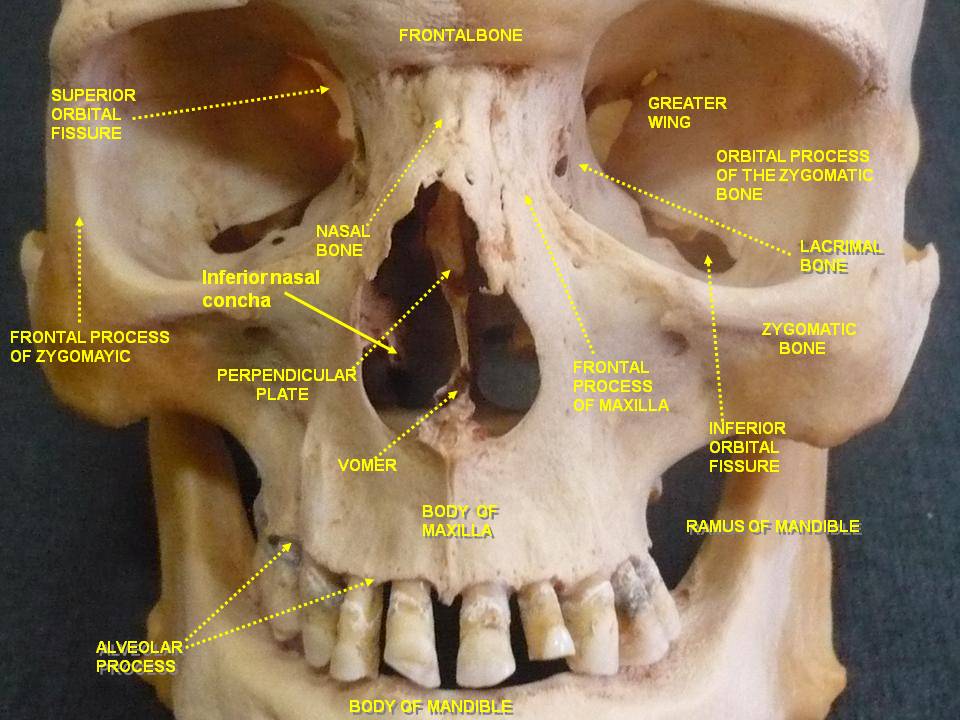
It occupies a central position between the maxillae and palatine bones inferiorly, the ethmoid bone superiorly, and the sphenoid bone posteriorly, thereby linking the facial skeleton with the cranial base.
Together with the perpendicular plate of the ethmoid bone and the septal cartilage, the vomer forms the nasal septum, which divides the nasal cavity into two compartments that regulate airflow and support normal respiratory physiology.
Because of this central anatomical position, the vomer contributes not only to nasal cavity architecture but also to respiratory function, facial symmetry, and craniofacial structural stability
ANATOMY
Surfaces
The vomer presents 2 lateral surfaces, each facing one of the nasal cavities.
Right and Left Surfaces
Both surfaces are slightly concave and irregular, forming the posterior part of the nasal septum. They are covered by nasal mucosa, which participates in the physiological processes of air warming, humidification, and filtration.
The surfaces provide attachment sites for the nasal septal cartilage anteriorly and articulate with surrounding bones that form the walls of the nasal cavity.
Through these surfaces, the vomer contributes to the division of airflow within the nasal cavity, ensuring balanced airflow through both nasal passages.
Exam Question
How do the bilateral surfaces of the vomer structurally and functionally regulate airflow partitioning, resistance symmetry, and laminar–turbulent transition within the posterior nasal cavity?
Borders
The vomer possesses 4 borders, each forming articulations with adjacent bones of the skull.
Superior Border – thickened and forms a groove that receives the rostrum of the sphenoid bone. This articulation connects the nasal septum with the cranial base, stabilizing the posterior nasal cavity.
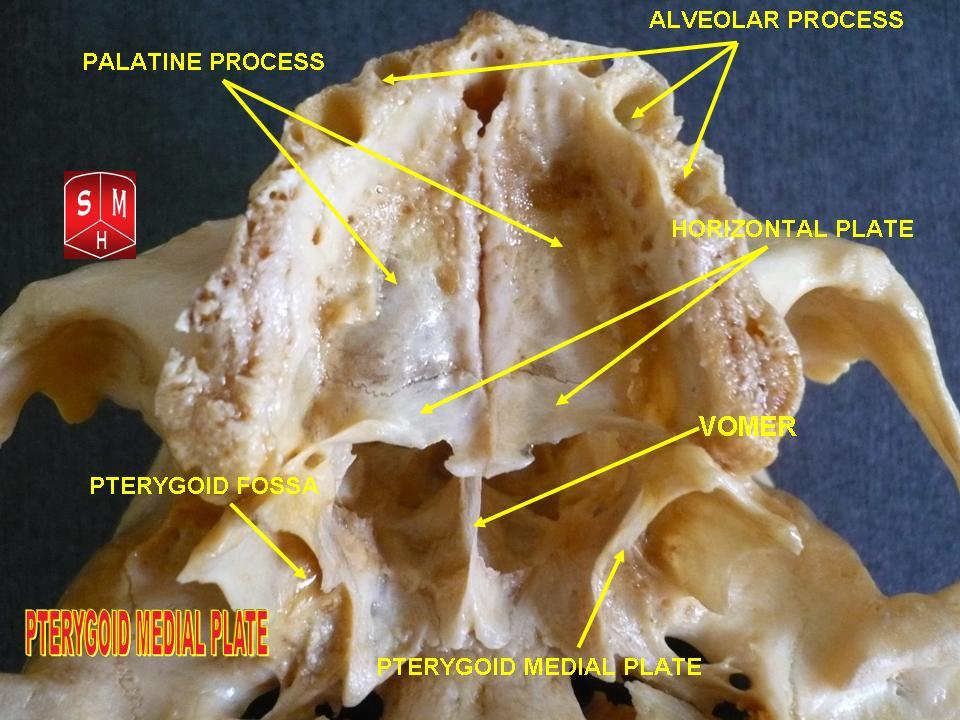
Inferior Border – rests upon the nasal crests of the maxillae and palatine bones, forming the bony floor of the nasal septum. This articulation provides structural support for the inferior part of the nasal septum.
Anterior Border – articulates with the perpendicular plate of the ethmoid bone superiorly and the septal cartilage inferiorly, completing the vertical partition between the two nasal cavities.
Posterior Border – free and concave, forming the posterior margin of the nasal septum and contributing to the boundaries of the choanae, the posterior openings that connect the nasal cavity to the nasopharynx.

Exam Question
How do the superior, inferior, anterior, and posterior borders of the vomer collectively distribute mechanical forces and maintain septal stability within the craniofacial skeletal framework?
Articulations
The vomer articulates with 6 bones of the skull, integrating the nasal septum with both the facial skeleton and cranial base.
These articulations include:
sphenoid bone
ethmoid bone
maxillae (right and left)
palatine bones (right and left)
Through these articulations, the vomer stabilizes the nasal septum and contributes to the overall architecture of the nasal cavity.
Exam Question
How do the articulations of the vomer with the sphenoid, ethmoid, maxillae, and palatine bones establish an integrated osteological axis that preserves midline alignment and resists deformation during respiration and mastication?
Landmarks
Vomer is associated with several important anatomical landmarks.
Alae of the vomer – superior border of the vomer expands into two thin projections known as the alae, which articulate with the rostrum of the sphenoid bone, stabilizing the posterior nasal septum.
Posterior nasal septum- contributing to the separation of the two nasal cavities and maintaining airflow symmetry.
Exam Question
How does the vomer serve as a three-dimensional midline reference for defining posterior nasal architecture and guiding safe surgical navigation in relation to the sphenoid sinus and choanal openings?
FUNCTIONAL IMPORTANCE
Septal Integrity
Provides the posteroinferior rigid component of the nasal septum, counterbalancing the flexible septal cartilage → maintains midline stability under dynamic pressure gradients during respiration.
Flow Symmetry
Ensures bilateral aerodynamic equivalence by preserving septal alignment → prevents pressure differentials that induce compensatory turbinate hypertrophy and asymmetric airflow resistance.
Structural Transmission
Acts as a load-distributing plate within the viscerocranial framework, transmitting forces between maxilla, palatine bones, and sphenoid rostrum → stabilizes posterior nasal aperture (choanae).
Choanae Patency
Maintains posterior nasal airway geometry, ensuring unobstructed airflow from nasal cavity to nasopharynx → critical for low-resistance respiratory flow and ventilation efficiency.
CLINICAL RELEVANCE
Septal Deviation
Vomerine deviation (often posterior–inferior) produces non-uniform airway cross-section, shifting airflow into a high-velocity jet on the concave side → induces shear stress on mucosa, compensatory inferior turbinate hypertrophy, and ostiomeatal complex dysfunction → secondary chronic rhinosinusitis.
Septal Instability
Disruption of vomer–sphenoid (rostrum) or vomer–palatine articulations compromises the posterior septal buttress, leading to loss of midline support under inspiratory negative pressure → dynamic narrowing of the posterior airway and impaired choanal airflow efficiency.
Septal Hematoma
Although classically cartilaginous, posterior extension involving vomerine periosteum can impair septal vascular network (posterior septal branches of sphenopalatine artery) → progression from hematoma to ischemic necrosis → structural collapse → saddle deformity if untreated
Septal Perforation
Defects involving the vomer create a pressure gradient between nasal compartments, generating bidirectional turbulent vortices → causes mucosal desiccation, crusting, epistaxis, and the characteristic Helmholtz-type whistle during airflow.
SUMMARY TABLE