Nasal Bone
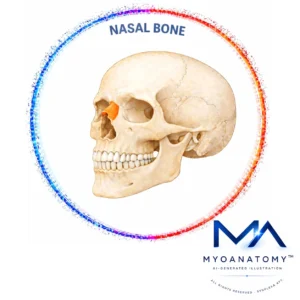
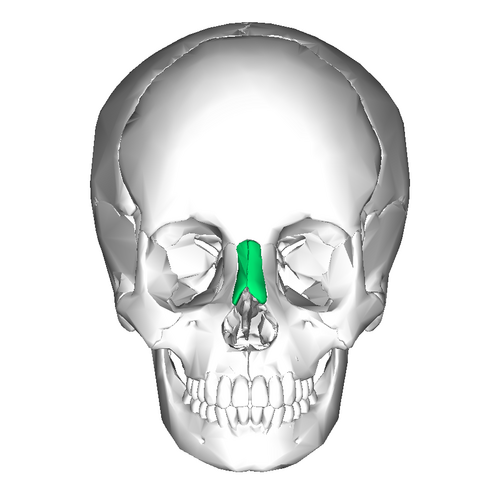
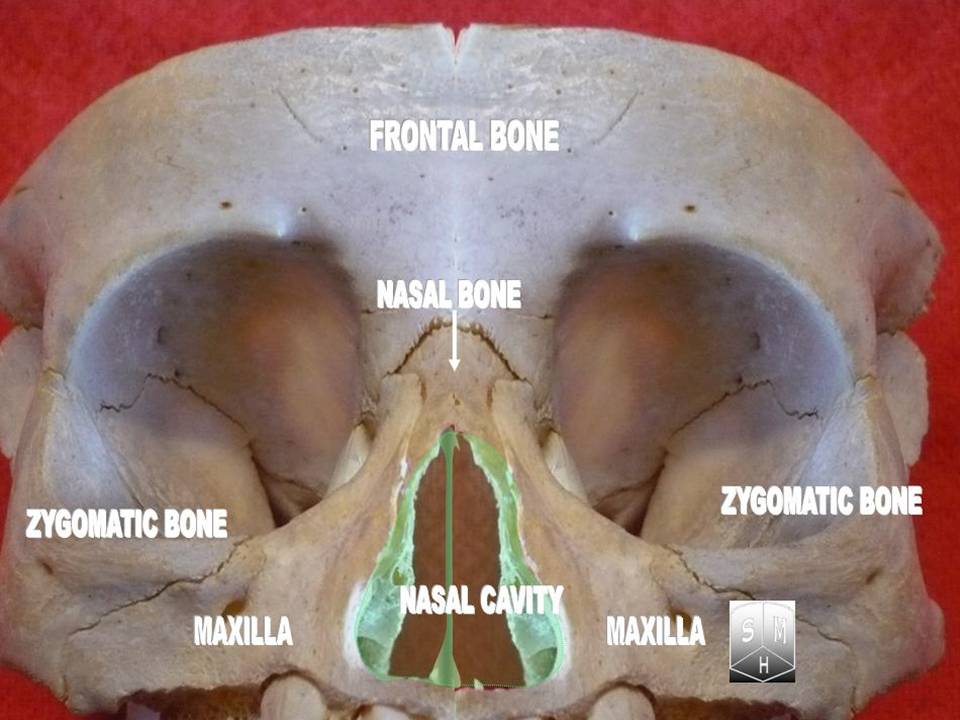
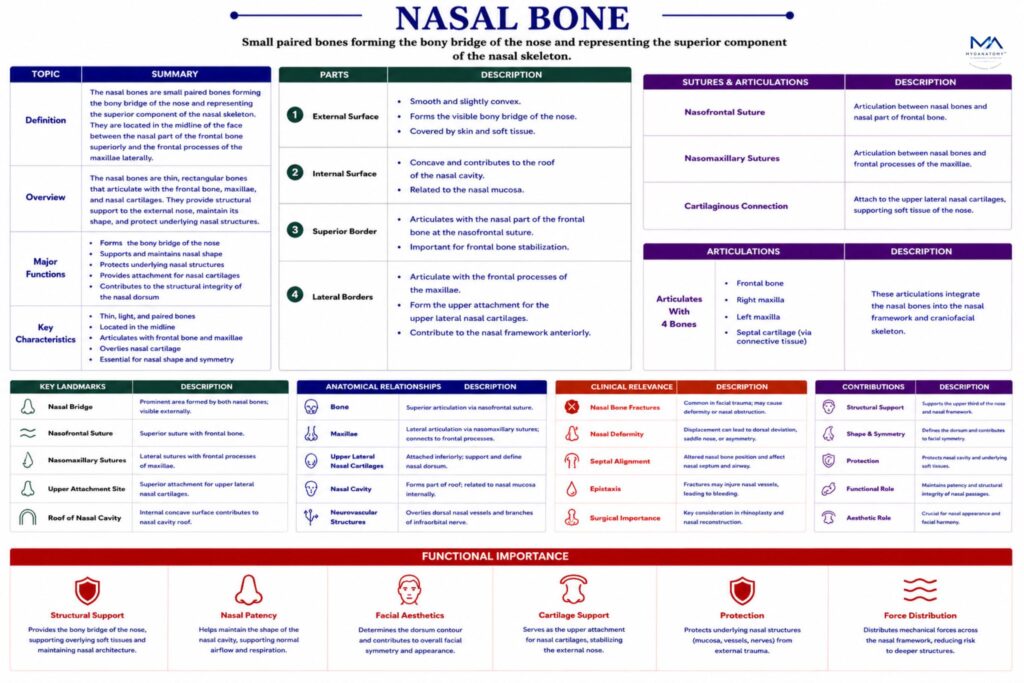
The nasal bones are small paired bones forming the bony bridge of the nose and representing the superior component of the osseous nasal skeleton. They are located in the midline of the face between the nasal part of the frontal bone superiorly and the frontal processes of the maxillae laterally, forming an important structural transition between the viscerocranium (facial skeleton) and the anterior region of the neurocranium
CORE


Overview
Although relatively small in size, the nasal bones play a crucial role in maintaining the architecture of the external nose and the superior boundary of the nasal cavity. They contribute to the roof of the nasal cavity, support the upper lateral nasal cartilages, and participate in the formation of the superior margin of the piriform aperture, the bony opening that forms the anterior entrance to the nasal cavity.
Through their articulations with the frontal bone, maxillae, and ethmoid, the nasal bones form part of the nasofrontal complex, a structural junction linking the cranial base with the midfacial skeleton. This region stabilizes the nasal dorsum and helps maintain the structural continuity between the forehead, orbit, and nasal framework.
In addition to their skeletal function, the nasal bones contribute to the structural support of the nasal cartilaginous skeleton, helping maintain the shape of the nose and the patency of the nasal airway.
ANATOMY
Surfaces
Each nasal bone presents 2 principal surfaces, reflecting its relationship with both the external facial skeleton and the internal nasal cavity.
External Surface- smooth, slightly convex, and forms the visible bony bridge of the nose. The curvature and orientation of this surface influence the projection and contour of the nasal dorsum, which plays an important role in determining facial aesthetics and midfacial symmetry. This Surface provides attachment for muscles of facial expression, including: procerus muscle, which produces transverse wrinkles across the nasal bridge and contributes to facial expressions of concentration or displeasure; nasalis muscle, which regulates the diameter of the nostrils and assists in modulating nasal airflow. Through these muscular attachments, the nasal bones participate indirectly in facial expression and respiratory airflow modulation.
Internal Surface – concave and contributes to the roof of the nasal cavity, forming part of the boundary between the nasal passages and the anterior cranial base. This surface is lined by respiratory mucosa, which performs several important physiological functions including:
warming inspired air
humidifying inhaled air
filtering airborne particles
A shallow groove may be present for the anterior ethmoidal nerve, a branch of the nasociliary nerve (ophthalmic division of the trigeminal nerve, CN V₁). This nerve provides sensory innervation to portions of the nasal cavity and nasal septum.
The internal surface also contributes to the structural interface between the nasal cavity and the olfactory region.
Exam Question
Explain how the structural differences between the external and internal surfaces of the nasal bones reflect their dual role in facial morphology and nasal cavity function, including their relationships with soft tissues, mucosa, and airflow dynamics.
Borders
Each nasal bone presents 4 borders, which articulate with surrounding bones and stabilize the nasal skeleton.
Superior Border – articulates with the nasal part of the frontal bone, forming the frontonasal suture. This articulation represents an important component of the nasofrontal junction, linking the facial skeleton to the anterior cranial base.
Inferior Border – contributes to the upper margin of the piriform aperture, which forms the bony entrance to the nasal cavity. Inferiorly, the nasal bones connect with the upper lateral nasal cartilages, which extend the nasal framework anteriorly.
Lateral Border– articulates with the frontal process of the maxilla, forming the nasomaxillary suture. This articulation integrates the nasal bones with the midfacial skeleton and contributes to the stability of the nasal framework.
Medial Border– of the paired nasal bones meet at the midline to form the internasal suture, maintaining the symmetry and structural alignment of the nasal dorsum.
Exam Question
Analyze how the borders of the nasal bones contribute to the stability of the nasofrontal and nasomaxillary junctions, and discuss how disruption of these articulations affects midfacial biomechanics and nasal structural integrity
Articulations
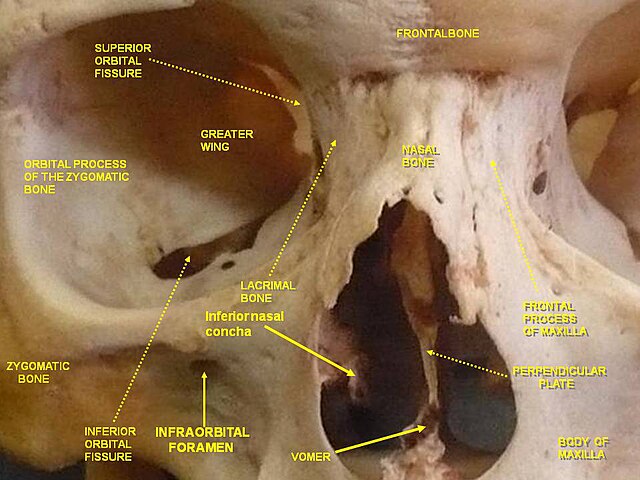
Each nasal bone articulates with 4 bones:
Frontal bone
Frontal process of the maxilla
Ethmoid bone
Opposite nasal bone
These articulations integrate the nasal bones into the nasofrontal skeletal complex, linking the nasal cavity, orbit, and anterior cranial base.
Exam Question
Discuss how the articulations of the nasal bones integrate the viscerocranium with the neurocranium, and evaluate their role in forming a functional interface between the nasal cavity, orbit, and anterior cranial base.
Landmarks
Important anatomical landmarks associated with the nasal bones include:
Frontonasal suture – articulation between frontal bone and nasal bones
Internasal suture – union between the paired nasal bones
Nasomaxillary suture – articulation with the maxilla
Piriform aperture margin – superior boundary of the anterior nasal opening
These landmarks serve as important reference points in craniofacial anatomy, radiology, and surgical procedures.
Exam Question
Evaluate the anatomical and clinical significance of key nasal bone landmarks (including the frontonasal suture, internasal suture, and piriform aperture margin) in relation to surgical approaches, radiological interpretation, and trauma assessment.
FUNCTIONAL IMPORTANCE
Structural Support
The nasal bones provide the rigid superior framework of the osteocartilaginous nasal unit, anchoring the upper lateral cartilages and stabilizing the nasal dorsum.
Their high stiffness relative to adjacent cartilaginous structures creates a fixed reference point that preserves alignment under dynamic mechanical loading and prevents dorsal collapse.
Airflow Mechanics
By forming the roof of the nasal cavity and stabilizing the internal nasal valve region, the nasal bones indirectly regulate airflow resistance and laminar flow patterns.
Their structural integrity maintains optimal valve angle and cross-sectional area, preventing turbulent flow and ensuring efficient air conditioning within the upper respiratory tract.
Force Transmission
As part of the nasofrontal buttress system, the nasal bones channel mechanical forces from the nasal dorsum toward the frontal bone and maxilla.
This redistributes impact energy across the midfacial skeleton, reducing localized stress concentration and protecting deeper craniofacial and intracranial structures.
Facial Projection
The nasal bones define the dorsal height and anterior projection of the midline face, acting as a geometric determinant of facial symmetry.
Due to their central position, even minimal displacement alters soft tissue draping and visual proportions, making them critical in both developmental morphology and reconstructive alignment.
CLINICAL RELEVANCE
Fractures Patterns
Nasal bones are the most frequently fractured facial bones due to their central and exposed position.
Low-energy trauma typically produces simple fractures, while higher-impact forces may extend into adjacent structures, reflecting their role as the anterior point of force dissipation in the midface.
Airway Obstruction
Displacement of nasal fractures commonly alters septal alignment, leading to septal deviation and narrowing of the nasal airway.
This disrupts airflow dynamics, increasing resistance and predisposing to chronic nasal obstruction and impaired respiratory efficiency
Skull Base Risk
Posterior extension of fractures into the ethmoid (cribriform plate) may result in cerebrospinal fluid leakage, establishing a pathological communication between the nasal cavity and intracranial space.
This significantly increases the risk of ascending infections, including meningitis.
Neurovascular Injury
Injury to the anterior ethmoidal nerve and associated vessels may produce sensory disturbances of the nasal cavity and septum.
The confined anatomical pathways amplify the impact of even minor trauma, leading to disproportionate functional deficits..
SUMMARY TABLE