Deep Veins

MYO CORE

Deep Facial Vein

The deep facial vein is a short, valveless communicating vein that connects the facial vein with the pterygoid venous plexus, establishing the principal venous communication between the superficial facial and deep craniofacial venous systems. 

OVERVIEW

The deep facial vein is a constant component of the deep craniofacial venous system, arising from the posterior aspect of the facial vein and passing through the buccal fat pad to reach the pterygoid venous plexus within the infratemporal fossa. 

Along its course, it accompanies the buccal neurovascular bundle, lies between the muscles of facial expression and mastication, and serves as the principal venous conduit between the superficial face and the deep infratemporal compartment. 

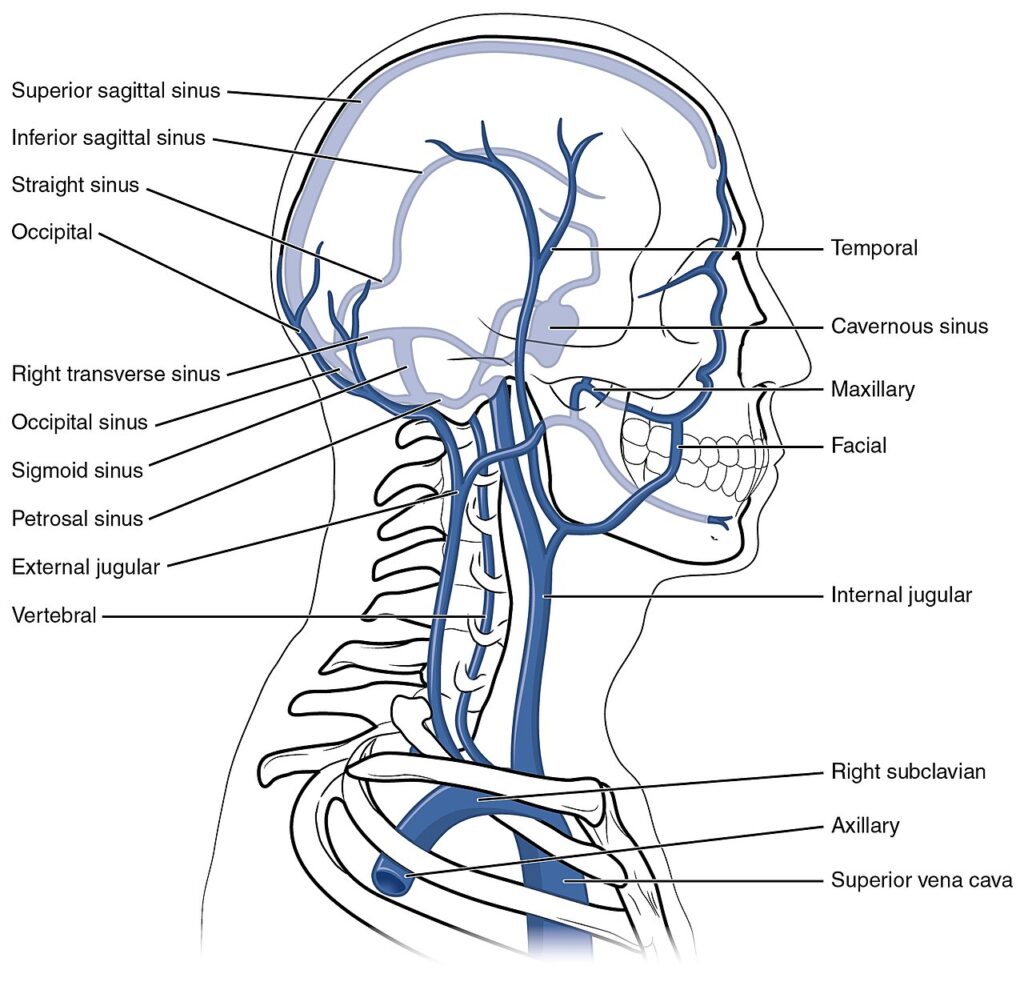
Through its continuity with the pterygoid venous plexus, it becomes anatomically integrated with the ophthalmic veins, emissary veins, dural venous sinuses, and the internal jugular venous system, forming a central element of the hierarchical deep craniofacial venous network.

ANATOMY

Formation & Origin

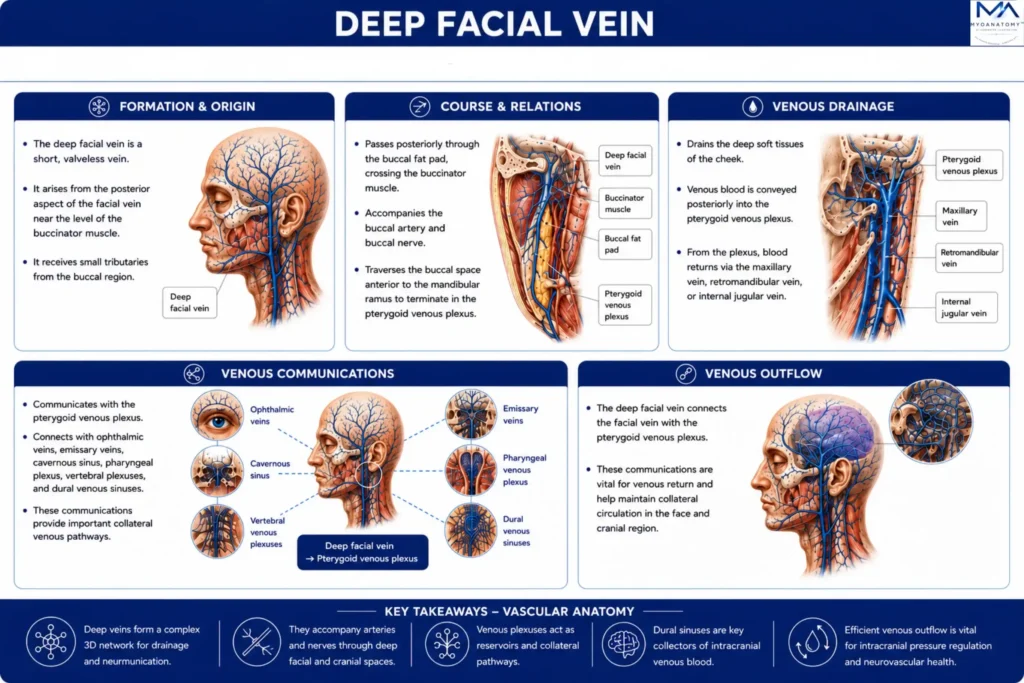
The deep facial vein is a short, valveless communicating vein that usually arises from the posterior aspect of the facial vein near the level of the buccinator muscle

It receives small tributaries from the buccal region and represents the principal venous channel linking the superficial facial venous system with the deep venous circulation of the infratemporal fossa. 

Although its precise origin and caliber exhibit minor anatomical variation, its continuity with the pterygoid venous plexus remains a constant feature of normal craniofacial venous anatomy, establishing the foundation of deep facial venous communication.

Exam Question

Describe the formation of the deep facial vein, identify its typical site of origin, and explain its anatomical significance as the principal communicating vein between the superficial facial and deep craniofacial venous systems.

Course Relations

From its origin, the deep facial vein passes posteriorly through the buccal fat pad,crossing the superficial surface of the buccinator muscle before entering the anterior part of the infratemporal fossa

Throughout its course it accompanies the buccal artery and buccal nerve, remaining closely related to the muscles of facial expression anteriorly and the muscles of mastication posteriorly. It traverses the buccal space immediately anterior to the mandibular ramus before terminating within the pterygoid venous plexus. 

These relationships position the vein as an important component of the deep neurovascular anatomy of the cheek and infratemporal region.

Exam Question

Trace the anatomical course of the deep facial vein from its origin to its termination, identifying its principal relationships with the buccinator muscle, buccal fat pad, buccal neurovascular bundle, and infratemporal fossa.

Venous Drainage

The deep facial vein drains the deep soft tissues of the cheek, including the buccinator muscle, buccal fat pad, adjacent facial musculature, and surrounding connective tissues. 

Venous blood is conveyed posteriorly into the pterygoid venous plexus, where it joins blood returning from the muscles of mastication, nasal cavity, paranasal sinuses, orbit, palate, and deep facial spaces. 

From the plexus, venous return continues through the maxillary vein, retromandibular vein, and ultimately reaches the external or internal jugular venous system, depending on the terminal drainage pathway. This hierarchical arrangement integrates superficial and deep facial venous return into the principal cervical outflow channels.

Exam Question

Explain the drainage territory of the deep facial vein and trace the hierarchical pathway of venous return from the buccal region to the cervical venous system through the pterygoid venous plexus and its collecting veins.

Venous Communications

The deep facial vein forms the principal anatomical communication between the facial vein and the pterygoid venous plexus, thereby linking the superficial facial venous system with the deep venous networks of the infratemporal region. 

Through the pterygoid venous plexus, it communicates with the superior and inferior ophthalmic veins, emissary veins, cavernous sinus, pharyngeal venous plexus, and the middle meningeal venous system, establishing continuity between the facial, orbital, skull base, and intracranial venous compartments. 

These extensive anastomoses constitute one of the principal venous communication pathways of the craniofacial region.

Exam Question

Analyze the anatomical communications of the deep facial vein with the pterygoid venous plexus and explain how these connections integrate the facial, orbital, skull base, and intracranial venous systems into a continuous craniofacial venous network.

SUMMARY TABLE

Scroll to Top