Muscle
Clinical Relevance

MYO CORE

Impared Force Transmission

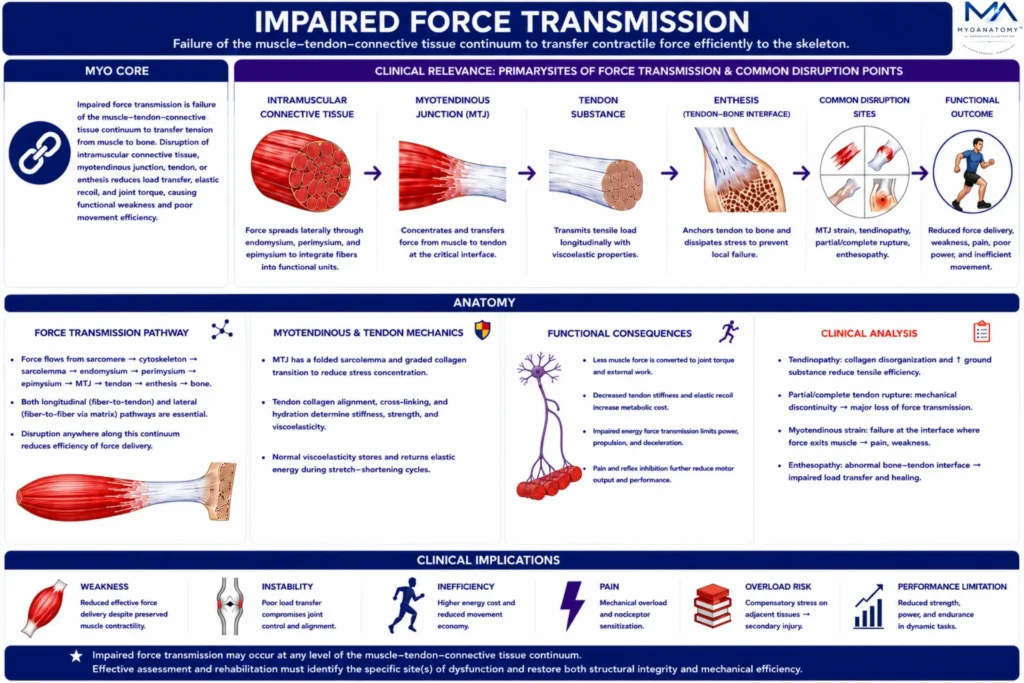
Impaired force transmission is failure of the muscle–tendon–connective tissue continuum to transfer sarcomere-generated tension efficiently to bone. Even when muscle fibers remain capable of contraction, disruption of the intramuscular collagen network, myotendinous junction, tendon, or enthesis reduces effective load transfer, elastic recoil, and joint torque production. The result is functional weakness, reduced power, and mechanical inefficiency that may exceed the degree of primary muscle fiber injury.

ANATOMY

Force Transmission Pathway

Muscle force reaches the skeleton through a continuous structural pathway extending from the sarcomere to the enthesis. Tension is transmitted through the cytoskeleton and sarcolemma-associated complexes into the endomysium, perimysium, and epimysium, then concentrated at the myotendinous junction before passing through tendon to bone. 

Importantly, force is conveyed not only longitudinally along fibers but also laterally through the intramuscular connective tissue matrix, which integrates adjacent fibers and fascicles into a unified mechanical unit. 

Thus, effective movement depends on the integrity of the entire myotendinous chain, not on contractile tissue alone.

Exam Question

Why can disruption of the connective tissue force-transmission pathway produce substantial weakness even when the muscle fibers themselves retain preserved contractile capacity?

Myotendinous-Tendinous Mechanics

The myotendinous junction is the principal interface where contractile force exits muscle and enters tendon. Its folded architecture enlarges the contact surface and helps dissipate tensile stress during loading. 

Distal to this, tendon collagen alignment, cross-linking, stiffness, and viscoelasticity determine how efficiently force is transmitted and how much elastic energy can be stored and returned during movement. 

Pathology affecting these properties does not simply reduce “strength”; it impairs the mechanical conversion of muscle contraction into skeletal motion, particularly during high-load or repetitive tasks.

Exam Question

Why is the myotendinous junction especially vulnerable during eccentric loading, and how does its normal architecture protect the muscle–tendon interface from mechanical failure?

Functional Consequences

When force transmission is impaired, the muscle may generate tension, but less of that tension is converted into joint torque and external movement

This produces a form of weakness often disproportionate to muscle bulk or voluntary activation. Loss of tendon stiffness and elastic recoil also increases the energetic cost of gait, running, and jumping, because the muscle must compensate for reduced passive energy return. 

As a result, movement becomes less powerful, less economical, and less mechanically efficient, especially during rapid force generation or stretch–shortening activity.


Exam Question

Why does impaired force transmission often affect running, jumping, and explosive propulsion more severely than slow static contraction?

Clinical Analysis

Clinically, impaired force transmission most commonly reflects pathology of the muscle–tendon unit

Tendinopathydisrupts collagen organization and reduces tensile efficiency; partial or complete tendon rupture creates mechanical discontinuity; and myotendinous injury compromises the interface where force exits the muscle. In each case, the essential problem is not simply reduced muscle contraction, but failure of the system to translate internal force into effective skeletal movement. 

Patients therefore present with functional weakness, pain during loading, reduced power, poor stretch–shortening performance, and impaired load tolerance.

Exam Question

Why may a patient with tendinopathy appear mechanically weaker during functional loading than expected from manual testing of muscle strength alone?

SUMMARY TABLE

Scroll to Top