Muscle
Clinical Relevance
MYO CORE
Disrupted Neural Control
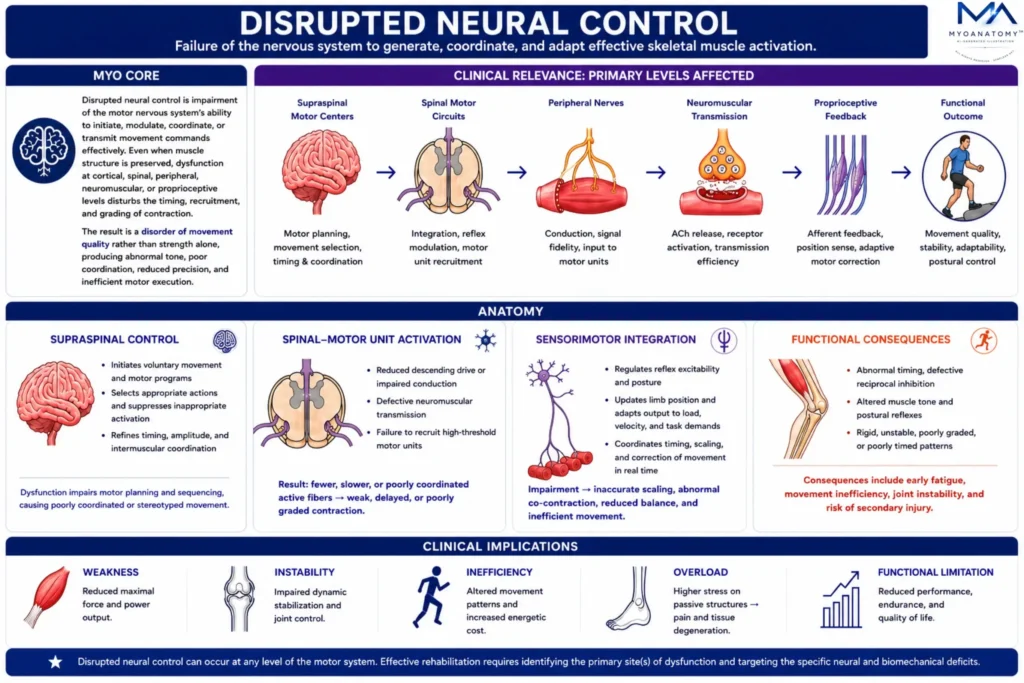
Disrupted neural control is the failure of the nervous system to generate, coordinate, and adapt effective skeletal muscle activation. It results from dysfunction of supraspinal motor centers, descending pathways, spinal motor circuitry, peripheral nerves, neuromuscular transmission, or proprioceptive feedback, leading to abnormal recruitment, impaired rate coding, altered muscle tone, defective movement sequencing, and loss of postural and task-specific motor precision.
ANATOMY
Supraspinal Control
Normal movement begins with integrated control from the motor cortex, basal ganglia, cerebellum, and descending brainstem pathways.
The motor cortex initiates and fractionates voluntary movement, the basal ganglia regulate movement selection and scaling, and the cerebellum refines timing, error correction, and intermuscular coordination. These supraspinal systems continuously modulate corticospinal and extrapyramidal output to spinal motor circuits.
Dysfunction at this level impairs motor planning, suppresses selective activation, and disrupts temporal sequencing, producing poorly coordinated, inefficient, or stereotyped movement despite preserved peripheral contractile tissue.
Exam Question
How does dysfunction of the motor cortex, basal ganglia, cerebellum, or descending pathways impair the initiation, timing, and coordination of skeletal muscle activation?
Spinal Motor Unit Activation
At the execution level, force production depends on intact α-motor neuron output, spinal interneuronal circuitry, orderly motor unit recruitment, rate coding, synchronization, and peripheral nerve conduction.
Spinal circuits integrate descending commands with segmental reflex input to regulate agonist activation, antagonist inhibition, and the graded recruitment of motor units according to task demand.
Reduced descending drive, impaired peripheral conduction, defective neuromuscular transmission, or failure to recruit high-threshold motor units diminishes the number, frequency, and coordination of active fibers, converting normal motor intent into weak, delayed, or poorly graded contraction.
Exam Question
How do abnormalities in spinal motor output, motor unit recruitment, or peripheral neural conduction disrupt effective muscle activation and graded force production?
Sensorimotor Integration
Effective movement also requires continuous afferent feedback from muscle spindles, Golgi tendon organs, joint mechanoreceptors, and cutaneous sensory pathways.
This sensory information is integrated within spinal and supraspinal networks to regulate reflex excitability, update limb position, and adapt motor output to changes in load, velocity, and task demands. When proprioceptive processing or sensorimotor integration is impaired, the nervous system loses the capacity to accurately scale force, coordinate timing, and correct movement in real time.
The result is impaired joint position sense, abnormal co-contraction, reduced balance control, and mechanically inefficient movement patterns.
Exam Question
How does impaired proprioceptive and sensorimotor feedback alter movement accuracy, postural control, and adaptive regulation of muscle activity?
Functional Consequences
Biomechanically, disrupted neural control compromises the quality, sequencing, and adaptability of movement rather than force output alone. Abnormal temporal activation, defective reciprocal inhibition, altered muscle tone, and impaired postural reflexes produce rigid, unstable, poorly graded, or poorly timed movement patterns.
Clinically, this appears as spasticity, hyperreflexia, and stereotyped synergies in upper motor neuron lesions; flaccidity, fasciculations, and denervation weakness in lower motor neuron lesions; or fatigable weakness in neuromuscular junction disorders.
Secondary consequences include compensatory co-contraction, inefficient gait or task performance, impaired joint stabilization, and progressive overload of surrounding passive tissues.

Exam Question
How does disrupted neural control produce abnormal movement sequencing, impaired stability, and biomechanical inefficiency during functional activity?
SUMMARY TABLE