Muscle
Clinical Relevance

MYO CORE

Impare Force Generation

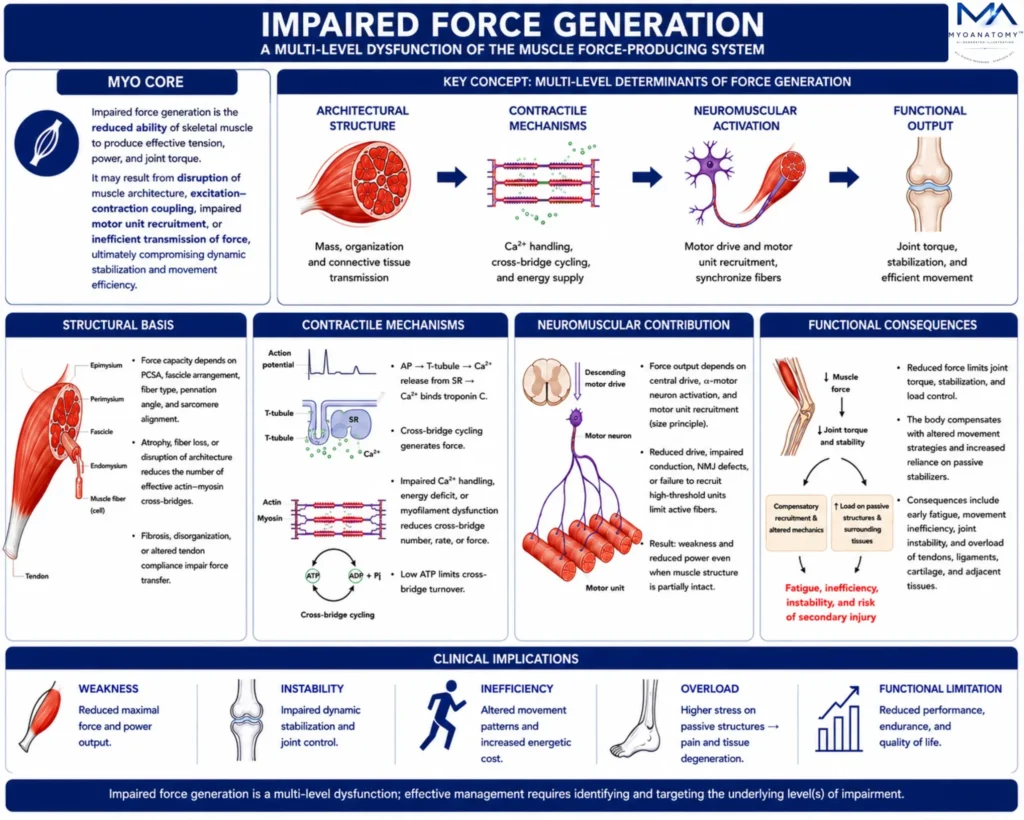
Impaired force generation refers to a reduction in the capacity of skeletal muscle to produce effective tension and mechanical output. It arises from structural disruption of contractile architecture, defective excitation–contraction coupling, impaired motor unit activation, or metabolic dysfunction, ultimately compromising joint torque, dynamic stabilization, and movement efficiency.

ANATOMY

Structural Basis

Force generation depends on preserved physiological cross-sectional area, fascicular organization, myofibrillar density, and sarcomeric alignment

Atrophy, fiber loss, or disruption of contractile architecture reduces the number of effective actin–myosin cross-bridges and lowers maximal tension. 

In addition, abnormalities within the endomysial, perimysial, epimysial, and tendinous connective tissue framework impair the transmission of muscular force to the skeleton.


Exam Question

How do muscle architecture and connective tissue organization determine skeletal muscle force production?

Contractile Mechanisms

At the cellular level, force production requires intact excitation–contraction coupling, efficient calcium release from the sarcoplasmic reticulum, and normal ATP-dependent cross-bridge cycling within the sarcomere. 

Disturbance of calcium handling, mitochondrial energy production, or myofilament function reduces peak tension, contractile efficiency, and the rate of force development.

Exam Question

How do excitation–contraction coupling, calcium handling, and cross-bridge cycling regulate muscular force generation?

Neuromuscular Contribution

Normal force output also depends on adequate central drive, α-motor neuron activation, and orderly recruitment of motor units

Reduced neural activation, impaired peripheral conduction, or failure to recruit high-threshold motor units limits the number and firing efficiency of active fibers, producing weakness even when muscle structure is only partially affected.

Exam Question

How do motor drive and motor unit recruitment influence normal force production, and how does neural dysfunction reduce it?

Functional Consequence

Biomechanically, impaired force generation reduces joint torque, dynamic stabilization, and load control during movement. 

The result is compensatory recruitment of adjacent muscles, increased reliance on passive stabilizers, altered movement mechanics, early fatigue, and progressive overload of surrounding tissues.

Exam Question

How does impaired force generation compromise joint stability, load control, and movement efficiency?

SUMMARY TABLE

Scroll to Top