Muscle
Clinical Relevance

Altered Joint Mechanics

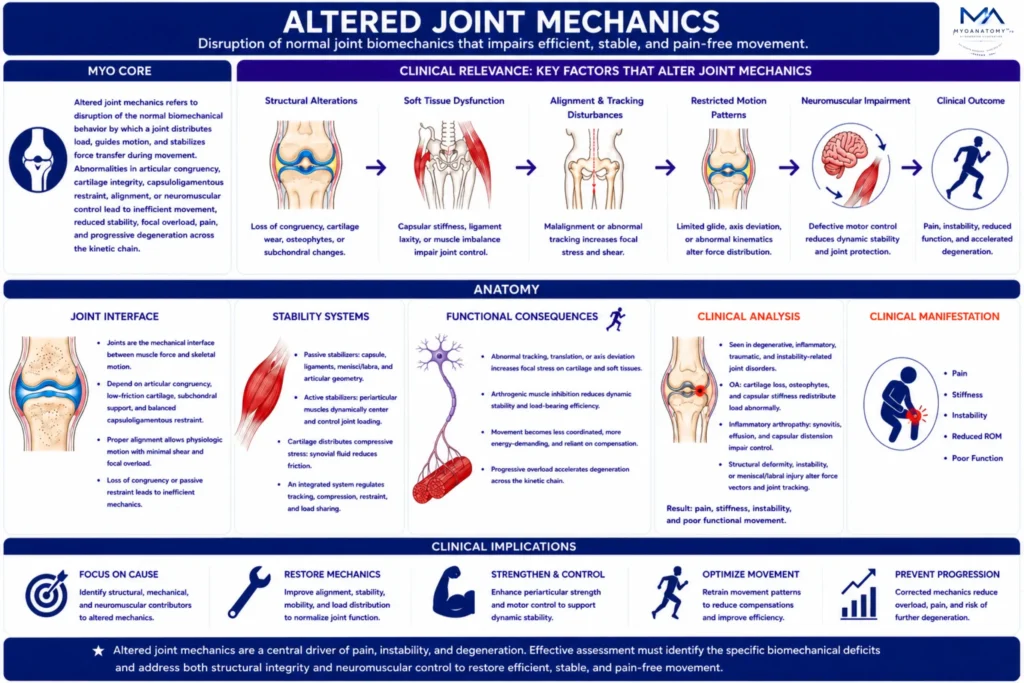
Altered joint mechanics refers to disruption of the normal biomechanical behavior by which a joint distributes load, guides motion, and stabilizes force transfer during movement. Because joints serve as the mechanical interface between muscle-generated force and skeletal motion, abnormalities in articular congruency, cartilage integrity, capsuloligamentous restraint, result in inefficient movement, reduced dynamic stability, focal overload, pain, and progressive degeneration across the joint and the surrounding kinetic chain.

ANATOMY

Joint Interface

A joint is not simply a point of articulation but a mechanical interface that determines how muscular force is translated into controlled skeletal motion. 

Normal function depends on precise articular congruency, low-friction cartilage surfaces, intact subchondral support, and balanced capsuloligamentous restraint. 

Together, these elements maintain alignment while permitting physiological motion with minimal shear and focal overload. 

When congruency is lost or passive restraints fail, the joint no longer behaves as a stable axis of movement, and force transmission becomes mechanically inefficient.

Exam Question

Why can loss of articular congruency impair movement efficiency even when surrounding muscles remain structurally intact?

Stability Systems

Normal joint mechanics depend on continuous interaction between passive stabilizers and active stabilizers. Passive stabilizers include the capsule, ligaments, fibrocartilage, menisci or labra, and the geometry of the articulating surfaces. 

Active stabilization is provided by periarticular muscles, which dynamically center the joint and control the direction and magnitude of articular loading. 

Cartilage distributes compressive stress, synovial fluid reduces friction, and subchondral bone supports load transfer. Joint mechanics therefore emerge from an integrated system that regulates tracking, compression, restraint, and load sharing across the full range of motion.

Exam Question

How do passive restraints and periarticular muscle activity complement each other in preserving normal joint mechanics during load-bearing movement?

Functional Consequence

When joint mechanics are altered, movement becomes inefficient because muscular force is no longer transmitted across a stable and congruent articular system. 

Abnormal tracking, excessive translation, restricted glide, or axis deviation redistribute load unevenly across cartilage, capsule, ligaments, and adjacent soft tissues. This often provokes arthrogenic muscle inhibition, further reducing dynamic stabilization and amplifying mechanical dysfunction. 

As a result, movement becomes less coordinated, more energy-demanding, and increasingly dependent on compensatory patterns, which may progressively overload adjacent joints and tissues.

Exam Question

Why does altered joint tracking frequently produce both local joint dysfunction and secondary biomechanical disturbance elsewhere in the kinetic chain?

Clinical Patterns

Clinically, altered joint mechanics are a central feature of degenerative, inflammatory, traumatic, and instability-related joint disorders. In osteoarthritis, cartilage degeneration, osteophyte formation, capsular stiffness, and subchondral remodeling disturb congruency and redistribute load abnormally. 

In inflammatory arthropathy, synovitis, effusion, and capsular distension impair motion and destabilize muscular control. Ligament insufficiency, labral or meniscal injury, post-traumatic deformity, and chronic malalignment similarly alter force vectors and joint kinematics, producing persistent overload, pain, stiffness, and inefficient movement. 

The clinical problem is therefore not only tissue damage, but failure of the joint to function as an efficient biomechanical interface.


Exam Question

Why should altered joint mechanics be viewed as a disorder of force distribution and motion control rather than simply a structural joint lesion?

SUMMARY TABLE

Scroll to Top