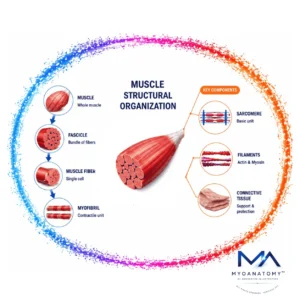
Muscle
Structural Organization
MYO CORE
Sarcomere organization
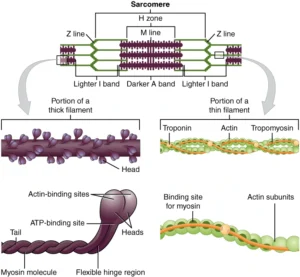
The contractile function of skeletal muscle is based on the highly organized interaction of actin and myosin filaments within repeating sarcomeres. Thin filaments contain actin together with the regulatory proteins troponin and tropomyosin, while thick filaments are composed of myosin molecules whose ATP-dependent heads generate force through cyclic cross-bridge activity.
OVERVIEW
Skeletal muscle contraction relies on a highly organized molecular system composed of contractile, regulatory, and structural proteins. Force is generated through interactions between actin (thin filaments) and myosin (thick filaments), while troponin and tropomyosin regulate this process in a calcium-dependent manner to ensure precise control of contraction.
The sarcomere also contains essential structural proteins that maintain mechanical stability and optimize force production. Titin preserves thick filament alignment and provides elasticity, nebulin stabilizes thin filament length, and dystrophin links the contractile apparatus to the sarcolemma, enabling efficient force transmission.
These components are arranged within repeating sarcomeres, extending from one Z-disc to the next. This highly ordered architecture ensures effective force generation, structural integrity, and synchronized contraction throughout the muscle.
“1003 Thick and Thin Filaments” – OpenStax College, Anatomy & Physiology. Wikimedia Commons. Licensed under CC BY 4.0
Exam Question
Explain how the coordinated interaction of contractile, regulatory, and structural proteins within the sarcomere enables efficient force generation, mechanical stability, and synchronized skeletal muscle contraction.
ANATOMY
Sarcomere Structure
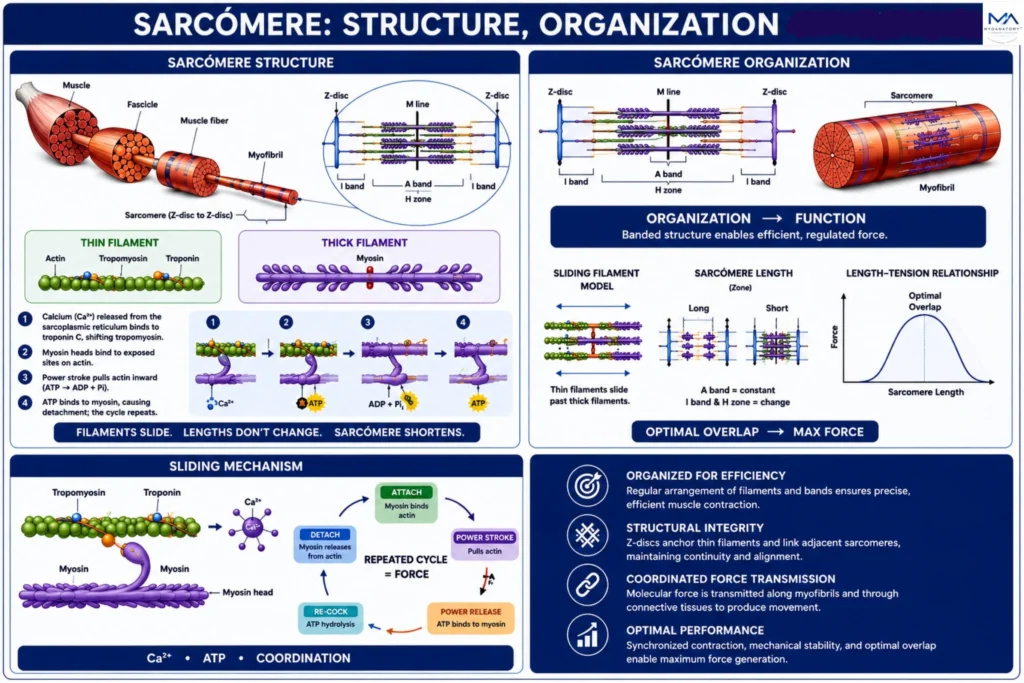
The sarcomere is the fundamental structural and functional unit of skeletal muscle, extending from one Z-disc to the next. It contains highly organized thin filaments (actin) and thick filaments (myosin) whose interaction forms the basis of muscle contraction.
Thin filaments are associated with the regulatory proteins troponin and tropomyosin, which control actin–myosin interaction in response to calcium, while thick filaments – myosin heads function as ATP-dependent molecular motors responsible for force generation.
In addition to contractile proteins, the sarcomere contains specialized structural proteins that maintain its integrity and mechanical efficiency. Titin spans from the Z-disc toward the M-line, stabilizing thick filaments and providing passive elasticity, whereas nebulin supports thin filament organization and length regulation. Dystrophin contributes to force transmission by linking the intracellular contractile apparatus to the sarcolemma and extracellular matrix.
The precise arrangement of these components within the sarcomere ensures optimal filament alignment, structural stability, and efficient force transmission.
Exam Question
Describe the structural organization of the sarcomere and critically discuss how its contractile, regulatory, and structural proteins cooperate to maintain force generation, mechanical stability, and efficient skeletal muscle contraction.
Sarcomere Architecture
Sarcomere architecture is defined by the precise arrangement of thick and thin filaments into distinct structural regions that optimize force generation and contraction efficiency.
The A band corresponds to the full length of the thick filaments and contains the zones of actin–myosin overlap where cross-bridge formation occurs.
The I band contains only thin filaments and is bisected by the Z-disc, serving as a region that changes in length during contraction.
At the center of the sarcomere, the H zone contains only thick filaments and narrows as thin filaments slide inward. The M line occupies the midpoint of the sarcomere and stabilizes thick filaments, ensuring their proper alignment and symmetrical force distribution.
This highly ordered architecture maintains optimal filament overlap, maximizes cross-bridge interactions, and forms the structural basis of the length-tension relationship, allowing skeletal muscle to generate force efficiently across a range of muscle lengths.
Exam Question
Describe the structural regions of the sarcomere and explain how their organization influences filament overlap, force generation, and the length–tension relationship in skeletal muscle.
Sliding Filament
The sliding filament mechanism is the fundamental process responsible for skeletal muscle contraction. Contraction occurs when actin filaments slide past myosin filaments, resulting in sarcomere shortening without altering filament length. The process is initiated by Ca²⁺ release, which binds to troponin and shifts tropomyosin, exposing myosin-binding sites on actin.
Activated myosin heads form cross-bridges with actin and generate force through ATP-dependent power strokes. Repeated cycles of attachment, force generation, detachment, and reactivation produce coordinated filament sliding and progressive sarcomere shortening.
This highly regulated mechanism ensures efficient force production, synchronized contraction, and preservation of sarcomere structural integrity throughout muscle activity.
Exam Question
Explain the sliding filament mechanism and discuss how calcium regulation and ATP-dependent cross-bridge cycling enable efficient force generation and skeletal muscle contraction.
SUMMARY TABLE