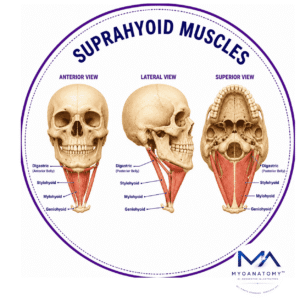
Suprahyoid Muscle

MYO CORE

Geniohyoid Muscle

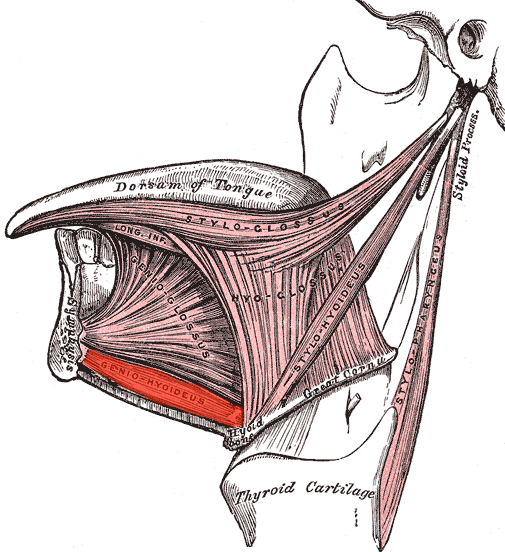
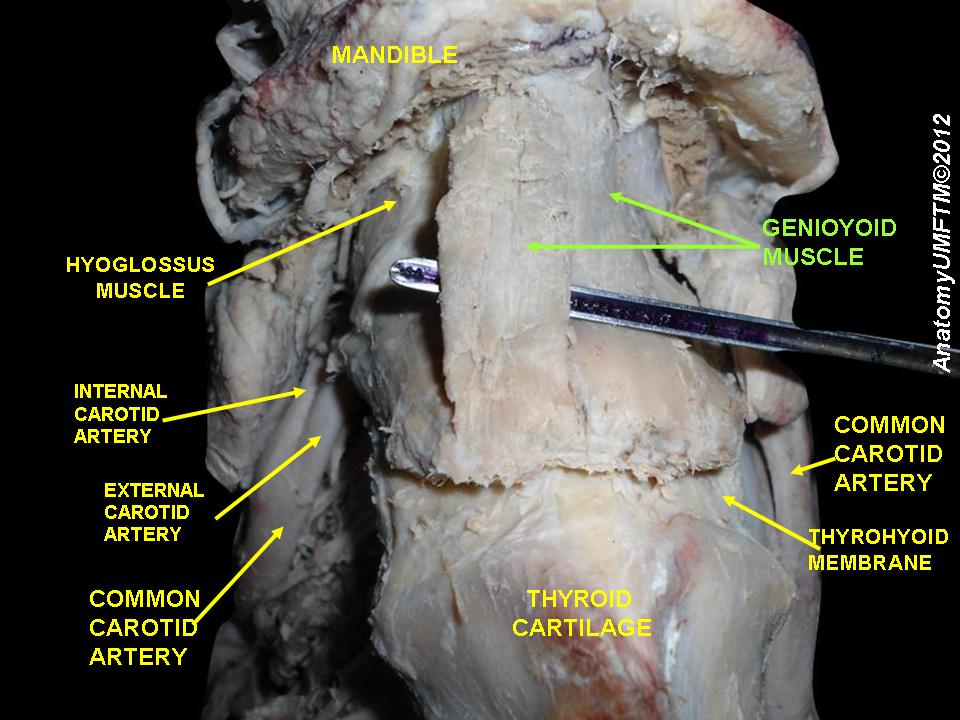
The geniohyoid muscle is a narrow, paired suprahyoid muscle located in the midline of the floor of the oral cavity, superior to the mylohyoid muscle. It extends from the mandible to the hyoid bone, forming part of the deep muscular layer of the suprahyoid region.

OVERVIEW

Functionally, the geniohyoid plays an important role in mandibular depression, elevation of the hyoid bone, and swallowing mechanics. It acts as a key component in the oropharyngeal phase of deglutition, where coordinated movement of the hyoid bone and larynx is required to protect the airway and facilitate passage of the food bolus.

Although the geniohyoid is anatomically grouped with the suprahyoid muscles, it differs from the other muscles in this group because it is innervated by fibers from the first cervical spinal nerve (C1) traveling with the hypoglossal nerve (CN XII).

The muscle lies within the submental region, contributing to the muscular framework that supports the tongue, floor of the mouth, and hyoid apparatus.

ANATOMY

Origin

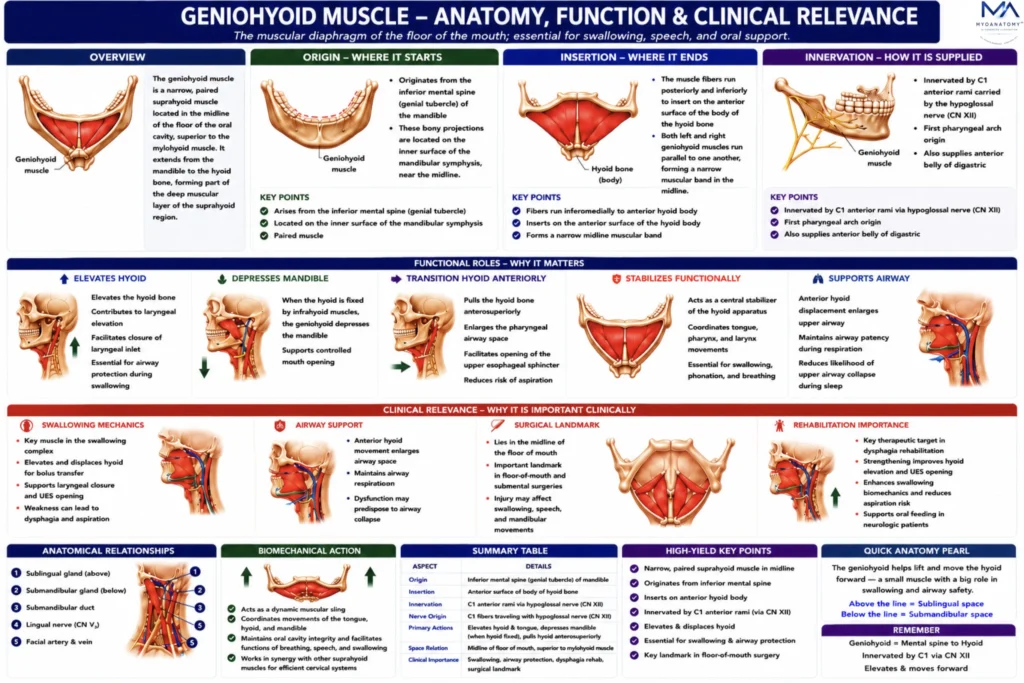
Originates from the -inferior mental spine (genial tubercle) of the mandible

These bony projections are located on the inner surface of the mandibular symphysis, near the midline.

Exam Question

How does the origin of the geniohyoid from the inferior mental spine (genial tubercle) optimize its mechanical advantage for anterior hyoid displacement and upper airway expansion during deglutition?

Insertion

The muscle fibers run posteriorly and inferiorly to insert on the -anterior surface of the body of the hyoid bone

Both left and right geniohyoid muscles run parallel to one another, forming a narrow muscular band in the midline.


Exam Question

Why is insertion onto the anterior surface of the hyoid body biomechanically essential for transforming geniohyoid contraction into both hyoid elevation and anterior hyoid excursion?

Innervation

C1 spinal nerve fibers traveling with the hypoglossal nerve (CN XII).

This means that although the fibers run within the hypoglossal nerve, the actual motor supply arises from the cervical spinal cord rather than from the cranial nerve nucleus.

This pattern of innervation is shared with the thyrohyoid muscle.

Exam Question

Explain how C1 spinal fibers traveling within the hypoglossal nerve provide motor innervation to the geniohyoid, and discuss the clinical implications of lesions affecting either C1 fibers or CN XII.


FUNCTIONAL ROLE

Hyoid Elevation

The geniohyoid is a primary suprahyoid elevator of the hyoid apparatus. When the mandible is stabilized, bilateral contraction elevates and draws the hyoid bone anteriorly, contributing to laryngeal elevation during deglutition. 

This movement is essential for airway protection by facilitating closure of the laryngeal inlet and promoting efficient transfer of the food bolus into the pharynx.

Exam Question

Why is geniohyoid contraction considered a critical component of laryngeal elevation and airway protection during the pharyngeal phase of swallowing?

Mandibular Depression

When the hyoid bone is fixed by the infrahyoid musculature, the geniohyoid reverses its action and assists in depressing the mandible. 

This contributes to controlled mouth opening and supports complex oral activities including mastication, swallowing, speech articulation, and respiratory coordination

Exam Question

When the hyoid is stabilized by the infrahyoid musculature, how does the geniohyoid contribute to mandibular depression, and what biomechanical principles explain this reversal of action?

Anterior Hyoid Transition

The geniohyoid is the most important muscle responsible for anterior displacement of the hyoid bone during swallowing. Forward movement of the hyoid enlarges the pharyngeal airway and facilitates opening of the upper esophageal sphincter. 

This biomechanical action is critical for safe bolus passage and reduction of aspiration risk.

Exam Question

How does anterior displacement of the hyoid by the geniohyoid facilitate opening of the upper esophageal sphincter and reduce the risk of aspiration during swallowing?

Functional Stabilization

Acting synergistically with the mylohyoid and digastric muscles, the geniohyoid stabilizes the hyoid apparatus during coordinated oral and pharyngeal movements. 

Because the hyoid serves as a central anchoring structure for the tongue, pharynx, and larynx, stabilization by the geniohyoid ensures effective integration of mastication, swallowing, phonation, and airway maintenance

Exam Question

Why is the geniohyoid regarded as a central stabilizer of the hyoid apparatus, and how does this stabilization coordinate tongue, pharyngeal, and laryngeal movements during oral function?

CLINICAL RELEVANCE

Swallowing Mechanics

The geniohyoid is a major contributor to swallowing by elevating and drawing the hyoid bone anterosuperiorly. This movement assists laryngeal elevation, promotes pharyngeal expansion, facilitates efficient bolus transfer, and enhances airway protection during deglutition. 

Its coordinated activity with other suprahyoid muscles is essential for normal swallowing biomechanics.

Exam Question

Discuss the role of the geniohyoid within the swallowing complex and predict the physiological consequences of bilateral geniohyoid weakness on bolus transport and airway protection.

Airway Support

Anterior displacement of the hyoid by the geniohyoid enlarges the pharyngeal airway and helps maintain upper airway patency. By supporting the position of the hyoid–laryngeal complex, the muscle contributes to airway stability during respiration, swallowing, and sleep, reducing the likelihood of upper airway collapse.

Exam Question

How does anterior hyoid displacement by the geniohyoid contribute to maintenance of upper airway patency, and why may dysfunction increase susceptibility to airway collapse?

Surgical Landmark

The geniohyoid serves as an important deep anatomical landmark within the floor of the mouth. Its close relationships with the tongue base, sublingual gland, mylohyoid muscle, and adjacent neurovascular structures make it highly relevant during oral, submental, and reconstructive surgical procedures. 

Accurate identification of the muscle assists safe surgical dissection and preservation of surrounding tissues.

Exam Question

Why is detailed knowledge of geniohyoid anatomy important during floor-of-mouth and submental surgical procedures, and which adjacent structures are most vulnerable to injury?

Rehabilitation Importance

Because of its central role in hyoid elevation and anterior excursion, the geniohyoid is a key target in dysphagia rehabilitation. Dysfunction may impair swallowing efficiency and airway protection, increasing aspiration risk.

 Therapeutic strengthening and neuromuscular re-education of the muscle can improve swallowing biomechanics, enhance functional recovery, and support safe oral feeding in neurologically affected patients

Exam Question

Why is the geniohyoid considered a key therapeutic target in dysphagia rehabilitation, and how can strengthening of this muscle improve swallowing biomechanics and patient outcomes?

SUMMARY TABLE

Scroll to Top