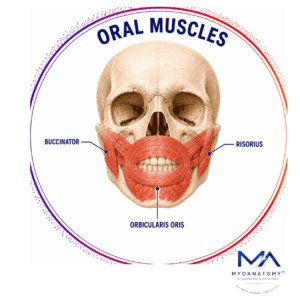
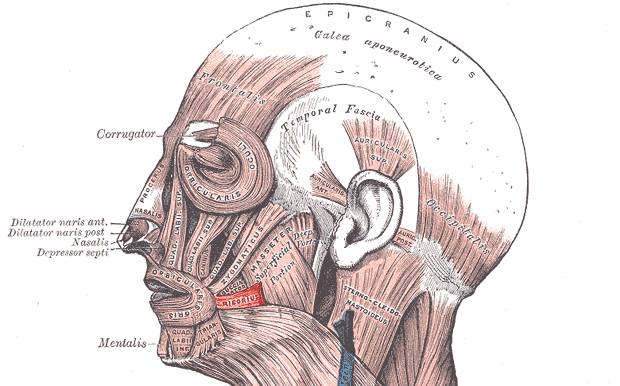
The risorius is a thin, superficial muscle of facial expression located within the subcutaneous tissue of the lateral cheek, extending horizontally from the parotid–masseteric fascia toward the modiolus at the angle of the mouth. It is one of the most variable muscles of the facial musculature, both in presence and morphology. In some individuals the muscle may be poorly developed or completely absent, reflecting its secondary role in facial expression compared with more powerful perioral muscles.
Risorius Muscle
CORE
Overview
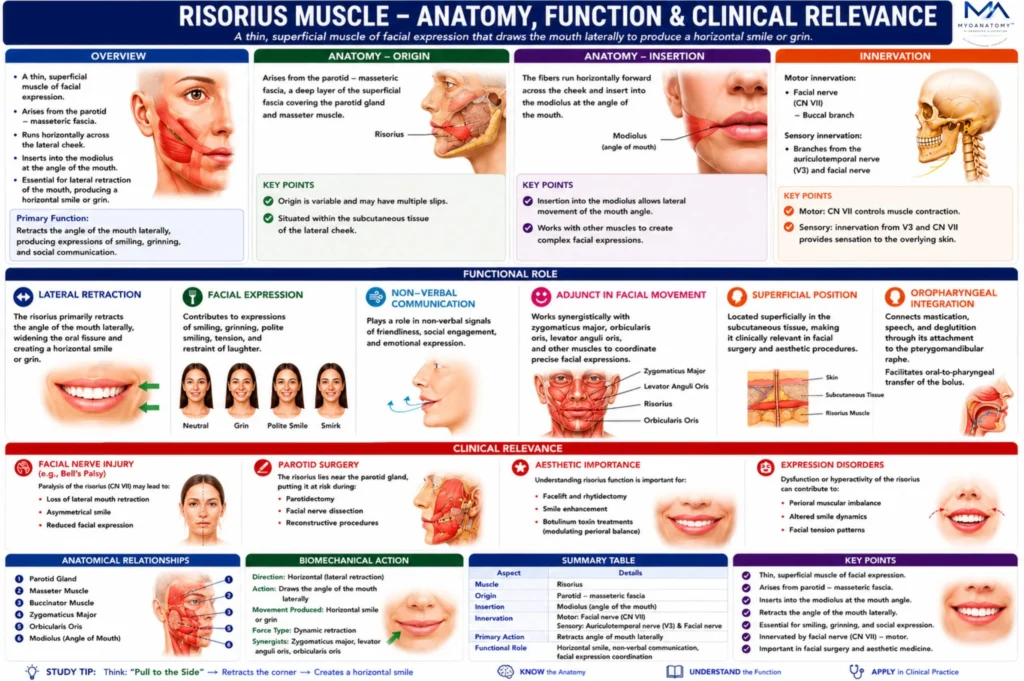
The risorius is a thin, superficial muscle of facial expression arising from the parotid – masseteric fascia and inserting into the modiolus at the angle of the mouth.
Functionally, the risorius is responsible for lateral retraction of the mouth angle, producing facial expressions associated with grinning, polite smiling, tension, or social smiling. Rather than elevating the mouth corner, it pulls it straight laterally, flattening the lips and widening the oral fissure.
Although relatively small and variable in development, the risorius plays an important role in the coordination of perioral muscle activity, particularly in modulating the position of the oral commissure.
Clinically, it is relevant in facial nerve disorders, parotid gland surgery, and aesthetic facial procedures, where preservation of normal muscular function is essential for maintaining symmetrical facial expression.

ANATOMY
Origin
The risorius originates from superficial fascial structures of the cheek, including:
parotid fascia
masseteric fascia
occasionally fibers from the superficial musculoaponeurotic system (SMAS)
Because these origins are fascial rather than osseous, the risorius functions primarily as a cutaneous muscle, transmitting tension across the facial soft tissues.
Exam Question
Describe the anatomical origin of the risorius muscle from the parotid fascia, masseteric fascia, and superficial musculoaponeurotic system (SMAS). How do these fascial attachments influence its biomechanical function as a cutaneous muscle of facial expression?
Insertion
The muscle fibers run horizontally and insert into:
modiolus (angle of the mouth)
fibers of the orbicularis oris muscle
Through its insertion into the modiolus,
Risorius contributes to the
Exam Question
Explain the insertion of the risorius into the modiolus and fibers of the orbicularis oris. How does this anatomical arrangement contribute to stabilization and controlled movement of the oral commissure during facial expression?
Anatomical Relation
The risorius occupies a superficial plane of the cheek, and therefore has important surgical and anatomical relationships.
superficial relations – skin of the cheek; Subcutaneous tissue
deep relations -masseter muscl , buccinator muscle
Posterior relations -parotid gland parotid duct
Medial relations – modiolus ; orbicularis oris
Superior relations – zygomaticus major
Inferior relations – depressor anguli oris
These anatomical relationships are particularly important in facial surgery and parotid gland operations.
Fiber Direction and Architecture
The risorius is characterized by long, thin, horizontally oriented fibers. Unlike the vertical elevators or depressors of the mouth, the risorius produces pure lateral traction on the oral commissure.
Because the muscle arises from fascia rather than bone, its contraction primarily affects:
soft tissue tension of the cheek
lateral displacement of the mouth angle
This architecture allows it to act as a modulator of mouth width rather than mouth elevation.

Exam Question
Analyze the anatomical relationships of the risorius muscle with the skin, subcutaneous tissue, masseter, buccinator, parotid gland, modiolus, and adjacent muscles of facial expression. Why are these relationships clinically important during facial and parotid surgery?
Innervation
Motor innervation is provided by:
buccal branch of the facial nerve (CN VII)
The buccal branches supply many muscles of the midface and perioral region, forming a facial nerve plexus across the cheek.
Exam Question
Discuss the motor innervation of the risorius by the buccal branches of the facial nerve (CN VII). How can injury to these branches affect oral commissure mechanics, facial symmetry, and social facial expression?
FUNCTIONAL ROLE
Lateral Retraction
The risorius primarily retracts the angle of the mouth laterally, widening the oral fissure and producing a horizontal smile or grin.
Unlike the zygomaticus major, it does not significantly elevate the mouth corner, creating a more subtle and controlled facial expression.
Exam Question
Explain the biomechanical mechanism by which the risorius produces lateral retraction of the oral commissure. How does its action differ from that of the zygomaticus major during smiling?
Facial Expression
The muscle contributes to social smiling, polite smiling, restrained laughter, and expressions of tension.
Through fine adjustment of mouth-angle position, it plays an important role in non-verbal communication and emotional expression.
Exam Question
Evaluate the contribution of the risorius to social smiling, restrained laughter, and subtle emotional expression. Why is precise control of oral commissure position important for non-verbal communication
Perioral Coordination
The risorius functions in coordination with the zygomaticus major, levator anguli oris, orbicularis oris, buccinator, and depressor anguli oris. Together, these muscles provide precise control of the oral commissure during smiling, speech, and other complex facial movements
Exam Question
Discuss how the risorius cooperates with the zygomaticus major, levator anguli oris, orbicularis oris, buccinator, and depressor anguli oris to produce coordinated movements of the mouth during speech and facial expression
Modiolar Integration
By inserting into the modiolus, the fibromuscular hub of the mouth angle, the risorius helps stabilize and regulate the horizontal position of the oral commissure.
This integration contributes to facial symmetry, balanced lip movements, and coordinated expression of the lower face.
Exam Question
Explain the functional significance of the risorius insertion into the modiolus. How does modiolar integration facilitate stabilization, coordination, and fine control of oral commissure movement?
CLINICAL RELEVANCE
Facial Paralysis
The risorius receives motor innervation from the buccal branches of the facial nerve (CN VII).
Injury to these branches may weaken or paralyze the muscle, resulting in reduced lateral movement of the oral commissure, asymmetrical smiling, and impaired control of mouth-angle position. Such findings are commonly observed in facial nerve palsy and traumatic injuries of the midface.
Exam Question
Analyze the clinical manifestations of risorius dysfunction following facial nerve (CN VII) injury. How does paralysis of the risorius contribute to impaired smiling, oral commissure asymmetry, and altered facial expression?
Surgical Relevance
Because the risorius lies in close proximity to the parotid gland and its associated facial nerve branches, it represents an important anatomical consideration during parotidectomy, facial nerve surgery, and midfacial operative procedures.
Preservation of neural integrity is essential to maintain normal smile mechanics and facial symmetry.
Exam Question
Evaluate the surgical importance of the risorius during parotidectomy, facial nerve surgery, and midfacial reconstructive procedures. Why is preservation of the buccal branches of the facial nerve essential for maintaining normal smile mechanics?
Aesthetic Applications
The risorius is clinically relevant in facelift surgery, midface rejuvenation procedures, and selected aesthetic interventions.
Alterations in muscle function may influence the width, symmetry, and overall appearance of the smile, making detailed anatomical knowledge important for achieving natural cosmetic outcomes.
Exam Question
Discuss the anatomical and functional relevance of the risorius in facial rejuvenation and aesthetic medicine. How can alterations in risorius function influence smile dynamics and lower facial aesthetics?
Expression Disorders
Abnormal activity, weakness, or asymmetry of the risorius may contribute to uneven smiling, perioral muscular imbalance, and altered facial expression patterns.
Dysfunction of the muscle can disrupt normal emotional communication and affect the harmonious movement of the oral commissure during facial expression.
Exam Question
Analyze how weakness, hyperactivity, asymmetry, or abnormal coordination of the risorius may contribute to disorders of facial expression. What effects can these abnormalities have on oral commissure position and facial symmetry?
SUMMARY TABLE