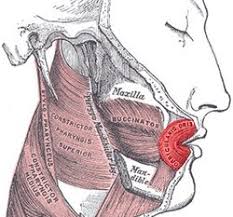
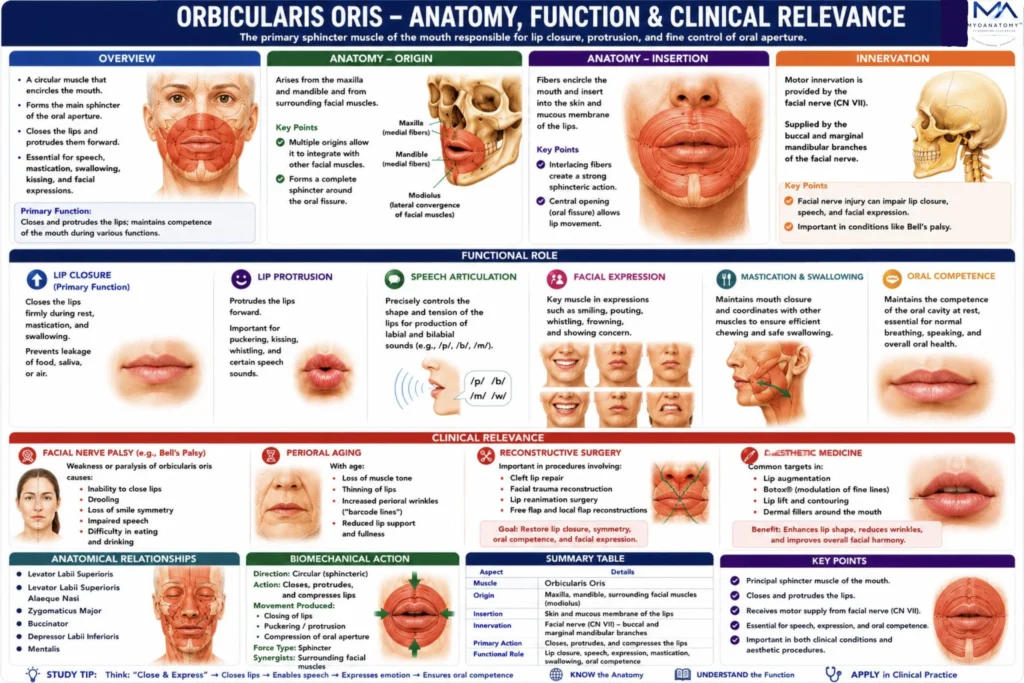
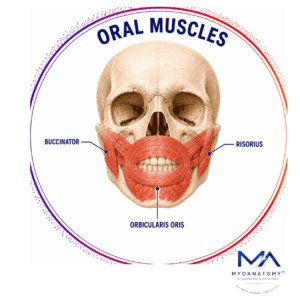
The orbicularis oris is the principal sphincter muscle of the oral aperture, forming a complex muscular structure that encircles the mouth. Unlike a simple circular muscle, the orbicularis oris represents a composite muscular system composed of fibers from multiple surrounding facial muscles, including the buccinator, levator labii superioris, depressor anguli oris, zygomaticus muscles, and other perioral muscles. These fibers interweave within the lips to form a functional muscular ring responsible for controlling movements of the lips.
Orbicularis Oris Muscle
CORE
Overview
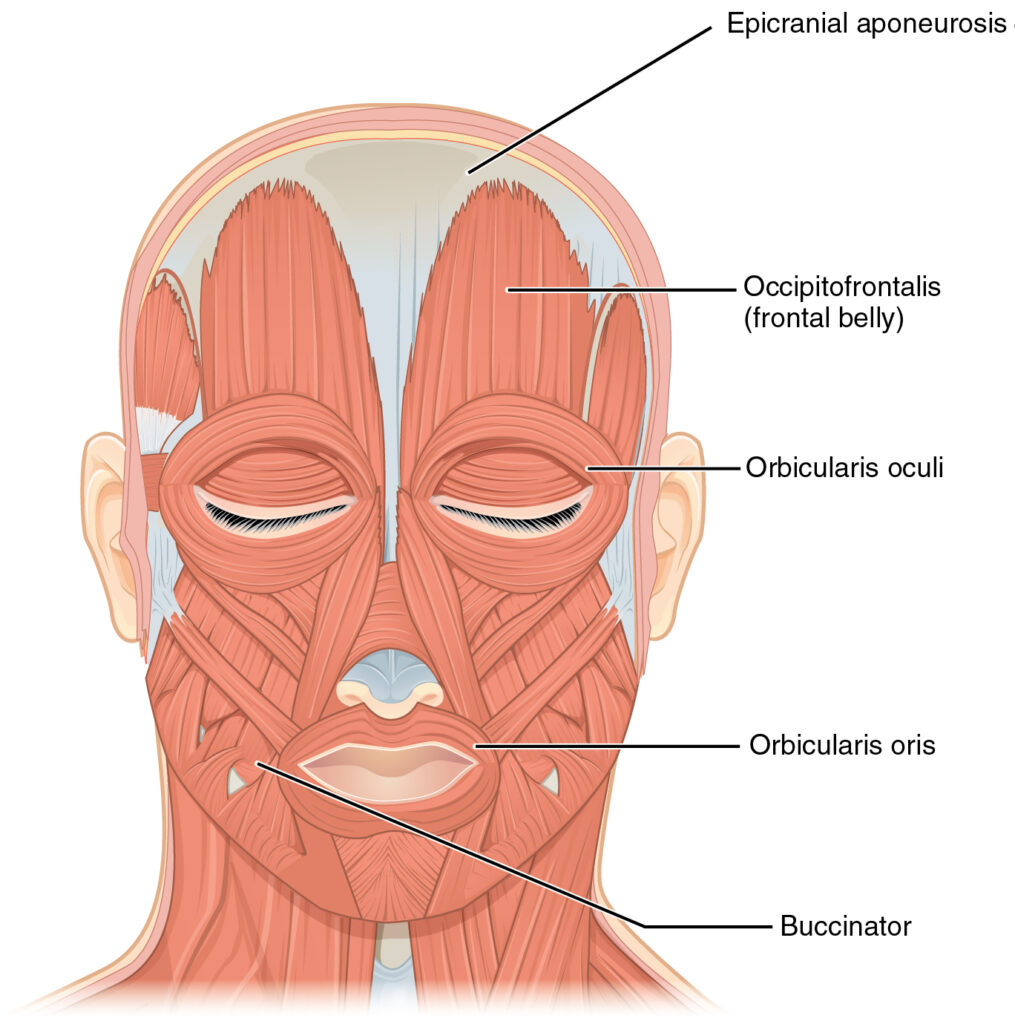
Anatomically, the orbicularis oris occupies the subcutaneous tissue of the upper and lower lips, lying superficial to the mucous membrane and deep to the skin of the lips.
Laterally, many of its fibers converge at the modiolus, a fibromuscular node located at the angle of the mouth where several muscles of facial expression interdigitate.
Orbicularis oris receives motor innervation from the facial nerve (cranial nerve VII).
The orbicularis oris is the central muscle of the lips and functions as the sphincter of the oral aperture. Through its complex arrangement of interlacing fibers derived from multiple facial muscles, it regulates lip closure, protrusion, and compression. This muscle plays an essential role in mastication, speech articulation, facial expression, and maintenance of oral competence.
Clinically, dysfunction of the orbicularis oris may occur in facial nerve paralysis, cleft lip, and perioral aging, highlighting its critical role in both functional and aesthetic aspects of facial anatomy

ANATOMY
Origin
Unlike many skeletal muscles, the orbicularis oris does not arise from a single fixed bony origin. Instead, it is formed by contributions from several surrounding muscles.
Major sources of muscular fibers include:
maxilla (medial fibers of the upper lip)
mandible (medial fibers of the lower lip)
modiolus (lateral convergence of facial muscles)
Fibers derived from surrounding muscles such as
buccinator
levator labii superioris
depressor anguli oris
zygomaticus major and minor
This arrangement forms a functional muscular ring around the mouth rather than a simple circular muscle
Exam Question
Describe the anatomical origin of the orbicularis oris and explain why it differs from the classical origin–insertion pattern observed in most skeletal muscles.
Insertion
The fibers of the orbicularis oris insert into:
skin and mucous membrane of the lips
dermis surrounding the oral fissure
The interlacing fibers allow the muscle to control both lip shape and lip movement, producing a wide variety of facial expressions and functional movements.
Exam Question
Explain how the insertion pattern of the orbicularis oris contributes to precise control of lip movement, facial expression, and oral competence
Innervation
Motor innervation is supplied by the facial nerve (cranial nerve VII) through:
buccal branches of the facial nerve
marginal mandibular branch of the facial nerve
These branches provide motor control to the muscles of the perioral region.
Exam Question
Discuss the motor innervation of the orbicularis oris, including the facial nerve branches involved and the functional consequences of their injury.
FUNCTIONAL ROLE
Mouth Closure
Orbicularis oris functions as the primary sphincter of the mouth, producing lip closure essential for food retention during mastication, initiation of swallowing, and maintenance of oral competence.
This action prevents leakage of saliva and oral contents while preserving the integrity of the oral cavity.
Exam Question
Why is orbicularis oris considered the primary sphincter of the oral fissure, and what roles does it play during mastication, swallowing, and oral continence?
Lip Protrusion
Coordinated contraction enables protrusion, compression, and shaping of the lips.
These movements are fundamental for kissing, whistling, controlled airflow regulation, and the formation of complex lip positions required during facial movement and oral function.
Exam Question
Describe the biomechanical actions of orbicularis oris in lip protrusion, compression, and shaping, and explain their importance in human communication and feeding.
Speech Articulation
The muscle plays a critical role in articulation by controlling precise lip closure and protrusion necessary for labial and bilabial consonant formation.
Fine neuromuscular control of the orbicularis oris allows accurate modulation of airflow, making it indispensable for clear verbal communication.
Exam Question
Explain the role of orbicularis oris in speech articulation. Which groups of speech sounds are most dependent on normal orbicularis oris function?
Perioral Integration
Acting as the central muscular hub of the perioral region, orbicularis oris integrates forces from surrounding facial muscles through the modiolus.
This coordinated interaction synchronizes movements of the upper lip, lower lip, and oral commissures, enabling efficient mastication, refined facial expression, and complex communicative functions.
Exam Question
Discuss the relationship between orbicularis oris and the modiolus. How does this muscular integration coordinate complex facial expressions?
CLINICAL RELEVANCE
Facial Paralysis
Injury to the facial nerve (CN VII) may weaken or paralyze the orbicularis oris, resulting in loss of effective lip closure, oral incompetence, drooling, impaired bilabial speech articulation, and asymmetry of the mouth.
These findings are characteristic features of peripheral facial nerve palsy, particularly Bell’s palsy.
Exam Question
How does facial nerve (CN VII) paralysis affect orbicularis oris function, and what clinical signs may be observed during examination of the perioral region?
Cleft Lip
Congenital failure of fusion of the upper lip musculature, including the orbicularis oris, results in cleft lip deformity.
Disruption of muscular continuity compromises normal lip function, feeding, speech development, and facial symmetry. Surgical repair aims to re-establish the anatomical and functional integrity of the muscle.
Exam Question
Explain the anatomical basis of cleft lip and discuss the importance of orbicularis oris reconstruction during surgical repair.
Perioral Aging
Age-related weakening and structural degeneration of the orbicularis oris contribute to the development of vertical perioral rhytides, loss of lip volume, and diminished lip support.
These changes represent major components of facial aging and are common targets of aesthetic and reconstructive facial procedures.
Exam Question
Describe the age-related structural and functional changes affecting orbicularis oris and explain how these changes contribute to perioral rhytides and lip support loss.
Oral Disfunction
Neurological disorders affecting peripheral facial nerve function or central motor control may impair orbicularis oris activity, leading to difficulty retaining food and liquids within the oral cavity, compromised swallowing efficiency, reduced oral competence, and disturbances of speech articulation.
Exam Question
How can neurological disorders affecting facial motor control impair orbicularis oris function, and what consequences may result for speech, swallowing, and oral competence?
SUMMARY TABLE