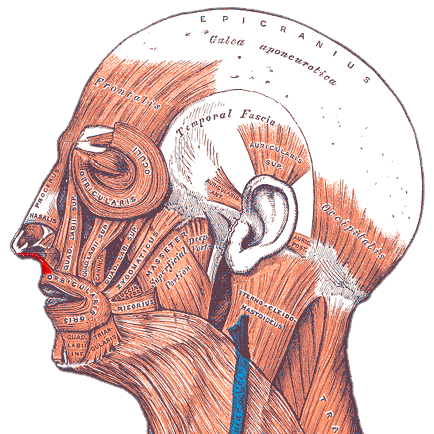
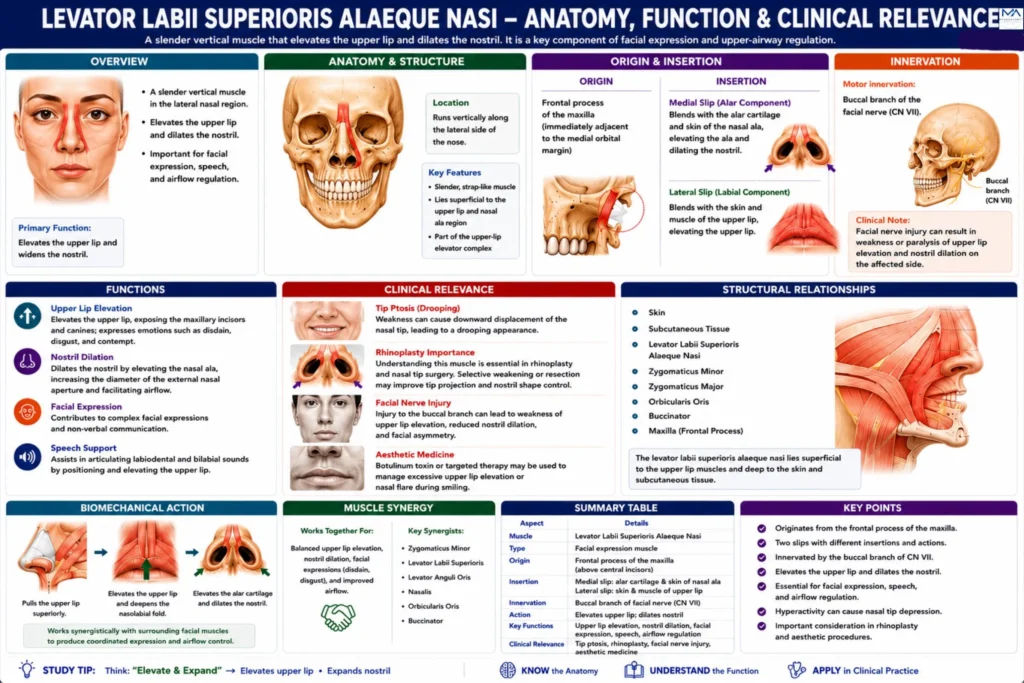
The levator labii superioris alaeque nasi is a slender vertical muscle located along the lateral side of the nose, extending from the frontal process of the maxilla to the upper lip and nasal ala. Because it elevates both the upper lip and the nasal wing, it is often referred to as the “Elvis muscle” due to the characteristic facial expression it produces.
Levator Labii Superioris Alaeque Nasi Muscle
CORE
Overview
This muscle forms the most medial component of the upper-lip elevator complex, which also includes:
levator labii superioris
zygomaticus minor
zygomaticus major
Together these muscles regulate upper lip elevation and nasal movement during facial expression.
The levator labii superioris alaeque nasi lies medial to the levator labii superioris and lateral to the nasal bones and upper nasal cartilages, forming part of the muscular framework that shapes the nasolabial region.
Functionally, is a key muscle of the nasolabial region, responsible for elevating the upper lip and dilating the nostril. Through its dual insertion into the nasal ala and upper lip, it plays an important role in facial expression, nasal airflow regulation, and speech articulation.
Clinically, the muscle is significant in facial nerve pathology, cosmetic facial procedures, and nasal surgery, highlighting its importance in both functional and aesthetic aspects of facial anatomy.
ANATOMY
Origin
The levator labii superioris alaeque nasi arises from:
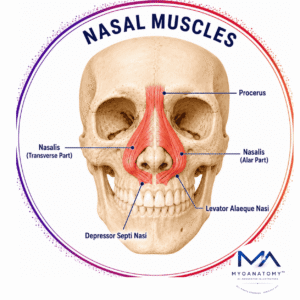
frontal process of the maxilla
This origin lies immediately adjacent to the medial orbital margin
Exam Question
Discuss the origin of the levator labii superioris alaeque nasi from the frontal process of the maxilla and explain how this attachment supports its actions on the upper lip and nasal ala.
Insertion
The muscle divides inferiorly into two distinct slips:
Medial slip (nasal component) – inserts into: alar cartilage of the nose
Lateral slip (labial component)- inserts into: skin and muscle of the upper lip, blending with fibers of orbicularis oris.
Exam Question
Describe the dual insertion of the levator labii superioris alaeque nasi and explain the functional significance of its alar and labial components.
Innervation
Motor innervation is provided by the: Buccal branch of the facial nerve (CN VII) occasionally contributions from the zygomatic branch
These branches form part of the facial nerve plexus supplying the midface muscles.
Exam Question
Describe the facial nerve supply of the levator labii superioris alaeque nasi and discuss the effects of facial nerve injury on muscle function and facial symmetry.
FUNCTIONAL ROLE
Upper Lip Elevation
The principal action of the levator labii superioris alaeque nasi is elevation of the upper lip. Contraction raises the upper lip superiorly, exposing the maxillary incisors and canine teeth.
This movement contributes significantly to facial expressions associated with disgust, contempt, disdain, and aggressive snarling, enhancing emotional communication through modification of the oral aperture and dentition display.
Exam Question
Explain how contraction of the levator labii superioris alaeque nasi elevates the upper lip and contributes to facial expressions such as disgust and contempt.
Nostril Dillation
The medial (alar) fibers elevate and slightly dilate the nasal ala, increasing the diameter of the external nasal aperture. This action enlarges the nasal vestibule and facilitates airflow through the anterior nasal passages, particularly during increased respiratory demand.
The muscle therefore serves both expressive and respiratory functions by influencing nostril configuration.
Exam Question
Discuss the role of the levator labii superioris alaeque nasi in nostril dilation and explain its importance during increased respiratory demand.
Facial Expression
The muscle plays a major role in nasolabial facial expression by combining upper-lip elevation with subtle nostril movement. Its activity contributes to characteristic expressions of disdain, displeasure, aggression, and nasal wrinkling.
Through coordinated contraction, it helps generate complex facial movements that communicate emotional states with high precision.
Exam Question
Evaluate the contribution of the levator labii superioris alaeque nasi to facial expression and non-verbal communication.
Speech Support
The muscle contributes to upper-lip positioning during speech. Working with adjacent perioral muscles, it assists articulation of labiodental and bilabial sounds by regulating upper-lip movement and oral aperture shape.
This coordination supports clear speech and effective verbal communication.
Exam Question
Explain how the levator labii superioris alaeque nasi assists speech by influencing upper-lip position and articulation
CLINICAL RELEVANCE
Facial Nerve Palsy
Because the levator labii superioris alaeque nasi is supplied by the facial nerve (CN VII), facial nerve dysfunction may impair elevation of the upper lip and dilation of the nostril.
Patients may demonstrate reduced facial symmetry, diminished nostril flare, and altered expression during smiling or emotional movement. Assessment of this muscle can therefore contribute to localization and evaluation of facial nerve lesions.
Exam Question
Discuss the functional consequences of facial nerve paralysis involving the levator labii superioris alaeque nasi muscle. Explain how muscle dysfunction affects upper-lip elevation, nostril dilation, facial symmetry, and clinical assessment of facial nerve integrity.
Nasal Valve Disfunction
The levator labii superioris alaeque nasi contributes to stabilization and dilation of the external nasal aperture.
Weakness or dysfunction of the muscle may reduce nostril expansion during inspiration, potentially contributing to impaired nasal airflow and increased airway resistance. This relationship is particularly relevant in patients with nasal valve compromise
Exam Question
Evaluate the role of the levator labii superioris alaeque nasi in maintaining nasal valve competence. Discuss how dysfunction of the muscle may influence nasal airflow, respiratory mechanics, and upper airway patency.
Rhinoplasty Surgery
The levator labii superioris alaeque nasi represents an important anatomical landmark during rhinoplasty and reconstructive nasal procedures.
Surgical disruption may alter nostril contour, nasal symmetry, and dynamic facial movement. Understanding its anatomy is therefore essential for preserving both aesthetic and functional outcomes.
Exam Question
Critically discuss the surgical significance of the levator labii superioris alaeque nasi in rhinoplasty and nasal reconstruction. Explain how preservation of the muscle contributes to optimal nasal function, facial symmetry, and postoperative aesthetic outcomes.
Aesthetic Medicine
Hyperactivity of the levator labii superioris alaeque nasi may produce excessive upper-lip elevation and exaggerated nostril flare during smiling.
In selected patients, botulinum toxin may be used to reduce muscle activity and improve smile balance, gingival display, and nasal aesthetics. Accurate anatomical knowledge is essential to achieve predictable results while avoiding undesirable facial asymmetry.
Exam Question
Discuss the anatomical rationale for targeting the levator labii superioris alaeque nasi in aesthetic medicine. Evaluate how muscle modulation may influence gingival display, nostril flare, smile dynamics, facial aesthetics, and potential treatment complications.
SUMMARY TABLE