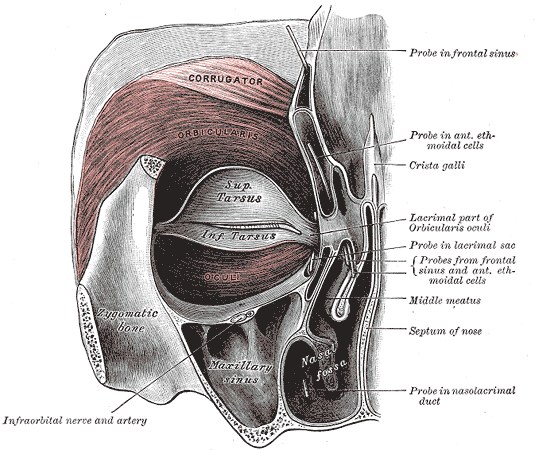
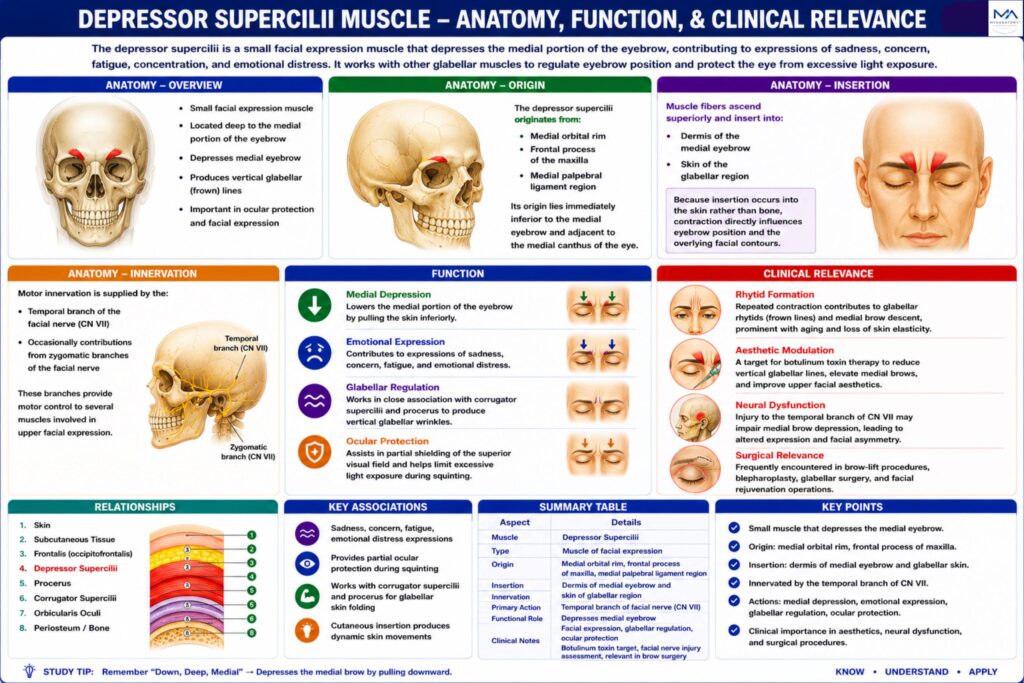
The depressor supercilii is a small paired muscle of facial expression located in the medial orbital region, deep to the orbicularis oculi and closely associated with the corrugator supercilii. It occupies the inferomedial aspect of the eyebrow and contributes to the dynamic control of eyebrow position during facial expression.

Depressor Supercilli Muscle

CORE

Overview

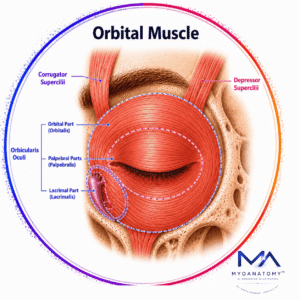
Although often regarded as a deep component of the orbicularis oculi or as fibers functionally integrated with the corrugator supercilii, the depressor supercilii is recognized as an independent muscle in many anatomical descriptions because of its distinct role in brow depression.

Functionally, the muscle acts primarily to depress the medial portion of the eyebrow, contributing to expressions of sadness, concern, fatigue, concentration, and emotional distress. Through its coordinated action with adjacent glabellar muscles, it helps regulate eyebrow height and contour while protecting the eye from excessive light exposure.

Within the functional anatomy of the glabellar region, the depressor supercilii operates in close association with:

corrugator supercilii

procerus

orbicularis oculi

frontalis (occipitofrontalis)

Together, these muscles form an integrated muscular complex responsible for precise movements of the eyebrows and forehead skin.

Clinically, the depressor supercilii is important in facial nerve assessment, cosmetic procedures, brow surgery, and botulinum toxin therapy.

ANATOMY

Origin

The depressor supercilii originates from:

medial orbital rim

frontal process of the maxilla

medial palpebral ligament region

Its origin lies immediately inferior to the medial eyebrow and adjacent to the medial canthus of the eye.

Exam Question

How does the anatomical origin of the depressor supercilii determine its influence on medial eyebrow movement and glabellar contour?

Insertion

Muscle fibers ascend superiorly and insert into:

dermis of the medial eyebrow

skin of the glabellar region

Because insertion occurs into the skin rather than bone, contraction directly influences eyebrow position and overlying facial contours

Exam Question

Why is insertion into the dermis of the medial eyebrow and glabellar skin functionally important for facial expression?

Innervation

Motor innervation is supplied by the:

Temporal branch of the facial nerve (CN VII)

Occasionally contributions from zygomatic branches of the facial nerve

These branches provide motor control to several muscles involved in upper facial expression.


Exam Question

How does facial nerve (CN VII) innervation enable depressor supercilii function, and what deficits occur following nerve injury?

FUNCTIONAL ROLE

Medial Depression

The depressor supercilii lowers the medial portion of the eyebrow by exerting an inferior traction force on the overlying skin. This action contributes to regulation of eyebrow position and creates a downward inclination of the medial brow during facial expression.

Exam Question

Explain how contraction of the depressor supercilii produces medial eyebrow depression and regulates brow position.

Emotional Expression

Contraction of the muscle enhances facial expressions associated with sadness, concern, fatigue, emotional distress, and focused concentration. 

By depressing the medial eyebrow, it increases the perceived emotional intensity of the upper face.

Exam Question

How does depressor supercilii activity contribute to facial expressions of sadness, concern, and concentration?

Glabellar Regulation

Acting synergistically with the corrugator supercilii and procerus, the depressor supercilii participates in dynamic control of the glabellar complex. Coordinated contraction produces medial brow descent, increased glabellar skin folding, and augmentation of frowning movements.

Exam Question

How does the depressor supercilii interact with the corrugator supercilii and procerus to regulate the glabellar region?

Occular Protection

Inferior displacement of the medial eyebrow provides partial shielding of the superior visual field and assists in limiting excessive light exposure. This protective action complements the functions of the orbicularis oculi and corrugator supercilii during squinting and sustained visual focus

Exam Question

How does medial brow depression assist in ocular protection and visual focus?

CLINICAL RELEVANCE

Rhytid Formation

Repeated contraction of the depressor supercilii contributes to the development of glabellar rhytids (frown lines), medial brow descent, and progressive age-related facial creasing. 

These changes become increasingly pronounced with aging and loss of dermal elasticity.

Exam Question

Why does repetitive contraction of the depressor supercilii contribute to glabellar wrinkle formation and brow descent?

Aesthetic Modulation

The depressor supercilii is a recognized target for botulinum toxin therapy. 

Selective muscle relaxation reduces glabellar lines, facilitates mild medial brow elevation, and improves upper facial aesthetics, making precise anatomical localization essential for effective treatment.

Exam Question

Why is the depressor supercilii a key target during botulinum toxin treatment of the glabellar region?

Neural Disfunction

Injury to the temporal branch of the facial nerve (CN VII) may impair depressor supercilii function, resulting in weakened brow depression, altered eyebrow symmetry, and diminished upper facial expressiveness. 

Assessment of brow movement can assist in localization of facial nerve lesions.

Exam Question

What functional and clinical changes occur following paralysis of the depressor supercilii?

Surgical Relevance

The muscle is frequently encountered during brow-lift procedures, blepharoplasty, glabellar surgery, and facial rejuvenation operations. 

Accurate identification and preservation are important for maintaining normal eyebrow biomechanics and achieving postoperative facial symmetry.

Exam Question

Why must the depressor supercilii be identified and preserved during brow-lift, blepharoplasty, and glabellar surgery?

SUMMARY TABLE

Scroll to Top