Two complementary systems are recognized.
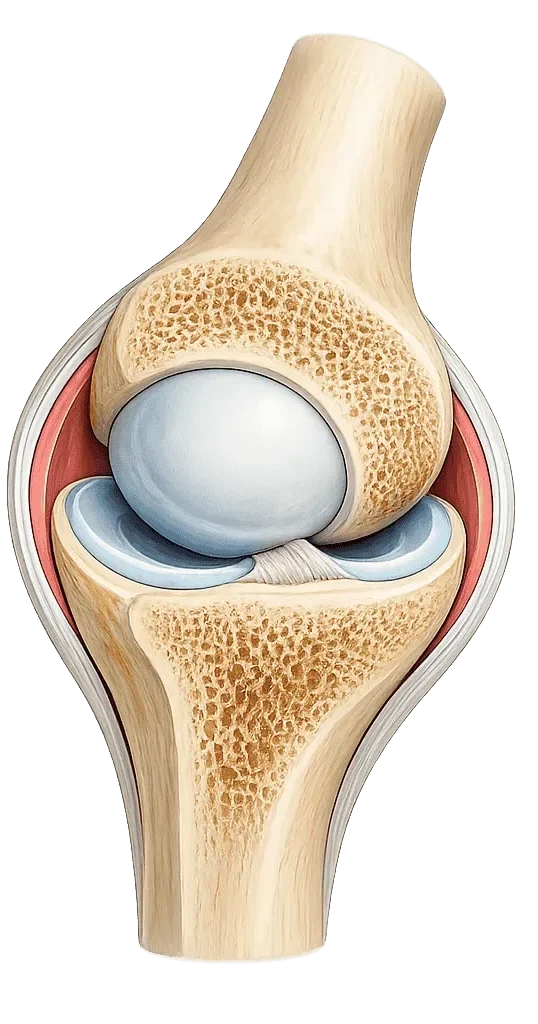
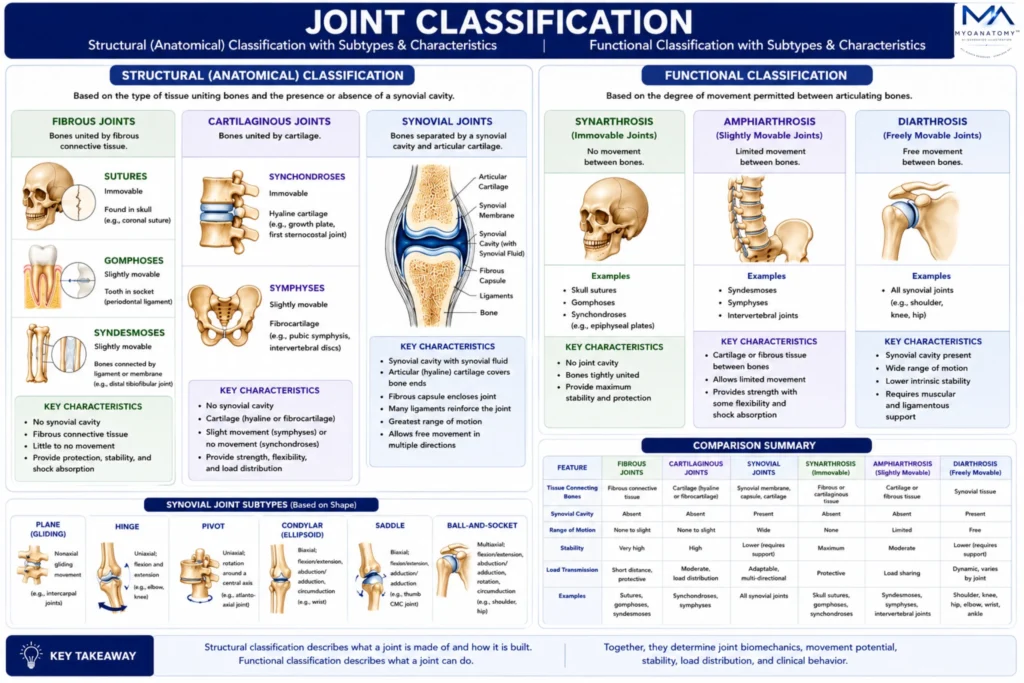
Structural classification is defined by the type of tissue uniting the bones and the presence or absence of a synovial cavity, categorizing joints into fibrous, cartilaginous, and synovial types.
Functional classification is based on the degree of mobility permitted between articulating surfaces, ranging from synarthrosis (immobile) through amphiarthrosis (limited movement) to diarthrosis (freely mobile).
These systems are functionally inseparable, as structural design determines mechanical performance. The material properties of connective tissue, the geometry of articular surfaces, and the presence of a synovial cavity collectively regulate degrees of freedom, load distribution, and joint kinematics.
Thus, joint classification is not purely descriptive but predictive, allowing inference of movement capacity, stability, and clinical behavior from anatomical structure.