Joint Classification
MYO CORE
Clinical Relevance
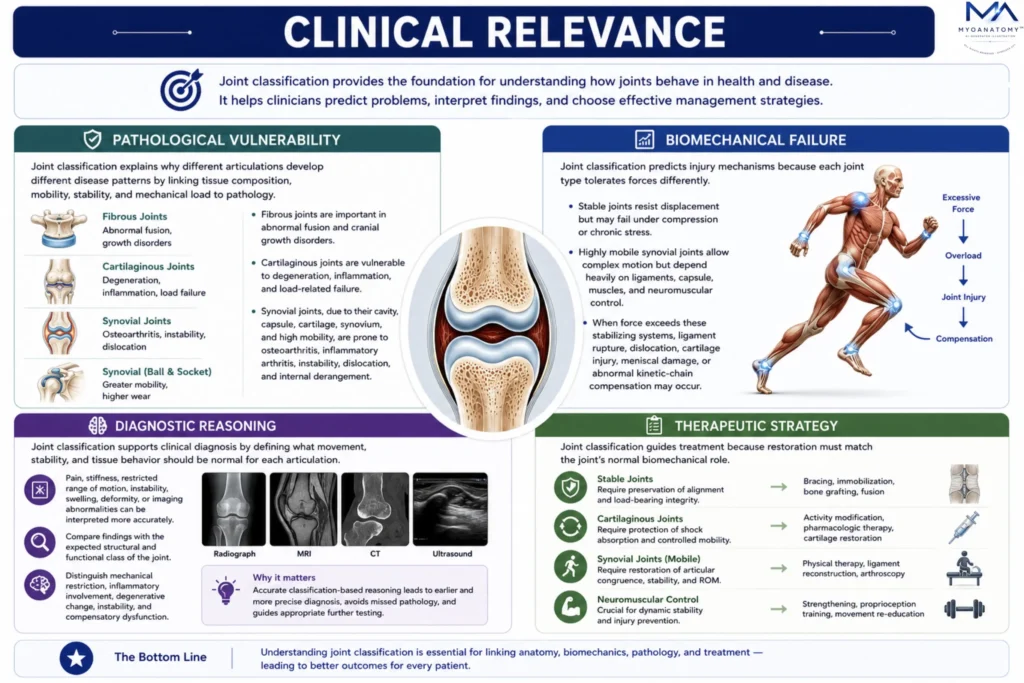
The clinical relevance of joint classification lies in its ability to predict joint function, biomechanical behavior, injury susceptibility, degenerative potential, and pathological response. Because structural and functional characteristics determine mobility, stability, load transmission, and tissue composition, joint classification provides a fundamental framework for understanding musculoskeletal disorders, diagnostic evaluation, orthopedic management, and rehabilitation strategies.
OVERVIEW
The clinical significance of joint classification extends beyond anatomical categorization and directly influences the diagnosis, progression, and management of musculoskeletal disease. Structural composition determines tissue-specific vulnerabilities, while functional classification predicts mechanical demands placed upon an articulation during normal activity and pathological states.
Fibrous joints are commonly associated with developmental abnormalities and premature fusion disorders, cartilaginous joints are frequently involved in degenerative, inflammatory, and load-related pathology, whereas synovial joints are particularly susceptible to instability, osteoarthritis, ligamentous injury, dislocation, and inflammatory arthropathies due to their extensive mobility.
Joint classification also provides insight into mechanisms of injury, patterns of degeneration, biomechanical dysfunction, and compensatory adaptations throughout the kinetic chain. Understanding the relationship between joint structure and function therefore allows clinicians to anticipate disease progression, interpret imaging findings, guide surgical intervention, optimize rehabilitation, and restore musculoskeletal performance.
Consequently, joint classification serves as an essential clinical foundation linking anatomy, biomechanics, pathology, orthopedics, sports medicine, and rehabilitation science.
Exam Question
How do structural and functional joint classifications predict tissue-specific pathology, biomechanical dysfunction, injury patterns, and clinical management across the musculoskeletal system?
ANATOMY
Pathological Vulnerability
Joint classification explains why different articulations develop different disease patterns by linking tissue composition, mobility, stability, and mechanical load to pathology.
Fibrous joints are clinically important in abnormal fusion and cranial growth disorders; cartilaginous joints are vulnerable to degeneration, inflammation, and load-related failure; synovial joints, because of their cavity, capsule, cartilage, synovium, and high mobility, are especially prone to osteoarthritis, inflammatory arthritis, instability, dislocation, and internal derangement.
Exam Question
How do tissue composition, joint cavity presence, mobility, and mechanical loading determine the pathological vulnerability of different joint classes?
Biomechanical Failure
Joint classification predicts injury mechanisms because each joint type tolerates forces differently.
Stable joints resist displacement but may fail under compression or chronic stress, whereas highly mobile synovial joints allow complex motion but depend heavily on ligaments, capsule, muscles, and neuromuscular control.
When force exceeds these stabilizing systems, ligament rupture, dislocation, cartilage injury, meniscal damage, or abnormal kinetic-chain compensation may occur.
Exam Question
Why does increased joint mobility increase dependence on dynamic stabilizers, and how does this relationship explain common patterns of biomechanical failure?
Diagnostic Reasoning
Joint classification supports clinical diagnosis by defining what movement, stability, and tissue behavior should be normal for each articulation.
Pain, stiffness, restricted range of motion, instability, swelling, deformity, or imaging abnormalities can be interpreted more accurately when compared with the expected structural and functional class of the joint.
This allows clinicians to distinguish mechanical restriction, inflammatory involvement, degenerative change, instability, and compensatory dysfunction.
Exam Question
How does knowledge of structural and functional joint classification improve interpretation of pain, restricted motion, instability, deformity, and imaging findings?
Therapeuric Staretegy
Joint classification guides treatment because restoration must match the joint’s normal biomechanical role.
Stable joints require preservation of alignment and load-bearing integrity; cartilaginous joints require protection of shock absorption and controlled mobility; synovial joints require restoration of articular congruence, cartilage health, capsuloligamentous stability, muscular control, and range of motion.
Therefore, classification directly informs surgical planning, rehabilitation priorities, mobility protection, stability restoration, and long-term functional recovery.
Exam Question
How should therapeutic management differ according to joint class when restoring mobility, stability, load transmission, and long-term musculoskeletal function?
SUMMARY TABLE