Joint Classification

MYO CORE

Functional Significance

The functional significance of joint classification lies in its ability to predict movement potential, mechanical stability, load distribution, and biomechanical behavior. By relating joint structure to function, it provides a foundation for understanding locomotion, posture, force transmission, and musculoskeletal performance.

OVERVIEW

The functional significance of joint classification lies in its ability to define how joints balance mobility, stability, force transmission, and biomechanical performance within the musculoskeletal system. Joints exist along a mobility–stability continuum, where increasing movement is generally associated with reduced intrinsic stability. 

Functional classification predicts the degrees of freedom, movement complexity, load distribution, shock absorption, and coordination of skeletal segments, thereby influencing locomotion, posture, and movement efficiency. 

Exam Question

How does functional joint classification define the relationship between mobility, stability, load transmission, and degrees of freedom, and why is this relationship essential for musculoskeletal biomechanics?

ANATOMY

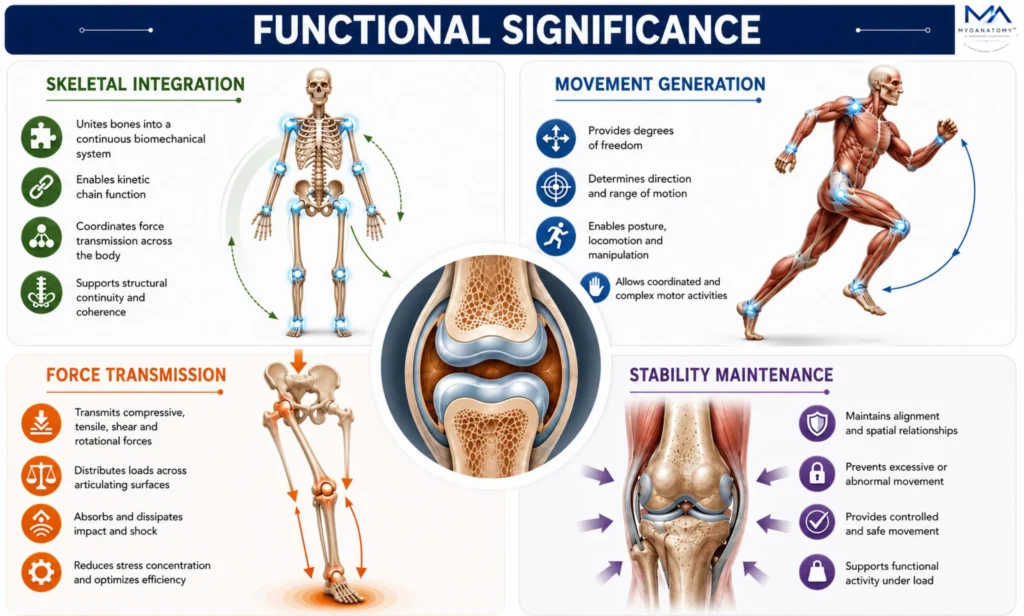
Skeletal Integration

Joints are the fundamental structural interfaces that integrate individual bones into a unified biomechanical system. Rather than functioning as isolated elements, bones become interconnected through articulations that establish continuity of force transmission, movement coordination, and structural support throughout the skeleton. 

This integration allows regional skeletal segments to operate collectively as kinetic chains, enabling efficient interaction between the axial and appendicular skeleton while maintaining overall mechanical coherence. 

Consequently, joints serve as the organizational framework through which the skeleton functions as a single dynamic unit rather than a collection of independent structures

Exam Question

How do joints establish biomechanical continuity between skeletal segments and transform the skeleton into an integrated functional system capable of coordinated movement and force transmission?

Movement Generation

Joints provide the anatomical and biomechanical platforms through which muscular forces are translated into controlled skeletal motion. By creating movable interfaces between bones, joints determine the direction, range, complexity, and degrees of freedom available for movement. 

Their structural design governs whether motion is restricted, guided, or multidirectional, thereby regulating posture, locomotion, manipulation, balance, and complex motor function. 

Without joints, muscular contraction would generate force but would be incapable of producing meaningful skeletal displacement or coordinated movement.

Exam Question

How does joint architecture regulate the conversion of muscular force into controlled skeletal motion and determine the biomechanical complexity of movement?

Force Transmission

Joints function as specialized biomechanical conduits that coordinate the transmission, distribution, absorption, and redirection of mechanical forces throughout the musculoskeletal system. 

During standing, locomotion, lifting, and other physical activities, articulations manage compressive, tensile, shear, and rotational stresses while preserving tissue integrity and movement efficiency. Through their structural organization, joints distribute loads across skeletal segments, prevent localized stress concentration, and optimize mechanical performance. 

This capacity allows the skeleton to function as an efficient load-bearing framework capable of adapting to diverse biomechanical demands.

Exam Question

How do joints coordinate the transmission, distribution, and modulation of mechanical forces to maintain skeletal efficiency and structural integrity during functional activity?

Stability Maintenance

Joints maintain precise spatial relationships between articulating bones while simultaneously permitting the movement necessary for functional activity. Through the integrated action of articular geometry, connective tissues, ligamentous restraints, and surrounding musculature, joints regulate motion within physiologically acceptable limits and resist excessive displacement. 

This dynamic balance between mobility and stability preserves skeletal alignment, ensures efficient force transfer, and enables controlled movement without compromising structural integrity. 

As a result, joint stability represents an active biomechanical process essential for maintaining both movement precision and skeletal support.

Exam Question

How do joints achieve the biomechanical balance between mobility and stability required to preserve alignment, control movement, and maintain musculoskeletal function?

SUMMARY TABLE

Scroll to Top