Cervical Plexus
MYO CORE
Innervation
The cervical plexus provides integrated general somatic efferent (GSE), general somatic afferent (GSA), and postganglionic sympathetic general visceral efferent (GVE) innervation through its superficial cutaneous, deep muscular, communicating, ansa cervicalis, and phrenic branches, coordinating cervical motor function, cutaneous sensation, autonomic regulation, swallowing, and diaphragmatic respiration throughout the neck and cervicothoracic region.
OVERVIEW
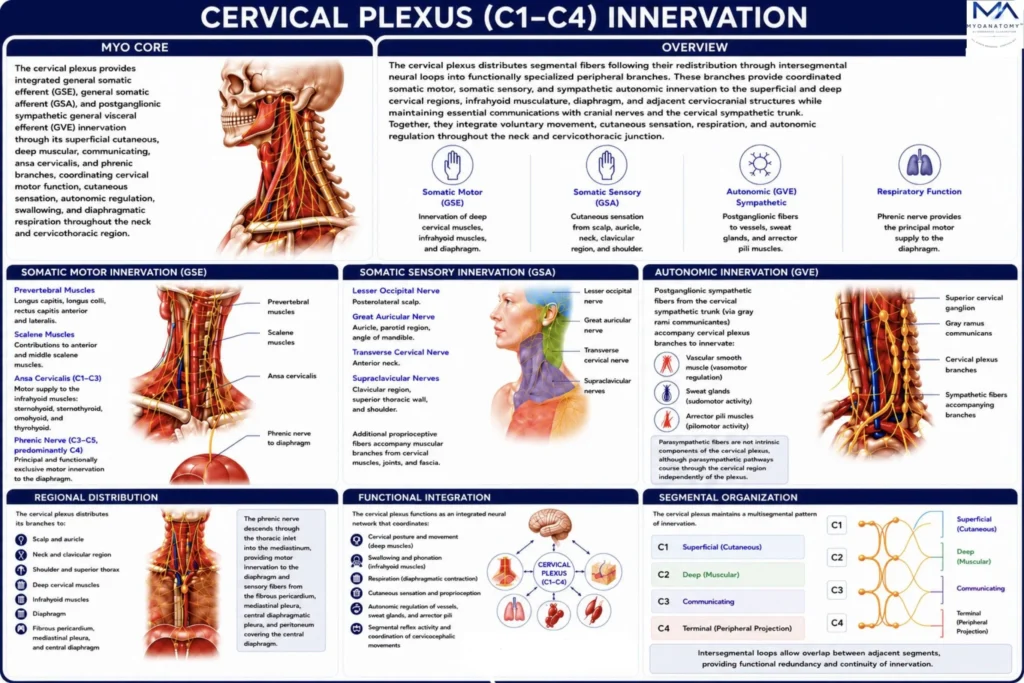
Following redistribution through its intersegmental plexiform network, the cervical plexus distributes fibers derived from the anterior (ventral) rami of C1–C4 into specialized peripheral branches that convey general somatic efferent (GSE), general somatic afferent (GSA), and postganglionic sympathetic general visceral efferent (GVE) fibers.
Motor fibers innervate the deep cervical musculature, infrahyoid muscles, and diaphragm; sensory fibers supply the cutaneous territories of the occipital region, auricle, anterolateral neck, clavicular region, and superior shoulder; while accompanying postganglionic sympathetic fibers regulate vasomotor, sudomotor, and pilomotor activity.
Through extensive communications with the hypoglossal nerve (CN XII), accessory nerve (CN XI), vagus nerve (CN X), and the cervical sympathetic trunk, the cervical plexus integrates cervical movement, somatic sensation, proprioception, respiration, and autonomic homeostasis throughout the head, neck, and cervicothoracic junction
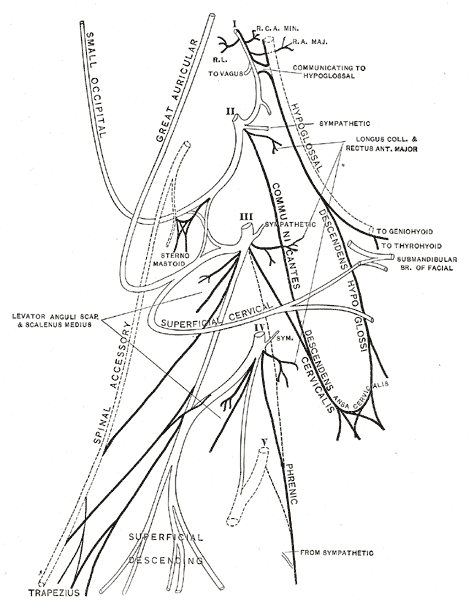
Henry Gray, Anatomy of the Human Body (20th ed., 1918), Plate 804. Illustration by Henry Vandyke Carter via Wikimedia Commons. Public Domain.
Exam Question
How does segmental redistribution of GSE, GSA, and postganglionic sympathetic GVE fibers enable the cervical plexus to coordinate somatic, respiratory, and autonomic function throughout the cervicocranial and cervicothoracic regions?
ANATOMY
Somatic Motor Innervation
General somatic efferent (GSE) fibers provide motor innervation to the prevertebral muscles (longus capitis, longus colli, rectus capitis anterior, and rectus capitis lateralis) together with proprioceptive contributions to the levator scapulae and anterior and middle scalene muscles.
Through the ansa cervicalis (C1–C3), the plexus supplies the sternohyoid, sternothyroid, and omohyoid muscles, while C1 fibers traveling with the hypoglossal nerve (CN XII) innervate the thyrohyoid and geniohyoid muscles.
The phrenic nerve (C3–C5, predominantly C4) provides the principal and functionally exclusive motor innervation to the diaphragm. Collectively, these motor pathways coordinate cervical stability, swallowing, laryngeal positioning, and diaphragmatic respiration.
Exam Question
How do the segmental GSE components of the cervical plexus coordinate cervical stability, infrahyoid muscle activity, and diaphragmatic contraction through the ansa cervicalis, C1 fibers accompanying CN XII, and the phrenic nerve?
Somatic Sensory Innervation
General somatic afferent (GSA) fibers provide cutaneous sensation through the lesser occipital, great auricular, transverse cervical, and supraclavicular nerves, supplying the posterolateral scalp, auricle, parotid region, angle of the mandible, anterolateral neck, clavicular region, superior thoracic wall, and shoulder.
Additional proprioceptive fibers accompany muscular branches from the cervical musculature, cervical joints, and deep cervical fascia, contributing to postural control and coordinated cervicocephalic movement.
Considerable overlap exists between adjacent sensory territories, providing functional redundancy within the cervical dermatomes.
Exam Question
How do the superficial sensory branches of the cervical plexus establish overlapping dermatomal territories while integrating cutaneous sensation with cervical proprioception and postural control?
Autonomic Innervation
The cervical plexus conveys postganglionic sympathetic general visceral efferent (GVE) fibers originating from the cervical sympathetic trunk via the gray rami communicantes.
These fibers accompany virtually all peripheral branches to innervate vascular smooth muscle, sweat glands, and arrector pili muscles, thereby regulating vasomotor tone, sudomotor secretion, and pilomotor activity throughout the cervical integument.
Parasympathetic fibers are not intrinsic components of the cervical plexus, although parasympathetic pathways traverse the cervical region independently through cranial autonomic pathways.
Exam Question
How are postganglionic sympathetic GVE fibers incorporated into cervical plexus branches, and why are parasympathetic fibers excluded from the intrinsic fiber composition of the plexus?
Regional Distribution
The cervical plexus demonstrates a highly organized topographical distribution. Superficial cutaneous branches supply the scalp, auricle, neck, clavicular region, and superior shoulder, whereas deep muscular branches innervate the prevertebral and infrahyoid musculature.
The phrenic nerve descends through the thoracic inlet into the mediastinum, providing motor innervation to the diaphragm and sensory innervation to the fibrous pericardium, mediastinal pleura, central diaphragmatic pleura, and central diaphragmatic peritoneum.
This regional organization establishes functional continuity between the cervical region and superior thorax.
Exam Question
How does the topographical distribution of cervical plexus branches integrate cervical and thoracic structures to coordinate somatic motor, sensory, respiratory, and autonomic function?
Functional Integration
The cervical plexus functions as a multisegmental neural network that integrates voluntary motor control, somatic sensation, proprioception, autonomic regulation, swallowing, phonation, cervical stabilization, and diaphragmatic respiration.
Continuous interaction between cervical spinal nerves, cranial nerves (particularly CN XI and CN XII), and the cervical sympathetic trunk permits synchronized neuromuscular activity, segmental reflex integration, respiratory coordination, and adaptive cervicocephalic movement.
Exam Question
How does multisegmental integration between cervical spinal nerves, cranial nerves, and the sympathetic nervous system optimize coordinated cervical movement, respiration, and neurological redundancy?
Segmental Organization
The cervical plexus maintains a multisegmental pattern of innervation, whereby fibers from individual cervical spinal segments contribute to multiple peripheral nerves and target structures.
Rather than functioning as isolated spinal nerves, C1–C4 fibers intermingle within the plexus before redistribution, allowing individual muscles and cutaneous territories to receive overlapping segmental input.
This organization enhances functional redundancy, preserves coordinated neuromuscular activity following partial nerve injury, and provides the anatomical basis for overlapping cervical dermatomes and myotomes.
Exam Question
How does the multisegmental organization of C1–C4 fibers within the cervical plexus establish overlapping myotomal and dermatomal innervation, and why is this organization functionally advantageous?
SUMMARY TABLE