Venous Drainage

MYO CORE

Clinical Relevance

Venous dysfunction elevates venous and capillary hydrostatic pressure, impairs tissue perfusion, promotes edema and thrombosis, and disrupts microvascular homeostasis. Progressive failure of venous drainage compromises oxygen delivery, waste clearance, and tissue viability, making venous pathology a major determinant of cardiovascular and musculoskeletal disease.

CLINICAL RELEVANCE

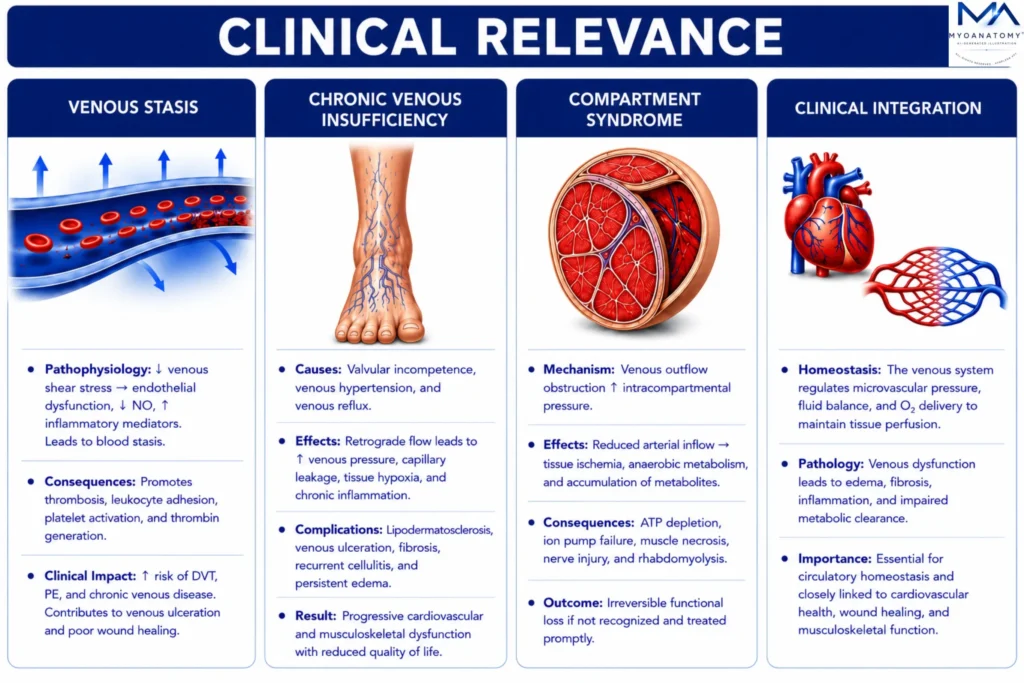
Venous Stasis

Venous stasis represents pathological reduction of venous shear stress, disrupting endothelial mechanotransduction and suppressing nitric oxide–mediated antithrombotic signaling. Endothelial activation promotes expression of P-selectin, ICAM-1, VCAM-1, and tissue factor, facilitating leukocyte recruitment, platelet adhesion, and thrombin generation. 

Progressive venous hypertension increases capillary hydrostatic pressure, impairing microvascular oxygen diffusion and predisposing to deep vein thrombosis, chronic edema, inflammatory tissue injury, and pulmonary embolism.

Chronic Venous Insufficiency

Chronic venous insufficiency arises from valvular incompetence and sustained ambulatory venous hypertension, producing persistent retrograde flow and elevated transmural venous pressure. 

Chronic venous hypertension disrupts the endothelial glycocalyx, increases capillary permeability, and promotes leukocyte trapping, matrix metalloproteinase activation, oxidative stress, and extracellular matrix remodeling

These processes progressively impair microvascular perfusion, culminating in lipodermatosclerosis, venous ulceration, fibrosis, and chronic tissue hypoxia.

Compartment Syndrome

Compartment syndrome is initiated by venous outflow obstruction, which elevates intracompartmental pressure and progressively reduces the arteriovenous perfusion gradient. Once tissue pressure approaches capillary perfusion pressure, microvascular collapse develops despite preserved arterial inflow. 

Cellular ischemia induces mitochondrial dysfunction, ATP depletion, ionic pump failure, intracellular calcium overload, and reperfusion-mediated oxidative injury, ultimately causing skeletal muscle necrosis, peripheral nerve infarction, rhabdomyolysis, and irreversible functional loss.

Clinical Integration

Venous drainage is a fundamental regulator of microvascular homeostasis, integrating venous return with Starling forces, lymphatic drainage, endothelial mechanobiology, and tissue oxygen transport. Impaired venous outflow elevates venous and capillary hydrostatic pressures, shifting transcapillary fluid exchange toward persistent filtration while reducing effective oxygen and nutrient diffusion. 

The resulting interstitial hypertension, endothelial dysfunction, inflammatory activation, and impaired metabolic clearance establish a self-perpetuating cycle of edema, fibrosis, delayed healing, and progressive cardiovascular and musculoskeletal dysfunction.

SUMMARY TABLE

Scroll to Top