Venous Drainage
MYO CORE
Venous Return
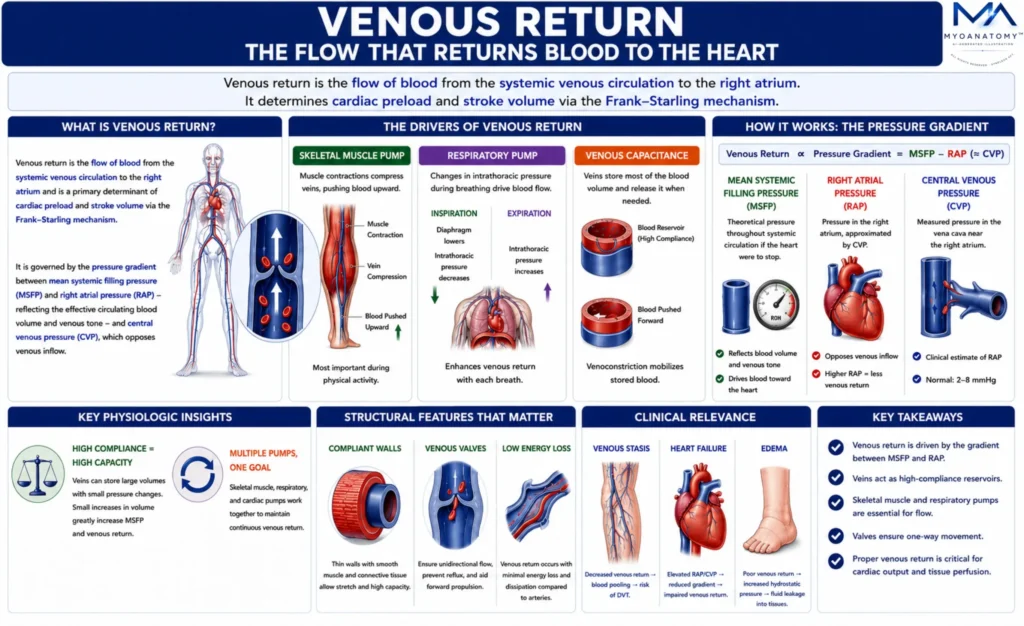
Venous return is the flow of blood from the systemic venous circulation to the right atrium and is a primary determinant of cardiac preload and stroke volume via the Frank–Starling mechanism.
OVERVIEW
It is governed by the pressure gradient between mean systemic filling pressure (MSFP) – reflecting the effective circulating blood volume and venous tone – and right atrial pressure (central venous pressure, CVP), which opposes venous inflow.
Veins function as high-compliance capacitance vessels, capable of storing large blood volumes and dynamically modulating venous return. Sympathetic venoconstriction reduces venous capacitance, elevates MSFP, and enhances the pressure gradient driving blood toward the heart, whereas increased CVP impairs return.
Structural features, including compliant vessel walls and venous valves, ensure unidirectional flow and minimize energy dissipation.
Venous return is therefore a dynamically regulated parameter integrating vascular tone, blood volume, and cardiac function to maintain circulatory equilibrium.
Exam Question
Explain how the MSFP–CVP pressure gradient, venous tone, venous valves, and skeletal muscle and respiratory pumps regulate venous return, and predict the consequences of impaired venous return on preload and cardiac output.
ANATOMY
Skeletal Muscle Pump
The skeletal muscle pump is a dominant extrinsic mechanism enhancing venous return, particularly in the lower limbs. Rhythmic contraction of skeletal muscles compresses deep veins within fascial compartments, generating transient increases in venous pressure that propel blood proximally.
Venous valves partition the blood column, preventing retrograde flow and converting intermittent compression into efficient unidirectional propulsion. This mechanism significantly augments venous return during locomotion and reduces venous pooling.
Functionally, the muscle pump increases effective MSFP locally and improves the pressure gradient toward the heart. Its failure, as in prolonged immobility, results in venous stasis, elevated venous pressure, and increased risk of thrombosis, demonstrating its critical role in both physiology and pathophysiology.
Exam Question
Explain how the skeletal muscle pump modifies local venous pressures and mean systemic filling pressure, and evaluate its role in maintaining venous return and preventing venous stasis under physiological and pathological conditions.
Respiratory Pump
The respiratory pump facilitates venous return through cyclic alterations in intrathoracic and intra-abdominal pressures. During inspiration, diaphragmatic contraction generates negative intrathoracic pressure, lowering right atrial pressure (CVP) and enhancing venous inflow into the thoracic cavity.
Simultaneously, increased intra-abdominal pressure compresses abdominal veins, augmenting upward blood displacement toward the thorax.
During expiration, rising intrathoracic pressure is counterbalanced by venous valves, which prevent retrograde flow and maintain forward movement.
This mechanism enhances the MSFP–CVP gradient and operates synergistically with the skeletal muscle pump and cardiac suction, ensuring continuous venous return under varying physiological states.
Exam Question
Critically evaluate how respiratory-induced pressure changes influence the MSFP–CVP gradient, and explain the interaction between the respiratory pump, venous valves, and cardiac function in maintaining effective venous return..
Starling Forces
Fluid exchange across capillary walls is governed by Starling forces, which determine the net movement of fluid between the intravascular and interstitial compartments. This process reflects a dynamic balance between hydrostatic and oncotic pressures, modulated by capillary permeability and surface area.
Capillary hydrostatic pressure (Pc) promotes filtration by driving fluid outward into the interstitial space, whereas plasma oncotic pressure (πc), generated primarily by albumin, opposes filtration and favors reabsorption. Interstitial hydrostatic (Pi) and oncotic pressures (πi) further influence this balance.
Net fluid movement is described by the Starling equation, integrating these forces along with the filtration coefficient (Kf) and reflection coefficient (σ), which account for capillary permeability and protein restriction:
→ Net filtration ∝ Kf [(Pc − Pi) − σ(πc − πi)]
In most systemic capillary beds, filtration predominates at the arteriolar end, while reduced hydrostatic pressure at the venular end favors reabsorption; however, a significant proportion of filtered fluid is returned via the lymphatic system rather than direct venous reuptake.
At the functional level, venous pressure critically influences capillary hydrostatic pressure; elevations in venous pressure (e.g., venous obstruction or heart failure) increase Pc, shifting the balance toward filtration and promoting interstitial edema.
Thus, Starling forces provide the mechanistic link between microcirculation and venous dynamics, integrating vascular pressure, plasma protein concentration, and lymphatic drainage to maintain tissue fluid homeostasis.
Exam Question
Critically analyze the Starling forces governing capillary fluid exchange, and evaluate how alterations in venous pressure, plasma oncotic pressure, and capillary permeability contribute to the development of edema in pathological states.
Venous Return
Venous return is the flow of blood from the systemic venous circulation to the right atrium and constitutes a primary determinant of cardiac preload and stroke volume via the Frank–Starling mechanism. It is governed by the pressure gradient between mean systemic filling pressure (MSFP) – reflecting effective circulating volume and venous tone – and right atrial pressure (central venous pressure, CVP), which acts as the principal opposing force to venous inflow.
Veins function as high-compliance capacitance vessels, containing the majority of circulating blood volume. Variations in venous tone, mediated predominantly by sympathetic activity, modulate venous capacitance: venoconstriction decreases compliance, elevates MSFP, and enhances venous return, whereas venodilation increases vascular capacity and reduces effective circulating volume.
Venous return is further augmented by extrinsic mechanisms. The skeletal muscle pump generates intermittent increases in venous pressure, propelling blood proximally, while venous valves ensure unidirectional flow and prevent reflux. The respiratory pump enhances return through cyclic pressure gradients: inspiration lowers intrathoracic pressure (reducing CVP) and increases intra-abdominal pressure, thereby facilitating centripetal blood movement.
At the hemodynamic level, venous return is dynamically balanced with cardiac output; under steady-state conditions, both must be equal. Alterations in blood volume, venous compliance, autonomic tone, or right atrial pressure directly shift this equilibrium, influencing preload and systemic perfusion.
Clinically, impaired venous return – due to elevated CVP (e.g., heart failure), reduced muscle pump activity, or venous obstruction – leads to venous stasis, increased capillary hydrostatic pressure, and interstitial edema, highlighting the central role of venous dynamics in both cardiovascular physiology and pathology.
Exam Question
Critically evaluate the determinants of venous return, incorporating mean systemic filling pressure, central venous pressure, venous compliance, and extrinsic pumping mechanisms, and analyze how their interaction regulates cardiac preload and contributes to pathological states such as venous stasis and edema.
SUMMARY TABLE