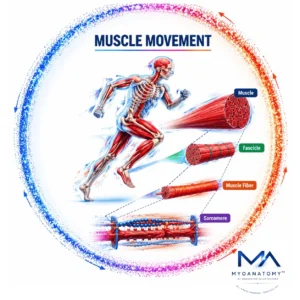
Muscle Movement
MYO CORE
Fiber Specialization
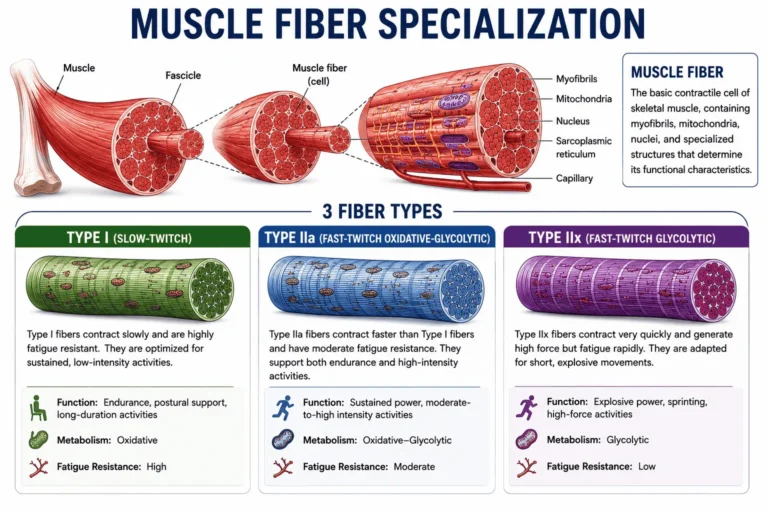
Muscle fibers are specialized contractile cells adapted for different functional demands, ranging from sustained endurance activity to rapid, high-force movements. Their specialization is determined by differences in myosin isoforms, metabolic capacity, mitochondrial content, and fatigue resistance, allowing skeletal muscle to optimize strength, speed, and endurance according to physiological requirements.
OVERVIEW
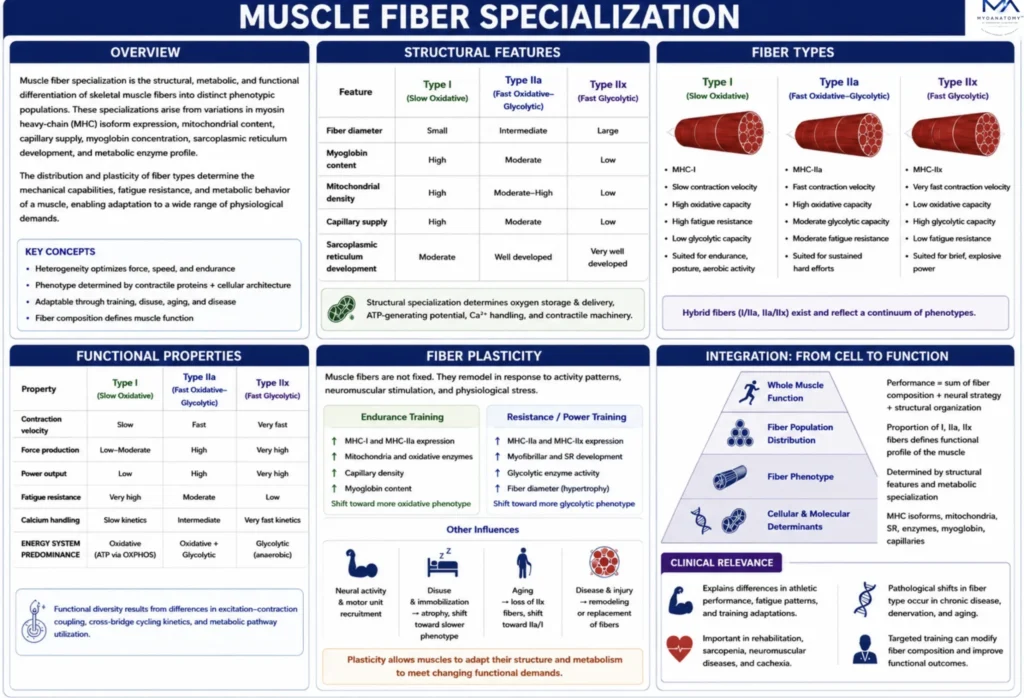
Muscle fiber specialization is a fundamental organizational principle of skeletal muscle, characterized by the differentiation of muscle fibers into distinct phenotypic populations with unique structural, metabolic, and contractile properties.
This specialization arises from variations in myosin heavy-chain isoform expression, myofibrillar organization, mitochondrial content, vascular supply, and calcium-regulatory systems, resulting in fibers optimized for specific patterns of force generation, contraction velocity, fatigue resistance, and energy utilization.
The precise distribution and interaction of these specialized fiber types establish the functional architecture of skeletal muscle, enabling the efficient execution of diverse physiological activities ranging from sustained postural stabilization to rapid, high-power movements.
AI generated Illustration MyoAnatomy.
Exam Question
How do differences in myosin heavy-chain expression, myofibrillar organization, mitochondrial density, capillary supply, myoglobin content, and sarcoplasmic reticulum development contribute to the structural specialization and functional diversity of Type I, Type IIa, and Type IIx skeletal muscle fibers?
ANATOMY
Fiber Types
Skeletal muscle fibers are organized into distinct phenotypic populations that differ in their contractile, metabolic, and structural characteristics.
The principal fiber categories include Type I (slow oxidative), Type IIa (fast oxidative–glycolytic), and Type IIx (fast glycolytic) fibers, each defined by unique patterns of myosin heavy-chain expression, mitochondrial content, capillary density, and myofibrillar organization.
These specialized adaptations establish characteristic functional profiles ranging from sustained endurance activity to rapid high-power contraction and determine the overall performance capabilities of skeletal muscle.
Exam Question
How do differences in myosin heavy-chain isoform expression, mitochondrial organization, capillary density, and myofibrillar architecture contribute to the structural specialization and functional diversity of Type I, Type IIa, and Type IIx skeletal muscle fibers?
Structural Features
The structural phenotype of a muscle fiber is determined by specialized cellular adaptations that directly influence contractile efficiency and metabolic capacity.
Variations in fiber diameter, myoglobin concentration, mitochondrial density, capillary supply, and sarcoplasmic reticulum development create distinct architectural profiles among fiber populations.
These ultrastructural characteristics regulate oxygen storage and delivery, ATP-generating potential, intracellular calcium handling, and the volume of contractile machinery, thereby providing the anatomical basis for muscle fiber specialization.
Exam Question
How do variations in fiber diameter, myoglobin concentration, mitochondrial density, capillary supply, and sarcoplasmic reticulum development establish the ultrastructural basis for muscle fiber specialization and influence skeletal muscle performance?
Functional Properties
The functional behavior of skeletal muscle fibers is governed by intrinsic differences in contractile kinetics, excitation–contraction coupling efficiency, calcium-handling dynamics, and metabolic organization.
These specialized physiological properties determine contraction velocity, force production, power output, fatigue resistance, and energetic efficiency, producing distinct performance profiles among fiber populations.
Consequently, the functional characteristics of a muscle reflect the integrated contribution of its constituent fiber types and their underlying structural and metabolic adaptations.
Exam Question
How do differences in contractile kinetics, excitation–contraction coupling mechanisms, calcium-handling dynamics, and metabolic organization determine the force-generating capacity, contraction velocity, fatigue resistance, and energetic efficiency of skeletal muscle fibers?
Fiber Plasticity
Muscle fiber plasticity refers to the capacity of skeletal muscle fibers to undergo phenotypic remodeling in response to changing physiological and mechanical demands.
Through alterations in myosin heavy-chain expression, mitochondrial organization, capillary density, enzymatic activity, and intracellular architecture, muscle fibers can modify their structural and metabolic characteristics to optimize performance.
This adaptive capability enables skeletal muscle to maintain functional efficiency and respond dynamically to neural stimulation, physical training, aging, disuse, injury, and other physiological stresses.
Exam Question
How does phenotypic remodeling of skeletal muscle fibers through alterations in myosin heavy-chain expression, mitochondrial organization, capillary density, and intracellular architecture enable adaptation to changing physiological, mechanical, and metabolic demands?
SUMMARY TABLE