Muscle Movement
MYO CORE
Synaptic Anatomy
Provides the structural basis for neural communication. The coordinated interaction of the presynaptic terminal, synaptic cleft, and postsynaptic membrane enables rapid signal transmission, information processing, and functional integration throughout the nervous system.
OVERVIEW
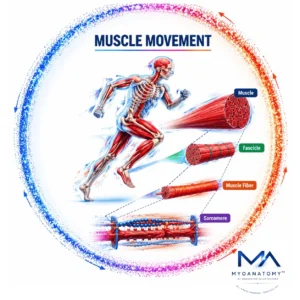
Through the precise organization of presynaptic active zones, a specialized synaptic basal lamina, and a deeply folded postsynaptic motor end plate enriched with acetylcholine receptors, the neuromuscular junction achieves exceptionally efficient conversion of neural signaling into muscle fiber activation and consequently skeletal muscle contraction.
The presynaptic terminal contains numerous synaptic vesicles concentrated around active zones rich in voltage-gated calcium channels, which regulate calcium-dependent neurotransmitter release.
The synaptic cleft is occupied by a specialized basal lamina containing acetylcholinesterase, extracellular matrix proteins, and adhesion molecules that maintain precise alignment between neuronal and muscular membranes.
The postsynaptic motor end plate exhibits deep junctional folds that markedly increase membrane surface area and concentrate nicotinic acetylcholine receptors at exceptionally high density.
Voltage-gated sodium channels are positioned along the depths of these folds, creating a highly organized membrane architecture optimized for rapid depolarization and efficient initiation of muscle fiber excitation.
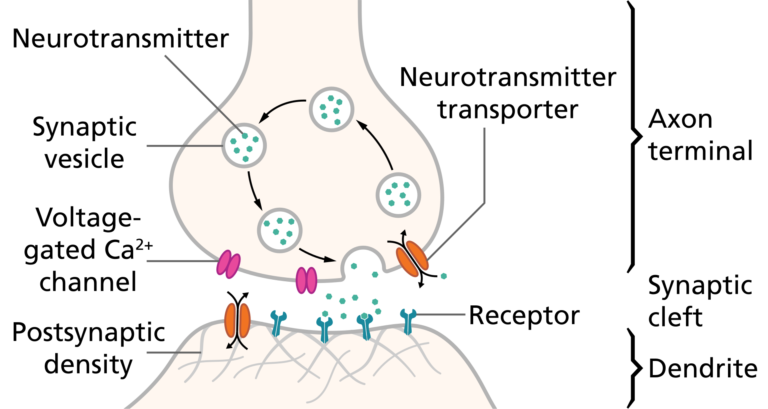
“Schematic of a Synapse” – Thomas Splettstoesser via Wikimedia Commons. Licensed under CC BY-SA 4.0.
Exam Question
Evaluate how the ultrastructural organization of the neuromuscular junction-including presynaptic active zones, the synaptic basal lamina, and the postsynaptic motor end plate-facilitates efficient neuromuscular transmission and skeletal muscle contraction.
ANATOMY
Presynaptic Organization
The presynaptic component of the neuromuscular junction is formed by the terminal specialization of an α-motor axon and represents one of the most highly organized secretory regions of the peripheral nervous system.
The axoplasm contains abundant mitochondria, cytoskeletal networks, and numerous acetylcholine-filled synaptic vesicles concentrated around specialized active zones.
These active zones contain precisely arranged vesicle-docking complexes positioned adjacent to clusters of voltage-gated calcium channels, creating a structurally integrated release apparatus.
Exam Question
Evaluate how the ultrastructural organization of the presynaptic terminal, including active zones, synaptic vesicles, and calcium-channel complexes, establishes the anatomical basis for efficient neuromuscular transmission.
Synaptic Cleft
The synaptic cleft is a highly specialized extracellular microenvironment that maintains structural continuity between neuronal and muscular tissues while preserving their cellular separation.
Occupying the cleft is a dense synaptic basal lamina enriched with acetylcholinesterase, laminin β2, collagen-associated molecules, agrin, and trans-synaptic adhesion proteins that regulate junctional architecture.
This extracellular matrix serves as a molecular scaffold responsible for synaptic maintenance, receptor organization, and long-term structural integrity of the neuromuscular junction.
Exam Question
Analyze the anatomical composition of the synaptic cleft and discuss how the specialized basal lamina contributes to synaptic alignment, structural maintenance, and neuromuscular junction integrity.
Postsynaptic Membrane
The postsynaptic membrane is a highly differentiated specialization of the sarcolemma characterized by extensive junctional folding and remarkable molecular compartmentalization.
The crests of the junctional folds contain exceptionally high densities of nicotinic acetylcholine receptors anchored within specialized membrane domains, whereas voltage-gated sodium channels are concentrated within the depths and perijunctional regions. This precise spatial segregation creates a highly amplified receptive surface that optimizes signal capture, membrane depolarization, and initiation of muscle fiber excitation.
Exam Question
Discuss how junctional folds, acetylcholine receptor localization, and membrane compartmentalization optimize signal reception and initiation of skeletal muscle fiber excitation.
Junctional Specialization
The neuromuscular junction exhibits a uniquely refined trans-synaptic microarchitecture in which presynaptic active zones are aligned directly opposite receptor-rich postsynaptic domains.
This geometric organization minimizes neurotransmitter diffusion distance, maximizes receptor activation, and establishes an exceptionally high safety factor for synaptic transmission.
Through the integration of neuronal release machinery, synaptic basal lamina specialization, and postsynaptic membrane differentiation, the neuromuscular junction functions as one of the most structurally sophisticated and reliable synaptic systems in the human body, providing the anatomical basis for rapid, precise, and sustained neuromuscular communication.
Exam Question
Assess how trans-synaptic alignment of presynaptic, extracellular, and postsynaptic components creates a highly specialized and reliable neuromuscular transmission system.
SUMMARY TABLE