Joint Classification
MYO CORE
Functional Classification
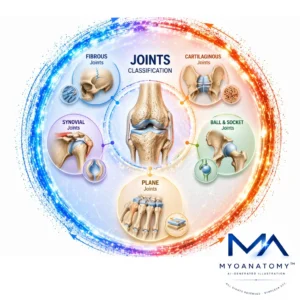
Functional classification categorizes joints according to the degree of movement permitted between articulating bones. It establishes a mobility–stability continuum in which increasing motion is associated with decreasing intrinsic stability, thereby predicting joint biomechanics, load transmission, and functional performance.
OVERVIEW
Joints are classified into synarthrosis (immobile), amphiarthrosis (slightly mobile), and diarthrosis (freely mobile). These categories represent a continuum in which increasing mobility is associated with decreasing intrinsic stability, requiring greater reliance on dynamic stabilizing mechanisms, including muscles and ligaments.
From a biomechanical perspective, functional classification determines the degrees of freedom available at a joint, the range and axes of motion, and the capacity for load transmission and absorption. Immobile joints prioritize structural integrity and protection, whereas highly mobile joints facilitate complex, multiaxial movement at the cost of reduced passive stability.
Thus, functional classification provides a predictive framework in which the extent of permitted motion directly reflects the mechanical demands placed on the joint, integrating structural constraints with dynamic functional requirements within kinematic chains.
Exam Question
How does functional classification of joints reflect the relationship between degree of mobility, mechanical stability, and degrees of freedom, and how do these factors influence the distribution of forces and coordination of movement within musculoskeletal kinematic chains?
ANATOMY
Joints are classified into synarthrosis (immobile), amphiarthrosis (slightly mobile), and diarthrosis (freely mobile). These categories represent a continuum in which increasing mobility is associated with decreasing intrinsic stability, requiring greater reliance on dynamic stabilizing mechanisms, including muscles and ligaments.
From a biomechanical perspective, functional classification determines the degrees of freedom available at a joint, the range and axes of motion, and the capacity for load transmission and absorption. Immobile joints prioritize structural integrity and protection, whereas highly mobile joints facilitate complex, multiaxial movement at the cost of reduced passive stability.
Thus, functional classification provides a predictive framework in which the extent of permitted motion directly reflects the mechanical demands placed on the joint, integrating structural constraints with dynamic functional requirements within kinematic chains.
Exam Question
How does functional classification of joints reflect the relationship between degree of mobility, mechanical stability, and degrees of freedom, and how do these factors influence the distribution of forces and coordination of movement within musculoskeletal kinematic chains?
ANATOMY
Synarthrosis
Synarthrotic joints are functionally immobile articulations specialized for maximum structural stability and protection. They are most commonly associated with fibrous joints, in which dense connective tissue rigidly unites adjacent bones, eliminating movement and resisting mechanical deformation.
Biomechanically, synarthroses are optimized to withstand tensile and compressive forces without displacement, thereby maintaining structural integrity under load. Their rigidity ensures effective force transmission across skeletal unitswhile protecting critical structures.
Examples include cranial sutures, where interdigitating fibrous joints stabilize the skull and protect the brain, and gomphoses (tooth–alveolar joints), where the periodontal ligament permits minimal micro-movement to absorb occlusal forces during mastication without compromising overall stability.
Thus, synarthrotic joints represent the extreme of the stability – mobility continuum, prioritizing structural cohesion over movement.
Exam Question
In the context of cranial sutures and gomphoses, how does the fibrous connective tissue architecture of synarthrotic joints enable force transmission and resistance to mechanical stress, while allowing minimal functional compliance in specific regions such as the periodontal ligament?
Amphiarthrosis
Amphiarthrotic joints permit limited movement and are structurally adapted to balance stability with controlled flexibility. They are typically associated with cartilaginous joints, particularly those composed of fibrocartilage, which allows elastic deformation under mechanical load.
Biomechanically, these joints are specialized to absorb compressive forces, redistribute mechanical stress, and maintain continuity between skeletal elements. The presence of fibrocartilage enables viscoelastic behavior, allowing the joint to deform slightly under load and return to its original shape, thereby facilitating shock absorption and load distribution.
Examples include the intervertebral discs, where fibrocartilage permits controlled deformation during axial loading to protect the spinal column, and the pubic symphysis, which allows limited flexibility while maintaining pelvic stability under weight-bearing conditions.
Thus, amphiarthroses occupy an intermediate position within the stability – mobility continuum, integrating structural support with limited motion to optimize mechanical efficiency in load-bearing regions.
Exam Question
In the context of intervertebral discs and the pubic symphysis, how does the fibrocartilaginous composition of amphiarthrotic joints enable viscoelastic deformation under compressive load, and how does this property contribute to shock absorption, load distribution, and controlled mobility in weight-bearing structures?
Diarthrosis
Diarthrotic joints are freely movable articulations corresponding to synovial joints, and represent the primary sites of dynamic, multiaxial movement within the musculoskeletal system. Their structural organization enables a high degree of mobility while maintaining functional stability through coordinated passive and active mechanisms.
Biomechanically, diarthroses are characterized by the presence of a synovial cavity, which permits low-friction movement, and by specialized structures that regulate motion. These joints allow a wide range of movement defined by their degrees of freedom and axes of rotation, enabling complex kinematic patterns such as flexion–extension, rotation, and circumduction. Mobility is facilitated by articular cartilage and synovial fluid, which reduce friction and distribute loads, while stability is maintained through capsuloligamentous structures and dynamic muscular control.
Examples include the shoulder joint, which permits extensive multiaxial movement at the expense of intrinsic stability, the hip joint, which balances mobility with structural stability for weight-bearing, and the knee joint, which enables controlled movement while managing high mechanical loads during locomotion.
Thus, diarthrotic joints represent the extreme of the mobility–stability continuum, where increased movement capacity necessitates greater reliance on dynamic stabilizing systems.
Exam Question
In the context of the shoulder, hip, and knee joints, how does the synovial joint architecture enable multiaxial movement through defined degrees of freedom, and how do articular structures and dynamic muscular stabilization interact to maintain joint stability under varying mechanical loads?
SUMMARY TABLE