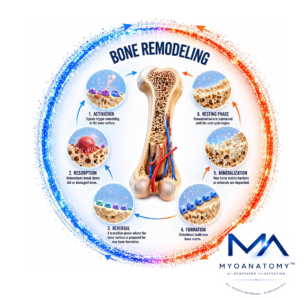
Bone Remodeling

MYO CORE

Clinical Relevance

Bone remodeling is a tightly regulated, continuous biological process by which bone tissue undergoes renewal, structural adaptation, and metabolic regulation throughout life.

Clinical Relevance

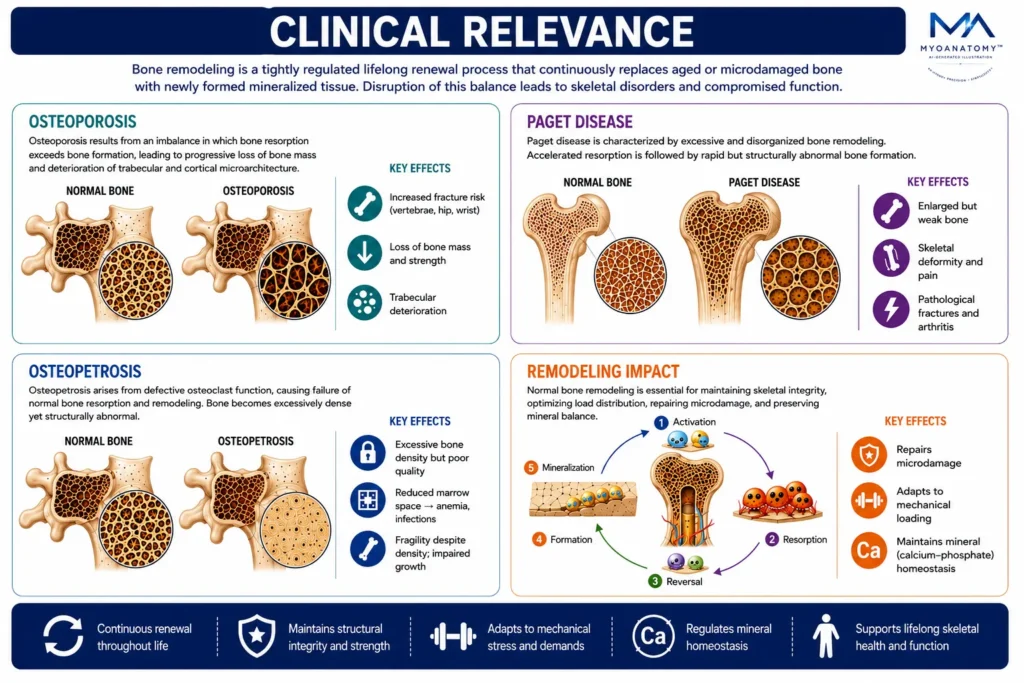
Osteoporosis

One of the most common disorders of bone remodeling is osteoporosis, which results from an imbalance favoring osteoclastic bone resorption over osteoblastic bone formation. The progressive loss of bone mass and deterioration of trabecular microarchitecture reduce the ability of bone to resist mechanical forces.

From a musculoskeletal perspective, osteoporosis leads to:

increased susceptibility to fragility fractures, particularly of the vertebrae, proximal femur, and distal radius

vertebral compression fractures, which alter spinal biomechanics and may lead to kyphotic deformity

 impaired load distribution across joints, increasing the risk of secondary degenerative changes.

These structural alterations compromise the functional stability of the skeleton and significantly impair mobility and quality of life.

Peget Disease

Paget disease of bone represents another disorder of remodeling characterized by excessive and disorganized bone turnover. In this condition, hyperactive osteoclastic resorption is followed by rapid but poorly coordinated osteoblastic bone formation.

Although the affected bones may appear enlarged and dense radiographically, the newly formed bone is structurally abnormal, mechanically weak, and prone to deformation.

Musculoskeletal consequences include:

bone deformities such as bowing of long bones

altered joint alignment leading to secondary osteoarthritis

increased risk of pathological fractures

compression of adjacent nerves due to skeletal enlargement.

Thus, despite increased bone mass, the structural integrity of bone is compromised due to abnormal remodeling.

Osteopetrosis

In contrast to osteoporosis, osteopetrosis results from defective osteoclast function, leading to impaired bone resorption and failure of normal remodeling.

As a result, bone becomes excessively dense but structurally abnormal and brittle.

From a musculoskeletal standpoint, this condition leads to:

 reduced ability to repair microdamage within bone

 increased susceptibility to fractures despite increased bone density

 narrowing of medullary cavities, which may affect bone marrow function

 impaired skeletal modeling during growth.

The condition highlights the fact that bone strength depends not only on bone mass but also on normal remodeling and microarchitectural organization.

Remodeling Impact

Bone remodeling maintains skeletal strength and adaptation to mechanical load. Its disruption leads to microfractures, trabecular deterioration, cortical thinning, and impaired load distribution, weakening joint support and increasing fracture risk.

Clinically, it is essential for fracture healing, implant stability, and bone adaptation to physical stress. It also enables microdamage repair and structural maintenance, ensuring long-term skeletal stability and musculoskeletal function.

SUMMARY TABLE

Scroll to Top