Bone Architecture
MYO CORE
Gross Structure
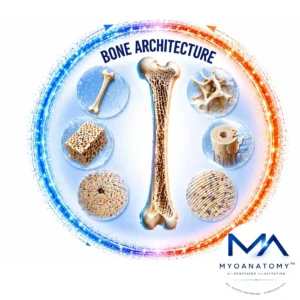
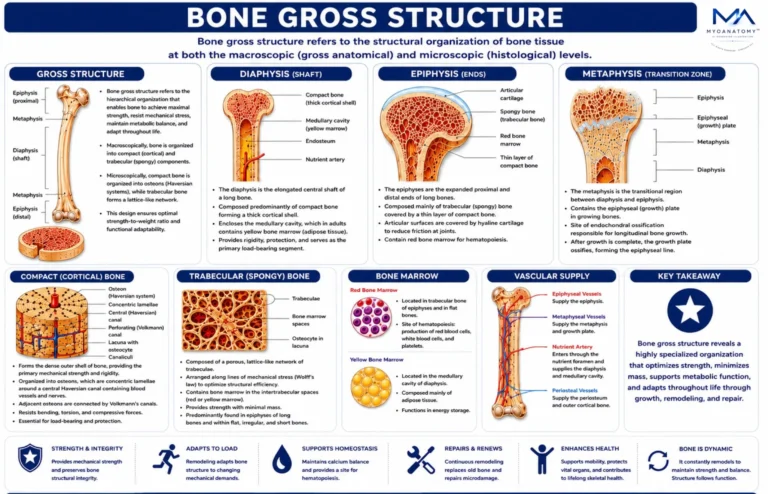
Bone architecture refers to the structural organization of bone tissue at both the macroscopic (gross anatomical) and microscopic (histological) levels.
OVERVIEW
This hierarchical organization enables bone to fulfill its primary roles within the musculoskeletal system, including mechanical support, protection of vital organs, facilitation of movement, and efficient transmission and distribution of mechanical forces generated during locomotion and muscular activity.
The architecture of bone reflects a fundamental principle of biological design: optimization of strength with minimal mass, allowing skeletal structures to withstand mechanical stress while maintaining lightweight efficiency and functional adaptability.
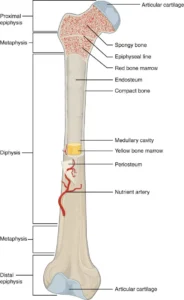
“Anatomy of Long Bone” by OpenStax College, via Wikimedia Commons. Licensed under CC BY SA 3.0
ANATOMY
Metaphysis
The metaphysis is the transitional region between the diaphysis and epiphysis, characterized by a gradual shift from dense cortical bone to trabecular architecture.
During skeletal development, it contains the epiphyseal (growth) plate, a zone of hyaline cartilage responsible for longitudinal bone growth through endochondral ossification.
This region is highly metabolically active and structurally specialized to facilitate rapid bone remodeling and adaptation to mechanical stress, while maintaining structural continuity between the shaft and the articular ends.
Following skeletal maturity, the growth plate undergoes ossification, forming the epiphyseal line, marking the cessation of longitudinal growth.
Exam Question
How does the structural and biological specialization of the metaphysis, particularly its role as a transition zone containing the epiphyseal growth plate, support longitudinal bone growth, remodeling activity, and integration of mechanical forces between the diaphysis and epiphysis?
Diaphysis
The diaphysis represents the elongated central shaft of a long bone, composed predominantly of compact (cortical) bone, which forms a dense outer shell providing high mechanical strength and resistance to loading.
It encloses the medullary (marrow) cavity, which in adults primarily contains yellow bone marrow (adipose tissue) and contributes to weight reduction without compromising structural integrity.
The cylindrical geometry of the diaphysis is biomechanically optimized to resist bending and torsional stresses, enabling efficient force transmission along the longitudinal axis while maintaining a favorable strength-to-weight ratio.
Exam Question
How does the structural composition and cylindrical geometry of the diaphysis enable efficient resistance to bending and torsional stresses while facilitating longitudinal force transmission in long bones?
Epiphysis
The epiphyses are the expanded proximal and distal ends of long bones, composed mainly of trabecular (spongy) bone, organized as a lattice-like network of trabeculae.
This architecture allows effective absorption and distribution of forces transmitted across synovial joints, reducing localized stress.
The articular surfaces are covered by hyaline cartilage, which minimizes friction and facilitates smooth, low-resistance joint movement.
Exam Question
How does the trabecular architecture and articular cartilage of the epiphysis support force absorption, load distribution, and low-friction movement at synovial joints?
BONE TISSUES
Compact & Cortical Bone
Compact (cortical) bone forms the dense outer shell of bone, providing the primary mechanical strength and rigidity of the skeleton, particularly in the diaphysis of long bones.
Microscopically, it is organized into osteons (Haversian systems), composed of concentric lamellae surrounding a central Haversian canal containing blood vessels and nerves.
Adjacent osteons are interconnected via Volkmann’s canals, enabling vascular and neural integration throughout the bone.
This highly organized structure allows compact bone to effectively resist compressive, bending, and torsional stresses, making it essential for load-bearing and force transmission during movement.
Exam Question
How does the osteonal organization of compact bone, including Haversian and Volkmann’s canal systems, enable efficient resistance to multidirectional mechanical stresses and support vascular integration within dense bone tissue?
Trabecular & Spongy Bone
Trabecular (spongy) bone consists of a porous, lattice-like network of trabeculae, arranged along lines of mechanical stress, optimizing structural efficiency.
This architecture enables bone to resist compressive forces while minimizing overall skeletal mass, contributing to a favorable strength-to-weight ratio.
The intertrabecular spaces contain bone marrow:
Red marrow → hematopoiesis
Yellow marrow → fat storage(adipose tissue)
Trabecular bone is predominantly found in regions subjected to multidirectional loading, such as the epiphyses of long bones, vertebrae, pelvis, and ribs, where it facilitates force distribution and shock absorption.

Exam Question
How does the trabecular architecture, aligned along lines of mechanical stress, allow spongy bone to achieve efficient load distribution, shock absorption, and reduction of skeletal mass while maintaining structural integrity?
SUMMARY TABLE