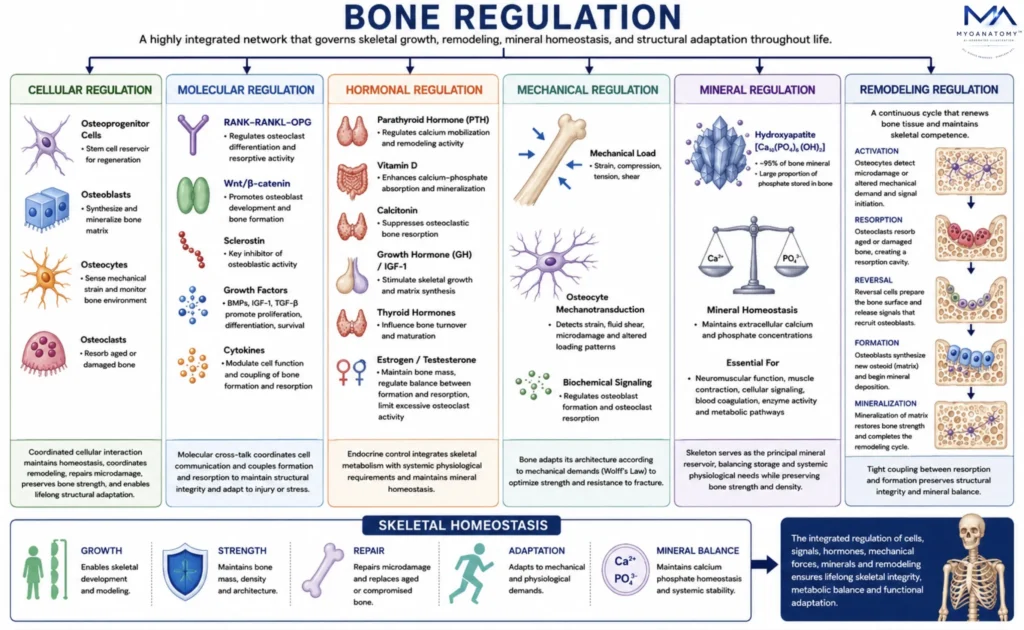
Bone Remodeling
MYO CORE
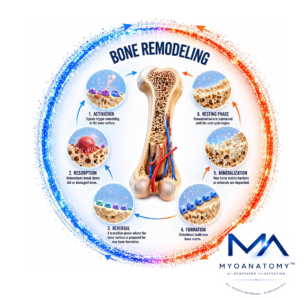
Bone Regulation
Bone remodeling regulation is controlled by an integrated mechanobiological network involving osteocyte mechanosensing, osteoclast-mediated resorption, osteoblast-driven formation, hormonal regulation, mineral homeostasis, and molecular signaling pathways. Through coordinated interactions between local skeletal cells and systemic regulators, it balances bone removal and replacement, enabling mechanical adaptation, microdamage repair, structural integrity, calcium–phosphate regulation, and lifelong musculoskeletal function.
OVERVIEW
Bone remodeling regulation is an advanced homeostatic control system that synchronizes skeletal renewal with mechanical stress, microdamage repair, and systemic mineral demands. Osteocytes act as central regulators by detecting strain and matrix injury, then directing osteoclast resorption and osteoblast formation through molecular pathways such as RANK–RANKL–OPG, Wnt/β-catenin, and sclerostin signaling.
This cellular communication is further shaped by hormones including PTH, vitamin D, calcitonin, estrogen, and growth hormone, which adjust bone turnover according to calcium–phosphate balance and whole-body metabolic needs.
Through this integrated regulation, remodeling preserves bone quality, replaces weakened tissue, adapts architecture to loading, and maintains lifelong skeletal strength and metabolic stability.
How do osteocyte-mediated mechanotransduction and the coordinated RANK-RANKL- OPG and Wnt/β-catenin signaling pathways integrate with systemic endocrine regulation to maintain bone remodeling, skeletal strength, and calcium–phosphate homeostasis throughout life?
Exam Question
REGULATION TYPES
Cellular Regulation
Cellular regulation of bone remodeling is governed by the coordinated activity of osteocytes, osteoclasts, osteoblasts, bone-lining cells, and osteoprogenitor cells, which collectively maintain skeletal homeostasis. Osteocytes serve as the principal regulatory cells, continuously monitoring mechanical strain, microdamage, and alterations in the bone microenvironment.
Through signaling molecules such as RANKL, OPG, sclerostin, nitric oxide, and prostaglandins, they direct the recruitment and activity of both osteoclasts and osteoblasts. Osteoclasts initiate the resorptive phase by removing aged or damaged bone, while osteoblasts subsequently synthesize and mineralize new matrix to restore skeletal integrity.
Osteoprogenitor cells replenish the osteoblastic population, ensuring continuous regenerative capacity. The tightly coupled interaction of these cellular populations enables precise control of bone turnover, structural adaptation, and lifelong skeletal renewal.
How do osteocytes coordinate the activities of osteoclasts, osteoblasts, and osteoprogenitor cells to maintain coupling between bone resorption and formation during the remodeling cycle?
Exam Question
Molecular Regulation
Molecular regulation of bone remodeling is mediated through complex signaling pathways that coordinate cellular communication, differentiation, activation, and survival.
The RANK-RANKL-OPG pathway serves as the central regulatory mechanism controlling osteoclastogenesis, where RANKL promotes osteoclast differentiation and activation, while osteoprotegerin (OPG) functions as a decoy receptor that limits excessive bone resorption. Bone formation is primarily regulated by the Wnt/β-catenin signaling pathway, which stimulates osteoblast differentiation, survival, and matrix production.
Additional molecular regulators, including sclerostin, bone morphogenetic proteins (BMPs), transforming growth factor-β (TGF-β), insulin-like growth factor-1 (IGF-1), cytokines, and prostaglandins, further integrate mechanical, hormonal, and local biological signals.
Together, these molecular networks ensure balanced skeletal remodeling, preservation of bone mass, and maintenance of structural integrity throughout life.
How do the RANK-RANKL-OPG and Wnt/β-catenin signaling pathways interact to regulate the balance between osteoclastic bone resorption and osteoblastic bone formation during skeletal remodeling?
Exam Question
Hormonal Regulation
Hormonal regulation integrates skeletal remodeling with systemic physiological and metabolic demands. Parathyroid hormone (PTH), vitamin D, calcitonin, growth hormone, thyroid hormones, estrogen, and testosterone collectively regulate osteoblast and osteoclast activity, bone turnover, and mineral homeostasis.
PTH and vitamin D play central roles in calcium-phosphate regulation by influencing both bone remodeling and intestinal mineral absorption.
Estrogen and testosterone help maintain skeletal mass by suppressing excessive osteoclastic resorption and preserving remodeling balance.
Growth hormone and IGF-1 stimulate osteoblastic activity and skeletal growth, while thyroid hormones regulate overall bone turnover.
Through these endocrine mechanisms, bone remodeling remains closely linked to mineral metabolism, skeletal maintenance, and long-term structural integrity.
How do parathyroid hormone, vitamin D, and sex steroids interact to regulate bone remodeling, mineral homeostasis, and the balance between osteoclastic resorption and osteoblastic formation?
Exam Question
Mechanical Regulation
Mechanical regulation enables the skeleton to continuously adapt its architecture and material properties to functional demands.
Osteocytes act as the primary mechanosensory cells, detecting mechanical strain, fluid flow, and microdamage within the lacuno-canalicular network.
In response, they modulate signaling pathways including sclerostin, RANKL, nitric oxide, and prostaglandins, which influence both osteoblastic bone formation and osteoclastic resorption. Increased mechanical loading stimulates bone formation and structural reinforcement, whereas reduced loading promotes bone loss through enhanced resorption.
This adaptive process, consistent with Wolff’s law, allows bone to optimize strength, distribute forces efficiently, resist fracture, and maintain biomechanical competence throughout life.
How do osteocyte-mediated mechanotransduction pathways convert mechanical loading into coordinated cellular responses that regulate skeletal adaptation, remodeling, and biomechanical integrity?
Exam Question
Mineral Regulation
Mineral regulation maintains the dynamic balance of calcium and phosphate between the skeleton and the extracellular environment, ensuring both skeletal integrity and systemic physiological function. As the principal mineral reservoir of the body, bone continuously stores and releases calcium and phosphate through tightly regulated remodeling processes.
This regulation is primarily mediated by parathyroid hormone, vitamin D, calcitonin, and osteocyte-derived signaling pathways, which collectively coordinate mineral deposition, mobilization, and exchange.
Through this continuous regulation, the skeleton supports neuromuscular transmission, cellular signaling, enzymatic activity, and numerous metabolic processes while preserving bone mineralization and structural strength.
How does the skeletal system function as a dynamic mineral reservoir, and through what cellular and endocrine mechanisms is calcium-phosphate homeostasis maintained while preserving bone mineralization and structural integrity?
Exam Question
Remodelingl Regulation
Remodeling regulation coordinates the sequential phases of activation, resorption, reversal, formation, and mineralization that collectively renew skeletal tissue throughout life.
This highly regulated process depends on precise coupling between osteoclast-mediated bone resorption and osteoblast-driven bone formation, ensuring that old or microdamaged bone is replaced with structurally competent tissue.
Osteocytes serve as the central regulatory cells that initiate and coordinate remodeling through mechanosensory and molecular signaling pathways, while local growth factors, cytokines, vascular influences, and systemic hormones modulate remodeling activity according to skeletal and metabolic demands.
Through continuous regulation of bone turnover, remodeling preserves bone quality, repairs microdamage, optimizes skeletal architecture, and maintains long-term biomechanical competence.
How do cellular, molecular, vascular, and endocrine regulatory mechanisms coordinate the activation, resorption, reversal, formation, and mineralization phases of bone remodeling to maintain skeletal quality, mechanical adaptation, and lifelong structural integrity?
Exam Question
SUMMARY TABLE