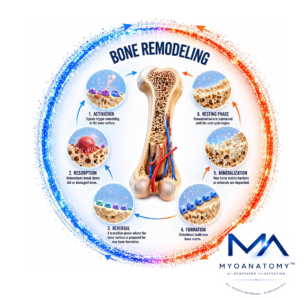
Bone Remodeling

MYO CORE

Functional Significance

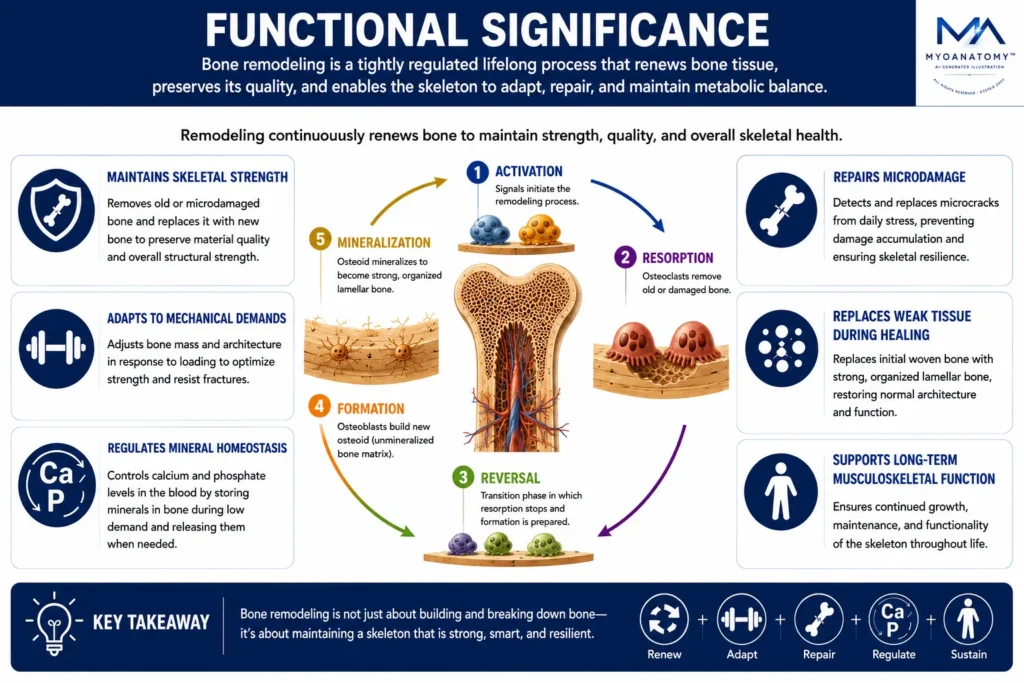
Bone remodeling provides the functional basis for lifelong skeletal strength, adaptation, repair, and metabolic balance. By continuously adjusting bone architecture to mechanical loading, preserving material quality and microarchitecture, regulating calcium-phosphate homeostasis, and replacing weak woven bone with organized lamellar bone during healing, remodeling ensures that the skeleton remains strong, resilient, biomechanically efficient, and capable of long-term musculoskeletal function.

Anatomy

Mechanical Adaption

A central function of bone remodeling is adaptation to the mechanical environment. During normal physiological activity – such as weight-bearing, locomotion, and muscle contraction – bone is exposed to complex forces including compression, tension, bending, torsion, and shear.

Reduced loading

e.g., immobilization, bed rest, microgravity shifts remodeling toward bone resorption, leading to structural weakening.

Thus, remodeling ensures that bone architecture remains matched to functional demand.

Integration with the Musculoskeletal System

Bone does not function in isolation but as part of an integrated system with muscles, tendons, ligaments, and joints.

Muscle contractions generate traction forces at entheses → stimulate local bone reinforcement

Joint loading influences periarticular and subchondral bone structure. Remodeling therefore maintains structural compatibility between skeletal tissue and mechanical forces generated by movement.

Bone Integrity

Skeletal strength depends not only on bone mass but on material quality, including:

collagen organization

degree of mineralization

microarchitecture

Remodeling replaces older bone with organized lamellar bone, preserving the balance between:

stiffness (load-bearing capacity)

toughness (resistance to fracture)

Mineral Homeostasis

Bone remodeling is also supports the skeleton metabolic’s role as reservoir for calcium and phosphate.

Through controlled resorption and deposition, it contributes to:

maintenance of extracellular calcium levels

neuromuscular function

mineral balance for new bone formation

Healing Role

Following fracture repair, initial woven bone is mechanically weak and disorganized. Remodeling gradually replaces it with lamellar bone, restoring:

normal architecture

internal alignment

biomechanical strength

SUMMARY TABLE

Scroll to Top