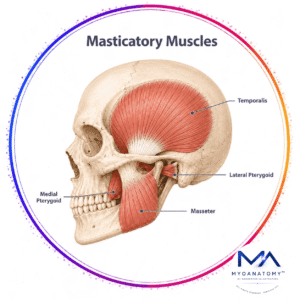
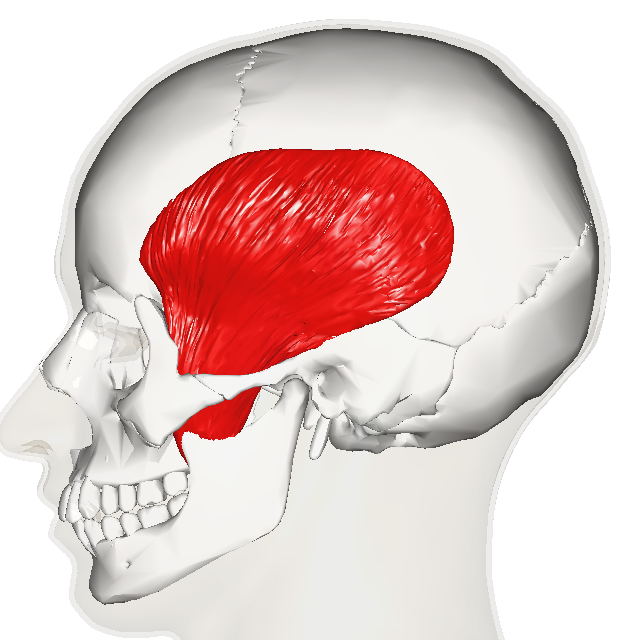
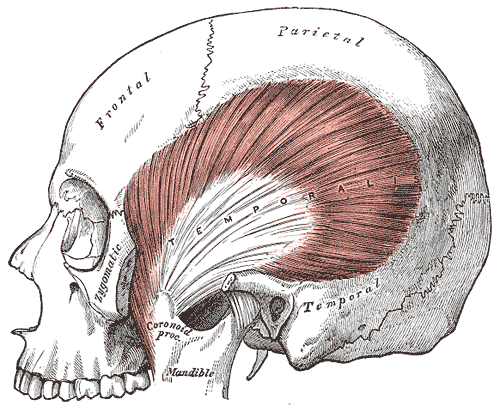
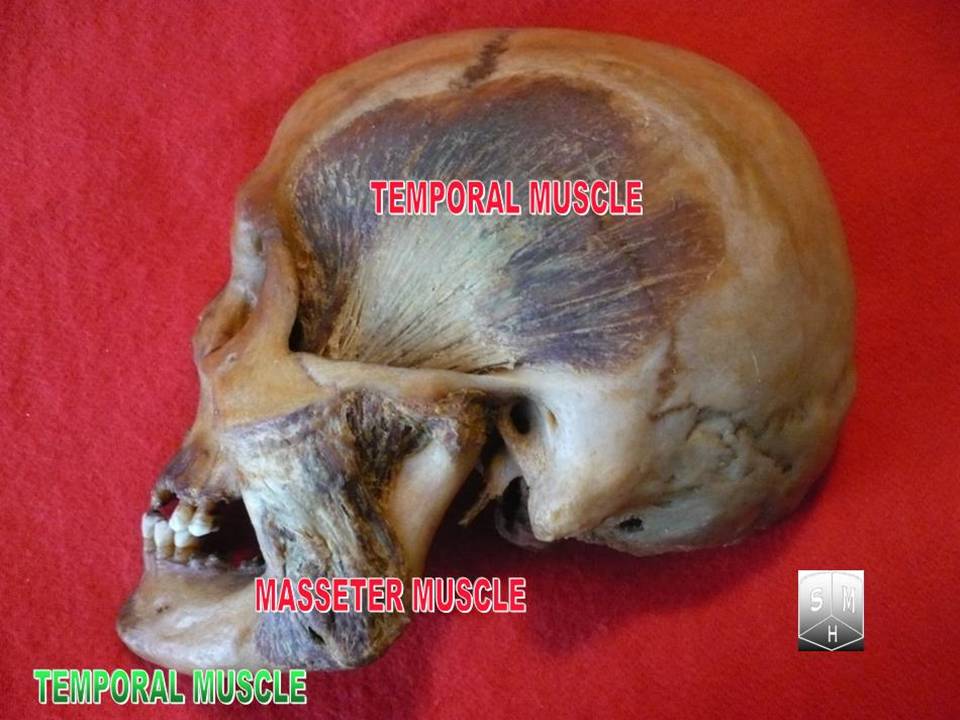
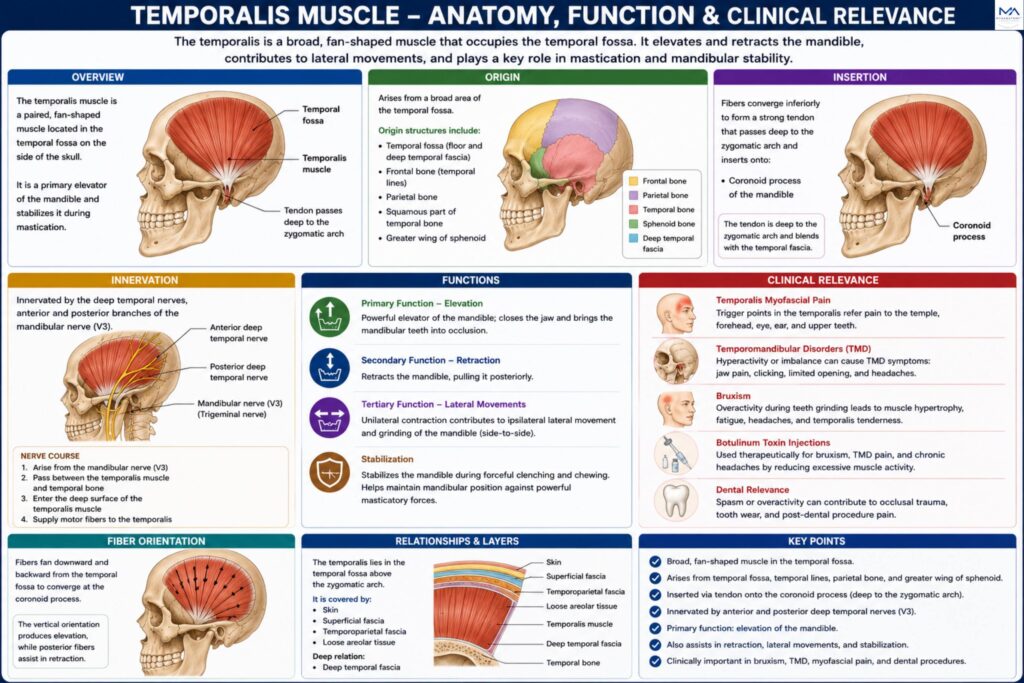
The temporalis muscle is a large, fan-shaped muscle occupying the temporal fossa of the lateral skull and represents one of the principal muscles of mastication. It extends from the broad surface of the cranial vault to the coronoid process of the mandible, forming a powerful yet highly controlled elevator of the mandible.
Temporalis Muscle
CORE
Overview
Unlike the masseter, which primarily generates strong bite force, the temporalis is particularly important for precision control of mandibular position, including elevation, retrusion, and stabilization of the mandible during occlusion.
Because of its extensive cranial origin and converging fiber arrangement, the temporalis functions as a dynamic stabilizer of mandibular movement, ensuring smooth coordination between the teeth, mandible, and temporomandibular joints during mastication.
The muscle occupies the temporal region of the skull, lying deep to the temporal fascia and passing deep to the zygomatic arch before inserting on the mandible


ANATOMY
Origin
The temporalis arises from a broad area of the temporal fossa, including contributions from several cranial bones.
Origin structures:
Temporal fossa, including surfaces of: frontal bone parietal bone
squamous part of the temporal bone
greater wing of the sphenoid
deep surface of the temporal fascia
The superior attachment follows the inferior temporal line, which marks the upper boundary of the muscle’s origin.
Exam Question
Explain the anatomical origin of the temporalis muscle, including its osseous attachments within the temporal fossa, relationship to the temporal fascia, and the functional significance of its broad cranial origin in generating multidirectional mandibular forces during mastication.
Insertion
The fibers converge inferiorly into a strong tendon that passes deep to the zygomatic arch and inserts onto:
apex of the coronoid process of the mandible
medial surface of the coronoid process
anterior border of the mandibular ramus
Some fibers extend inferiorly toward the retromolar area behind the last molar.
This insertion allows the muscle to exert strong vertical and posterior traction forces on the mandible.
Exam Question
Describe the insertion of the temporalis muscle onto the coronoid process and mandibular ramus, and explain how the orientation of its tendon contributes to mandibular elevation, retrusion, and biomechanical stabilization of the temporomandibular joint.
Innervation
The temporalis receives motor innervation from the deep temporal nerves, which arise from the anterior division of the mandibular nerve (CN V3).
These nerves include:
anterior deep temporal nerve
posterior deep temporal nerve
The nerves enter the deep surface of the muscle from the infratemporal fossa.
Because these nerves arise from the trigeminal motor root, they coordinate with other muscles of mastication during chewing
Exam Question
Analyze the motor innervation of the temporalis muscle by the deep temporal nerves arising from the mandibular division of the trigeminal nerve (CN V3), including their anatomical course through the infratemporal fossa and their coordinated role within the muscles of mastication
FUNCTIONAL ROLE
Mandibular Elevation
The temporalis is a major elevator of the mandible. Contraction of its vertically oriented anterior fibers elevates the mandibular ramus, producing jaw closure and maintaining efficient occlusion during biting and mastication.
Exam Question
How do the anatomical orientation and fiber arrangement of the temporalis muscle enable efficient mandibular elevation and contribute to forceful jaw closure during mastication?
Mandibular Retraction
The posterior fibers of the temporalis retract the mandible following protrusive movements. This action restores the mandible to its resting position and contributes to the posterior positioning of the mandibular condyle within the temporomandibular joint (TMJ).
Exam Question
Explain the role of the posterior fibers of the temporalis in mandibular retrusion and discuss their importance in restoring mandibular position following protrusive movements
Mastication Phase
The temporalis functions primarily during the closing phase of mastication. Its broad fan-shaped architecture allows coordinated elevation and retrusion of the mandible while providing precise positional control during chewing. Working synergistically with the masseter and pterygoid muscles, it ensures efficient food processing and controlled mandibular movement.
Exam Question
Why is the temporalis considered a key positional muscle of mastication, and how does its fan-shaped architecture facilitate coordinated chewing mechanics and precise mandibular control?
TMJ Stabilization
The temporalis serves as an important positional stabilizer of the mandible. Continuous tonic activity helps maintain mandibular posture, stabilize the mandibular condyle within the TMJ, and preserve proper dental alignment during occlusion. This stabilizing function contributes to smooth jaw mechanics and fine control of masticatory movements.
Exam Question
Describe how the temporalis muscle stabilizes the mandible and temporomandibular joint during occlusion, mastication, and resting mandibular posture
CLINICAL RELEVANCE
Temporalis Myofascial Pain
Syndrome – temporalis muscle is frequently involved in myofascial pain syndromes affecting the craniofacial region. Chronic overactivity, clenching, or abnormal occlusal mechanics may lead to the development of trigger points within the muscle fibers, producing localized or referred pain.
Patients commonly present with:
temporal headache
tenderness in the temporal region
pain radiating to the orbit, teeth, or ear
fatigue of the jaw during chewing
Because the temporalis shares innervation with other muscles of mastication through the mandibular division of the trigeminal nerve, pain originating in the muscle may be misinterpreted as dental pain or temporomandibular joint pathology.

Exam Question
Explain the pathophysiological mechanisms underlying temporalis myofascial pain syndrome, including trigger-point formation, referred craniofacial pain patterns, and the relationship between muscular hyperactivity, parafunctional habits, and temporomandibular dysfunction.
TMJ Disorders
Dysfunction of the temporalis muscle is frequently associated with temporomandibular disorders. Hyperactivity or imbalance between the temporalis and other masticatory muscles may disturb normal mandibular mechanics.
Clinical manifestations may include:
difficulty closing the jaw smoothly
muscle tenderness during palpation of the temporal fossa
altered occlusion during chewing
fatigue or tightness in the temporal region
Because the temporalis is a major stabilizer of mandibular position, abnormal contraction patterns may contribute to malposition of the mandibular condyle within the temporomandibular joint.
Exam Question
Evaluate the contribution of temporalis muscle dysfunction to temporomandibular disorders (TMD), including its effects on mandibular mechanics, occlusal stability, muscular coordination, and condylar positioning within the temporomandibular joint
Bruxism/Hypertrophy
Chronic bruxism (teeth grinding) often results in hypertrophy of the temporalis muscle due to repetitive excessive contraction during sleep or stress-related clenching.
Consequences may include:
enlargement of the temporal region; increased bite force; accelerated dental wear; muscular fatigue and headaches
hypertrophy of the temporalis may be visible as prominence of the temporal fossa during clenching.
Exam Question
Discuss the relationship between chronic bruxism and temporalis muscle hypertrophy, including the biomechanical consequences of repetitive clenching on muscle morphology, bite force generation, dental wear, and craniofacial muscular fatigue.
Trigeminal Motor Lesion
The temporalis muscle receives motor innervation from the deep temporal branches of the mandibular nerve (CN V3).
Damage to the trigeminal motor root may produce:
weakness of mandibular elevation
reduced bite strength
deviation of the mandible during jaw movement
Because the muscles of mastication act bilaterally, unilateral trigeminal motor injury may cause the mandible to deviate toward the affected side during opening.
Exam Question
Analyze the clinical manifestations of trigeminal motor lesions affecting the temporalis muscle, including weakness of mandibular elevation, reduced bite strength, mandibular deviation, and the functional importance of bilateral mastication muscle coordination.
SUMMARY TABLE