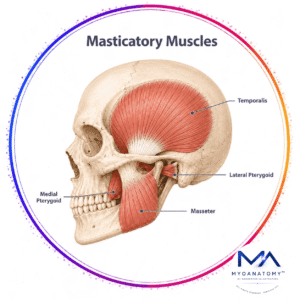
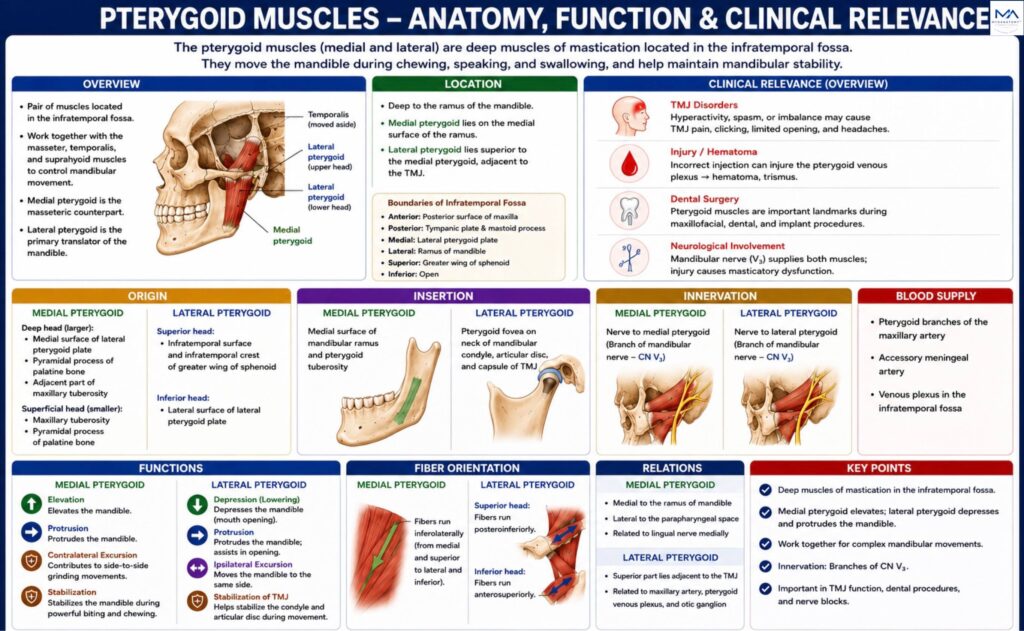
The pterygoid muscles form the deep muscular component of the masticatory apparatus, located within the infratemporal fossa. Together with the masseter and temporalis, they produce the complex mandibular movements required for mastication, speech articulation, and swallowing.
Pterygoid Muscle
CORE
Overview
Unlike the superficial muscles of mastication, which primarily elevate the mandible, the pterygoid muscles are responsible for protrusion, depression, and lateral excursion of the mandible, allowing the grinding movements necessary for effective food processing.
Both pterygoid muscles originate from the pterygoid processes of the sphenoid bone and extend to the mandible and temporomandibular joint (TMJ). They develop from the first pharyngeal arch and receive motor innervation from branches of the mandibular division of the trigeminal nerve (CN V₃).
Functionally, the pterygoid muscles form the deep motor system of the mandible, coordinating translational and rotational movements at the temporomandibular joint.
ANATOMY
Medial Pterygoid
General Description
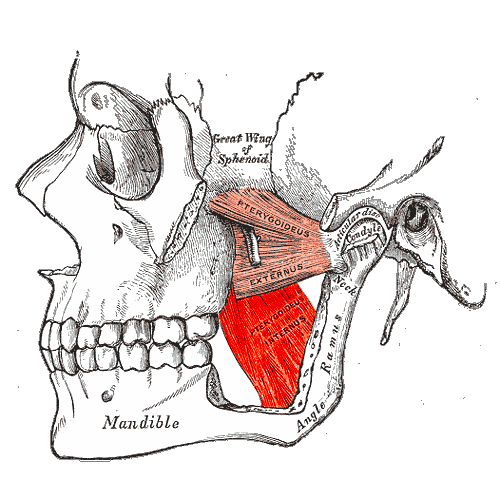
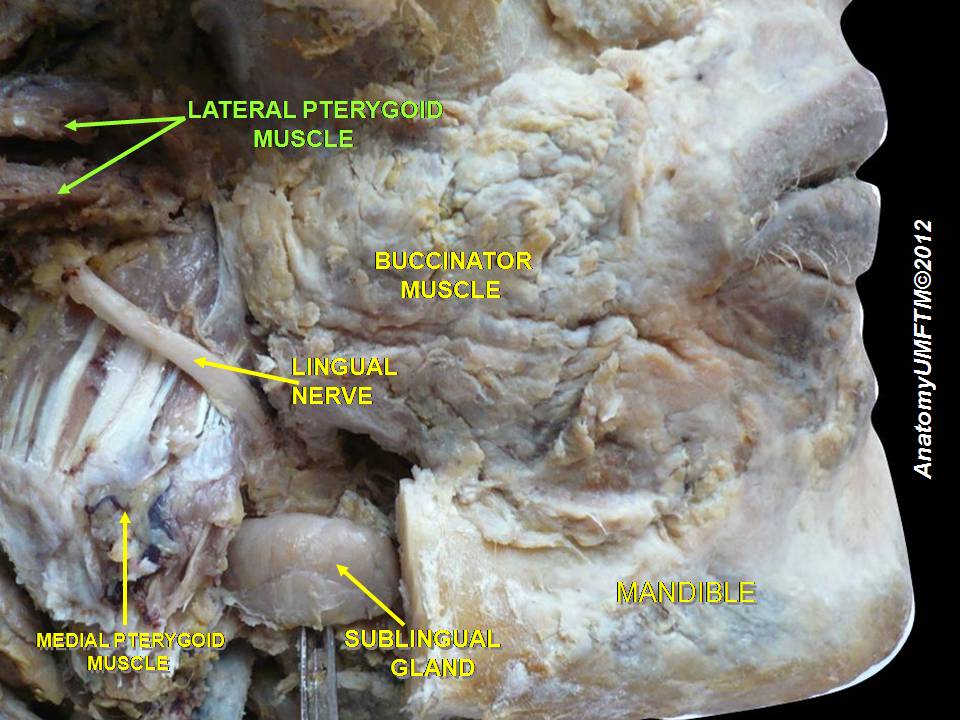
The medial pterygoid is a thick quadrangular muscle located on the medial surface of the mandibular ramus. It mirrors the masseter muscle, which lies on the lateral side of the mandible. Together, these muscles form a muscular sling around the mandibular ramus, producing powerful elevation of the mandible during mastication.
Because of its oblique fiber orientation, the medial pterygoid also contributes to protrusion and side-to-side grinding movements of the mandible.


Origin
The medial pterygoid consists of two heads.
Deep head
from medial surface of the lateral pterygoid plate pyramidal process of the palatine bone adjacent surface of the maxillary tuberosity
Superficial head
from maxillary tuberosity pyramidal process of the palatine bone
Exam Question
Explain the dual-headed origin of the medial pterygoid muscle and discuss how its attachments to the sphenoid, palatine, and maxillary bones contribute to mandibular biomechanics.
Insertion
The fibers pass inferolaterally to insert on:
medial surface of the mandibular ramus
angle of the mandible pterygoid tuberosity
Exam Question
Describe the insertion of the medial pterygoid onto the medial mandibular ramus and pterygoid tuberosity, and explain its functional significance during mastication.
Innervation
Nerve to medial pterygoid Branch of Mandibular nerve (CN V₃) This nerve also supplies:
tensor veli palatini
tensor tympani
These muscles share a common embryological origin from the first pharyngeal arch
Exam Question
Analyze the innervation of the medial pterygoid by the mandibular division of the trigeminal nerve (CN V₃) and explain its developmental relationship with the tensor veli palatini and tensor tympani.
Lateral Pterygoid
General Description
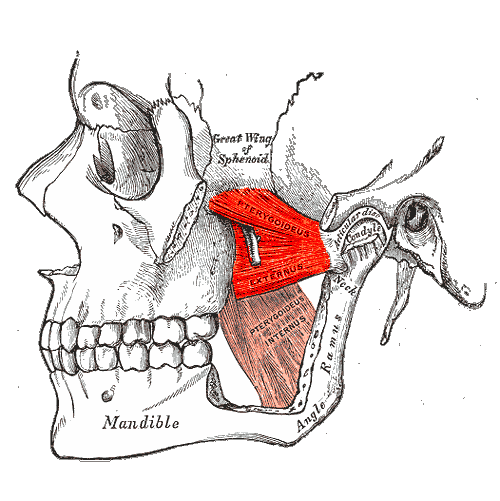
The lateral pterygoid is a short, triangular muscle located in the upper part of the infratemporal fossa. It differs from other masticatory muscles because it inserts partly into the articular disc and capsule of the temporomandibular joint.
This unique attachment makes it the primary muscle controlling translational movement of the mandibular condyle, playing a critical role in opening the mouth and protruding the mandible.
The muscle consists of 2 distinct heads.


Origin
Superior head
infratemporal surface of the greater wing of the sphenoid
infratemporal crest
Inferior head
lateral surface of the lateral pterygoid plat
Exam Question
Describe the superior and inferior heads of the lateral pterygoid and discuss how their sphenoidal origins contribute to multidirectional mandibular control.
Insertion
Fibers pass posterolaterally to insert on
pterygoid fovea of the mandibular condyle
articular disc of the TMJ
capsule of the temporomandibular joint
Exam Question
Explain the insertion of the lateral pterygoid into the pterygoid fovea, articular disc, and TMJ capsule, and analyze its significance in temporomandibular joint mechanics.
Innervation
Nerve to lateral pterygoid
Branch of:
Mandibular nerve (CN V₃)
Exam Question
Discuss the motor innervation of the lateral pterygoid by the mandibular division of the trigeminal nerve (CN V₃) and its role in coordinated mastication.
FUNCTIONAL ROLE
Mandibular Protrusion
The pterygoid muscles are the primary protrusors of the mandible. Bilateral contraction advances the mandibular condyles anteriorly, moving the lower jaw forward and facilitating efficient food manipulation during mastication.
Exam Question
How do the medial and lateral pterygoid muscles coordinate mandibular protrusion, and why is this movement essential for efficient mastication and temporomandibular joint function?
Mandibular Exercusion
Unilateral contraction produces contralateral mandibular deviation, generating side-to-side grinding movements essential for mechanical breakdown of food during the chewing cycle.
Exam Question
Explain how unilateral contraction of the pterygoid muscles produces contralateral mandibular deviation and discuss its biomechanical significance during the grinding phase of mastication.
Masticatory Role
The pterygoid muscles coordinate dynamic mandibular movements during mastication. The medial pterygoid contributes powerful jaw closure, while the lateral pterygoid controls condylar translation and jaw opening. Together they facilitate protrusion, grinding, and efficient food processing.
Exam Question
Analyze the complementary roles of the medial and lateral pterygoid muscles in coordinating mandibular elevation, protrusion, and translational movements during the masticatory cycle.
TMJ Stabilization
The pterygoid muscles play a critical role in temporomandibular joint mechanics. They stabilize condylar position, regulate movement of the articular disc, and ensure smooth coordination of mandibular opening, closing, and translational movements during functional activities
Exam Question
Describe how the pterygoid muscles regulate condylar and articular disc movement within the temporomandibular joint, and explain their importance in maintaining smooth, stable, and coordinated mandibular mechanics.
CLINICAL RELEVANCE
TMJ Disorder
The pterygoid muscles, particularly the lateral pterygoid, play a fundamental role in controlling mandibular translation and articular disc movement within the temporomandibular joint (TMJ). Dysfunction, hyperactivity, or muscular imbalance may disrupt normal disc-condyle coordination, contributing to temporomandibular disorders (TMD). Excessive contraction of the lateral pterygoid may promote anterior displacement of the articular disc and abnormal mandibular biomechanics.
Patients may present with:
TMJ clicking or popping
Mandibular locking
Preauricular pain
Restricted jaw movement
Difficulty chewing
Deviated mandibular opening
Because the lateral pterygoid inserts into the TMJ capsule and articular disc, it is frequently implicated in internal derangement of the joint.
Exam Question
Explain why dysfunction of the lateral pterygoid is strongly associated with temporomandibular disorders (TMD), and discuss its role in articular disc displacement, mandibular biomechanics, and restricted jaw movement.
Inferior ALveolar Nerve Block
The medial pterygoid lies adjacent to the pterygomandibular space, where dentists perform the inferior alveolar nerve block.
Incorrect injection may cause:
muscle injury
hematoma
postoperative trismu
Exam Question
Describe the anatomical relationship between the medial pterygoid muscle and the pterygomandibular space, and explain how inaccurate inferior alveolar nerve block administration may result in trismus, hematoma, or muscular injury.
Trismus
Spasm, inflammation, or injury of the medial pterygoid may result in trismus:
A condition characterized by painful limitation of mouth opening.
Due to the muscle’s deep location and powerful elevating action, even minor inflammation may significantly impair mandibular mobility.
Common causes include:
odontogenic infections
pericoronitis of impacted third molars
facial trauma
postoperative inflammation
complications of dental anesthesia
deep fascial space infections
Patients commonly experience difficulty eating, speaking, swallowing, and maintaining oral hygiene.
Exam Question
Analyze the role of the medial pterygoid in trismus and discuss how inflammation, infection, trauma, or dental procedures can produce painful limitation of mandibular opening
Surgical Significance
The pterygoid muscles serve as important anatomical landmarks during maxillofacial, dental, and skull-base procedures. Their relationships to the mandibular nerve, maxillary artery, pterygoid venous plexus, and infratemporal fossa make them critical structures during surgical planning.
Iatrogenic injury may result in:
postoperative trismus
altered mandibular mechanics
hemorrhage from regional vessels
neurological deficits involving branches of the mandibular nerve
persistent masticatory dysfunction
Exam Question
Evaluate the surgical importance of the pterygoid muscles within the infratemporal region, emphasizing their relationships to the mandibular nerve, maxillary artery, and pterygoid venous plexus during maxillofacial and skull-base procedures.
SUMMARY TABLE