Overview

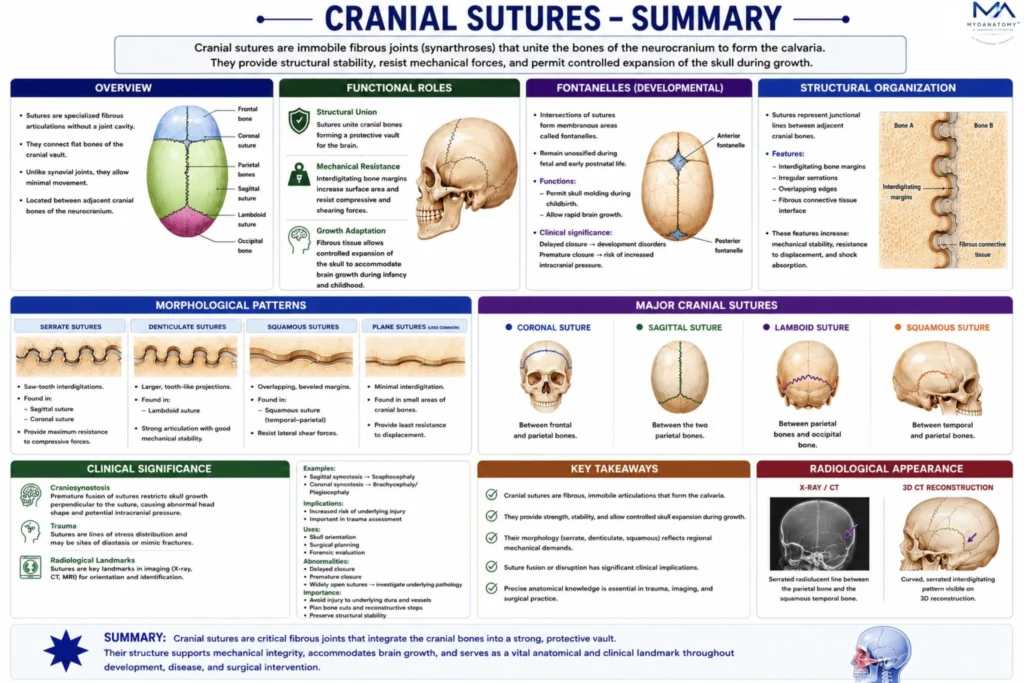
The bones of the cranial vault are united by specialized fibrous articulations known as cranial sutures. These joints represent the principal mechanism through which the flat bones of the neurocranium articulate to form the calvaria, the dome-like structure that encloses and protects the brain.

Unlike synovial joints, cranial sutures are immobile fibrous unions that tightly interlock adjacent bones through complex interdigitating margins. This configuration provides high mechanical strength while permitting controlled expansion of the cranial vault during growth.

CORE

Function Role

From a gross anatomical perspective, sutures serve 3 major structural roles:

union of cranial bones forming the calvaria

maintenance of cranial vault architecture and stability

accommodation of cranial expansion during postnatal brain growth

The pattern of sutures also acts as an important topographical framework, allowing identification of skull regions and facilitating orientation during anatomical study, surgery, and radiological imaging.

During fetal and early postnatal development, sutures intersect at membranous intervals called fontanelles, which represent regions where ossification has not yet occurred. 

These areas permit temporary flexibility of the skull during parturition and early brain expansion.

ANATOMY

Structural Organization

From an anatomical viewpoint, sutures represent the junctional lines between adjacent cranial bones, where the margins of bones interlock in complex patterns.

The morphology of these articulations is characterized by:

Interdigitating bone margin

Irregular serrations that increase contact surface area

Complex overlapping bone edges in certain regions

These features serve to increase mechanical resistance to forces applied to the skull, particularly those generated by trauma or muscular activity.

Exam Question

Explain how the interdigitating architecture and irregular serrations of cranial sutures enhance mechanical resistance of the skull while simultaneously permitting controlled cranial expansion during growth.

Morphological Patterns

Although all sutures unite cranial bones through fibrous connections, they exhibit several distinct morphological patterns that reflect the mechanical demands of different skull regions.

Serrate Sutures

possess saw-tooth interdigitations, where the bone margins form deeply interlocking projections. This configuration provides maximum resistance to mechanical stress, particularly in the cranial vault where impact forces may occur.

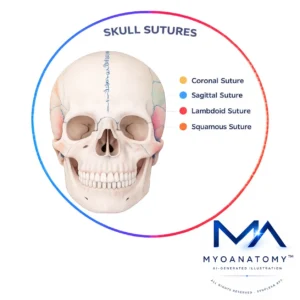
Coronal suture; Sagittal sutures

these sutures form the primary articulations between the major bones of the cranial vault.

Denticulate Sutures; Lambdoid suture 

display larger, tooth-like projections that interlock less tightly than serrate sutures but still provide considerable mechanical stability.

Squamous Sutures

consist of overlapping beveled bone margins, where one bone partially overlaps another. Example-squamous suture between the temporal and parietal bones. This arrangement allows slight flexibility and accommodates the complex curvature of the lateral cranial wall.

Exam Question

Compare the morphological patterns of serrate, denticulate, and squamous sutures, and explain how these structural differences reflect region-specific biomechanical demands of the cranial vault.

SUMMARY TABLE

Scroll to Top