Contents
The orbital cavity contains a complex arrangement of neural, vascular, muscular, glandular, and connective tissue structures that together form the visual and oculomotor apparatus. These structures are organized within a confined bony space but remain highly mobile, allowing precise control of eye position and visual alignment.
CORE

Overview
The orbital contents are arranged within a confined pyramidal cavity as a highly integrated neurovascular and neuromuscular unit, in which structural packing is optimized for both protection and mobility.
The globe is suspended rather than rigidly fixed, supported by fascial condensations (Tenon’s capsule, suspensory ligaments) that permit smooth, coordinated movement.
Extraocular muscles form a dynamic cone directing force vectors toward the orbital apex, while nerves and vessels follow predictable axial and peri-muscular pathways. This spatial organization ensures precise ocular alignment, rapid neuromuscular response, and stable visual fixation despite continuous motion.
ANATOMY
Eyeball
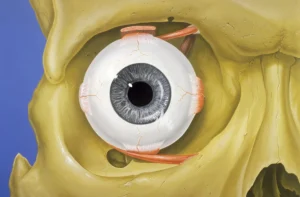
The eyeball is the principal organ of vision and occupies the anterior portion of the orbit, positioned slightly lateral to the orbital axis.
Structurally, the globe consists of 3 concentric layers:
Fibrous layer – sclera cornea
Vascular layer (uvea) choroid ciliary body iris
Neural layer – retina
The globe is suspended within the orbit by the extra-ocular muscles and surrounding connective tissue structures, including Tenon’s capsule and orbital fat, which allow controlled movement while protecting the eye from mechanical forces.
Posteriorly, the eyeball is connected to the brain by the optic nerve, which transmits visual information from the retina to the visual cortex.
Exam Question
Explain the structural organization of the eyeball, detailing its three concentric layers and correlate how each layer contributes to visual transduction, optical clarity, and accommodation.
Extraocular Muscles
6 extra-ocular muscles control the precise movements of the eyeball.
Rectus Muscles – 4 rectus muscles originate from the common tendinous ring (annulus of Zinn) at the orbital apex: superior rectus, inferior rectus, medial rectus, lateral rectus. These muscles primarily control horizontal and vertical eye movements.
Oblique Muscles
Two oblique muscles provide rotational movements of the globe:
superior oblique – originates from the sphenoid bone and passes through the trochlea
inferior oblique – originates from the anterior orbital floor
These muscles enable torsional movements of the eye, stabilizing vision during head movement.
The extra-ocular muscles function in coordinated groups to maintain binocular alignment, ensuring that both eyes focus on the same visual target.
Exam Question
Analyze the anatomical arrangement and functional coordination of the extraocular muscles, including the role of the common tendinous ring and oblique muscles in producing conjugate gaze and maintaining binocular alignment.
Nerves
Several cranial nerves pass through the orbit to control vision, ocular movement, and sensory innervation.
Optic Nerve (CN II)- carries visual information from the retina to the brain. It enters the orbit through the optic canal and lies centrally within the posterior orbit.
Oculomotor Nerve (CN III) supplies:
superior rectus ; inferior rectus; medial rectus; inferior oblique ; levator palpebrae superioris
It also carries parasympathetic fibers responsible for pupillary constriction and accommodation.
Trochlear Nerve (CN IV) – innervates the superior oblique muscle, controlling rotational movement of the eye.
Abducens Nerve (CN VI)– supplies the lateral rectus muscle, enabling abduction of the eyeball.
Trigeminal Nerve (CN V₁) – The ophthalmic division of the trigeminal nerve provides sensory innervation to the eye and surrounding orbital structures. Branches include:
lacrimal nerve
frontal nerve
nasociliary nerve

Exam Question
Describe the cranial nerve supply of the orbit, specifying the functional components of each nerve and explaining how lesions at different levels produce characteristic patterns of ophthalmoplegia and sensory deficits.
Blood Vescels
The orbit receives its primary blood supply from the ophthalmic artery, a branch of the internal carotid artery.
Important branches include:
central retinal artery
lacrimal artery
supraorbital artery
posterior ciliary arteries
Venous drainage occurs through the superior and inferior ophthalmic veins, which communicate with the cavernous sinus and pterygoid venous plexus. Because of these venous connections, infections of the face may spread to intracranial venous sinuses.
Exam Question
Discuss the arterial supply and venous drainage of the orbit, emphasizing the role of the ophthalmic artery and the clinical significance of venous communications with the cavernous sinus in the spread of infection.
Lacrimal gland
The lacrimal gland lies in the lacrimal fossa of the frontal bone in the superolateral portion of the orbit.
It produces tear fluid, which lubricates the eye, removes debris, and contains antimicrobial substances that protect the ocular surface. Tears drain through the lacrimal canaliculi → lacrimal sac → nasolacrimal duct, eventually entering the inferior nasal meatus.
Exam Question
Evaluate the anatomical position, secretory function, and drainage pathway of the lacrimal apparatus, and explain how disruption at different levels leads to clinical conditions such as epiphora or dry eye.
Supportive Tissue
Orbital Fat and Connective Tissue
The orbit contains abundant orbital fat, which acts as a protective cushion that stabilizes the globe and allows smooth movement of ocular structures.
Important connective tissues include:
Tenon’s capsule (fascia bulbi) – surrounds the eyeball
orbital septum – forms the anterior boundary of the orbit
check ligaments – stabilize extra-ocular muscles
These structures maintain positional stability of the globe while permitting mobility.
Exam Question
Examine the role of orbital fat and fascial structures, including Tenon’s capsule and orbital septum, in maintaining globe stability while permitting mobility, and discuss their relevance in orbital trauma and surgical approaches.
SUMMARY TABLE